
Maximize the Number of Target Nodes After Connecting Trees I - Solution & Explanation
Problem Statement
There exist two undirected trees with n and m nodes, with distinct labels in ranges [0, n - 1] and [0, m - 1], respectively.
You are given two 2D integer arrays edges1 and edges2 of lengths n - 1 and m - 1, respectively, where edges1[i] = [ai, bi] indicates that there is an edge between nodes ai and bi in the first tree and edges2[i] = [ui, vi] indicates that there is an edge between nodes ui and vi in the second tree. You are also given an integer k.
Node u is target to node v if the number of edges on the path from u to v is less than or equal to k. Note that a node is always target to itself.
Return an array of n integers answer, where answer[i] is the maximum possible number of nodes target to node i of the first tree if you have to connect one node from the first tree to another node in the second tree.
Note that queries are independent from each other. That is, for every query you will remove the added edge before proceeding to the next query.
Example 1:
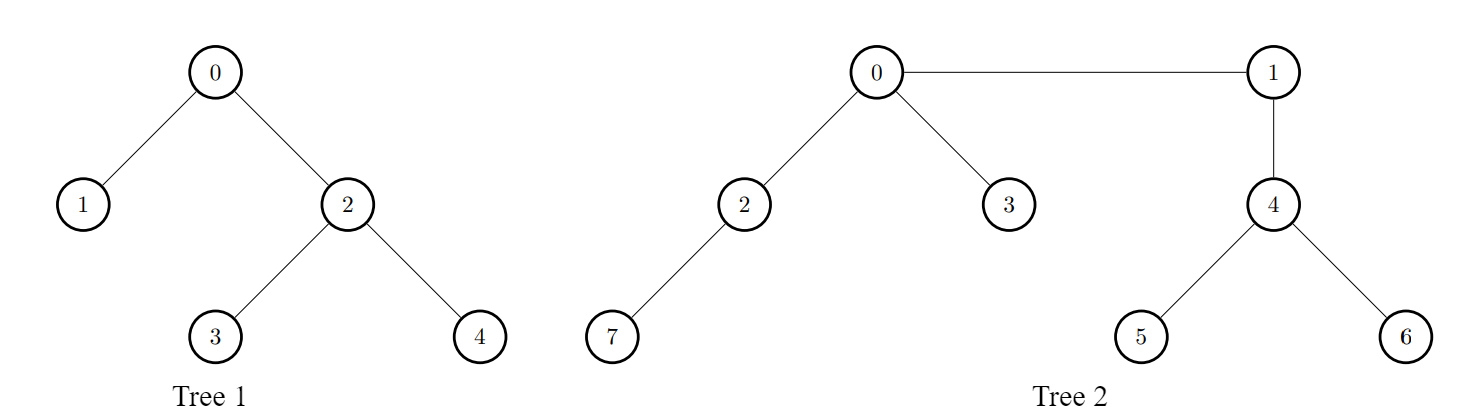
Input: edges1 = [[0,1],[0,2],[2,3],[2,4]], edges2 = [[0,1],[0,2],[0,3],[2,7],[1,4],[4,5],[4,6]], k = 2
Output: [9,7,9,8,8]
Explanation:
- For
i = 0, connect node 0 from the first tree to node 0 from the second tree. - For
i = 1, connect node 1 from the first tree to node 0 from the second tree. - For
i = 2, connect node 2 from the first tree to node 4 from the second tree. - For
i = 3, connect node 3 from the first tree to node 4 from the second tree. - For
i = 4, connect node 4 from the first tree to node 4 from the second tree.
Example 2:
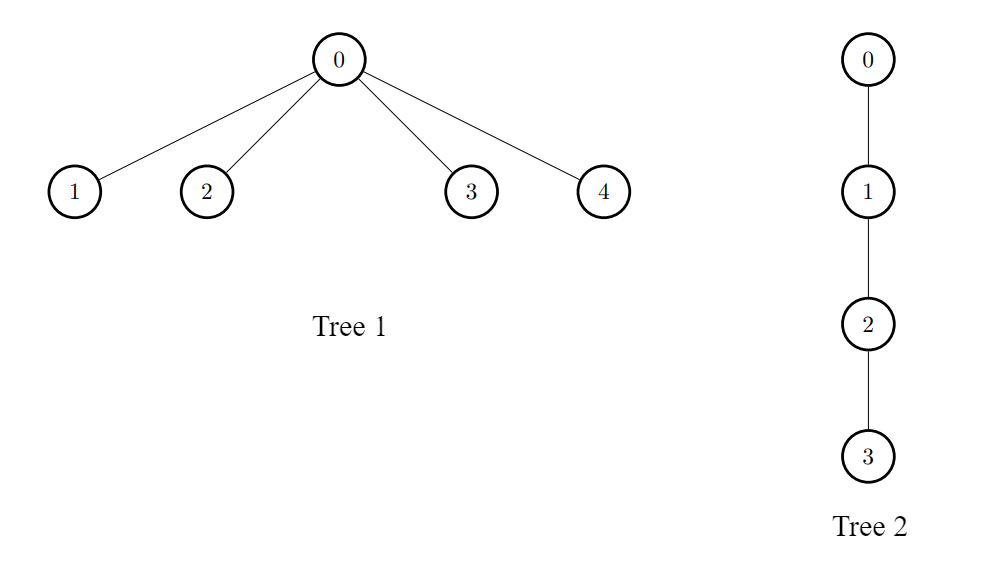
Input: edges1 = [[0,1],[0,2],[0,3],[0,4]], edges2 = [[0,1],[1,2],[2,3]], k = 1
Output: [6,3,3,3,3]
Explanation:
For every i, connect node i of the first tree with any node of the second tree.
Constraints:
2 <= n, m <= 1000edges1.length == n - 1edges2.length == m - 1edges1[i].length == edges2[i].length == 2edges1[i] = [ai, bi]0 <= ai, bi < nedges2[i] = [ui, vi]0 <= ui, vi < m- The input is generated such that
edges1andedges2represent valid trees. 0 <= k <= 1000
Approach Overview
Problem Overview: You are given two separate trees. You may connect exactly one node from the first tree to one node from the second tree with a new edge. For every node in the first tree, compute the maximum number of target nodes reachable within distance k after the connection is made. The goal is to choose the best node in the second tree so the reachable node count is maximized.
Approach 1: Breadth-First Search (BFS) Traversal (O(n^2 + m^2) time, O(n + m) space)
Treat both trees independently first. For each node in tree1, run a BFS to count how many nodes are within distance k. This produces an array where count1[i] represents reachable nodes if traversal stays inside tree1. Next, evaluate tree2 separately. Because one connecting edge consumes one step, nodes in tree2 must be within distance k-1 from the chosen connection node. Run BFS from every node in tree2 and compute how many nodes fall within distance k-1, then keep the maximum value. That maximum can be paired with any node in tree1 because you can always connect to the best node in tree2. The final answer for each node i becomes count1[i] + bestTree2. This approach works well because BFS naturally explores nodes level by level and stops once distance exceeds k. Tree traversal details rely on standard Breadth-First Search techniques.
Approach 2: Depth-First Search (DFS) with Memoization (O(n^2 + m^2) time, O(n + m) space)
The same distance counting can be implemented using recursive DFS. From each starting node, perform a depth-limited DFS that stops once the remaining distance becomes negative. Memoization can cache partial results for (node, remainingDistance) to avoid recomputing overlapping subtrees. This is useful when multiple DFS traversals revisit the same subtree with the same remaining distance. The logic mirrors the BFS approach: compute reachable counts within distance k for nodes in tree1 and within k-1 for nodes in tree2, then combine them using the maximum value from tree2. DFS implementations rely on adjacency lists and recursive traversal patterns from Depth-First Search on a tree.
Recommended for interviews: The BFS approach is usually expected. It is straightforward, avoids recursion depth issues, and clearly models the distance constraint. Showing the brute-force BFS from every node demonstrates understanding of tree traversal, while recognizing that the second tree only needs the global maximum shows the optimization insight interviewers look for.
Approach 1: Breadth-First Search (BFS) Based Approach
The idea is to calculate the number of target nodes for each node in both trees initially using a BFS traversal, given the constraint 'k'. After obtaining these counts, for each node in the first tree, try connecting it with every node in the second tree and compute the maximum target nodes considering the nodes in the second tree.
This approach leverages BFS to efficiently compute reachability within 'k' edges by using level-order traversal.
This solution involves breaking down the existing trees into adjacency lists and calculating the reachable node counts within 'k' distance using BFS. Subsequently, it integrates both trees by evaluating each node's reachability from the first to the second tree, providing a combined reachability value for node targets.
Complexity
Time Complexity: O(N * M * K), where N is the number of nodes in the first tree, M is the number of nodes in the second tree, and K is the target distance threshold.
Space Complexity: O(N + M), considering the space for adjacency lists and auxiliary structures used during traversal.
Approach 2: Depth-First Search (DFS) Based Approach with Memoization
This approach leverages DFS to find the number of target nodes reachable within 'k' from each node, utilizing memoization to store already computed results. By efficiently storing the DFS traversal results, we reduce redundant calculations, improving performance for larger graphs.
The integration of memoization with depth-first traversal provides an efficient matrix to determine targets when interlinking trees.
This solution builds trees using undirected edges and applies DFS with memoization to calculate reachable nodes efficiently within 'k'. The results are aggregated by finding the potential target nodes the first tree could exploit from the second tree.
Code
C++
JavaScript
Complexity
Time Complexity: O(N * M), where N and M represent the number of nodes in the respective trees.
Space Complexity: O(N * K) due to memoization array usage.
Approach 3: Enumeration + DFS
According to the problem description, to maximize the number of target nodes for node i, we must connect node i to one of the nodes j in the second tree. Therefore, the number of target nodes for node i can be divided into two parts:
- In the first tree, the number of nodes reachable from node
iwithin a depth ofk. - In the second tree, the maximum number of nodes reachable from any node
jwithin a depth ofk - 1.
Thus, we can first calculate the number of nodes reachable within a depth of k - 1 for each node in the second tree. Then, we enumerate each node i in the first tree, calculate the sum of the two parts mentioned above, and take the maximum value.
The time complexity is O(n^2 + m^2), and the space complexity is O(n + m). Here, n and m are the number of nodes in the two trees, respectively.
Complexity Comparison
| Approach | Complexity |
|---|---|
| Breadth-First Search (BFS) Based Approach | Time Complexity: O(N * M * K), where N is the number of nodes in the first tree, M is the number of nodes in the second tree, and K is the target distance threshold. Space Complexity: O(N + M), considering the space for adjacency lists and auxiliary structures used during traversal. |
| Depth-First Search (DFS) Based Approach with Memoization | Time Complexity: O(N * M), where N and M represent the number of nodes in the respective trees. |
| Enumeration + DFS | — |
Detailed Complexity Analysis
| Approach | Time | Space | When to Use |
|---|---|---|---|
| BFS Traversal from Every Node | O(n^2 + m^2) | O(n + m) | Best general approach for medium constraints and easiest to implement |
| DFS with Memoization | O(n^2 + m^2) | O(n + m) | Useful when recursion with distance pruning is preferred or when caching subtree results |
Video Solution
Maximize the Number of Target Nodes After Connecting Trees I | BFS | DFS | Leetcode 3372 | MIK • codestorywithMIK • 10,294 views views
Watch 9 more video solutions →Frequently Asked Questions
Is Maximize the Number of Target Nodes After Connecting Trees I easy or hard?
Maximize the Number of Target Nodes After Connecting Trees I Python/Java solution
How to solve Maximize the Number of Target Nodes After Connecting Trees I in O(n)?
What is the best approach for Maximize the Number of Target Nodes After Connecting Trees I?
Is Maximize the Number of Target Nodes After Connecting Trees I asked at Google/Amazon/Meta?
What data structure is used in Maximize the Number of Target Nodes After Connecting Trees I?
What is the time complexity of Maximize the Number of Target Nodes After Connecting Trees I?
Ready to solve this problem?
Practice Maximize the Number of Target Nodes After Connecting Trees I with our built-in code editor and test cases.
Practice on FleetCodeTable of Contents
Practice this problem
Open in Editor