Given the root of a binary tree, return all root-to-leaf paths in any order.
A leaf is a node with no children.
Example 1:
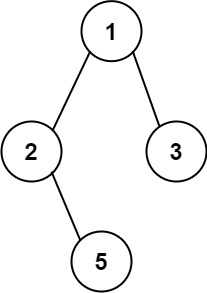
Input: root = [1,2,3,null,5]
Output: ["1->2->5","1->3"]
Example 2:
Input: root = [1]
Output: ["1"]
Constraints:
[1, 100].-100 <= Node.val <= 100Problem Overview: Given the root of a binary tree, return every path from the root node to each leaf node. Each path must be represented as a string in the format node1->node2->node3. A leaf node is a node with no children, so a valid path ends only when both left and right pointers are null.
Approach 1: Depth-First Search (DFS) - Recursive (O(n) time, O(h) space)
The most natural way to solve this problem is with recursive Depth-First Search. Start from the root and carry the current path as a string while traversing the tree. At each node, append its value to the path. When you reach a leaf node, store the completed path in the result list. The recursion then backtracks and explores the remaining branches.
This approach works because DFS naturally explores one root-to-leaf path at a time. The recursion stack keeps track of the traversal state while you build the path incrementally. Each node is visited exactly once, giving a time complexity of O(n), where n is the number of nodes. The space complexity is O(h) due to the recursion stack, where h is the height of the binary tree. In skewed trees this becomes O(n), while balanced trees keep it closer to O(log n). This solution is concise and commonly expected in interviews.
Approach 2: Iterative DFS using a Stack (O(n) time, O(h) space)
The same traversal can be implemented iteratively using an explicit stack instead of recursion. Each stack entry stores a pair: the current node and the path string built so far. Pop an element, extend the path with the current node's value, and push its children back onto the stack with updated paths.
When the algorithm pops a node that has no left or right child, the path represents a complete root-to-leaf sequence and gets added to the result list. This method mirrors recursive DFS but avoids relying on the call stack. It still visits each node once, so the time complexity remains O(n). The stack holds at most one branch of nodes at a time, giving a space complexity of O(h). Iterative DFS is useful when recursion depth might be large or when you want explicit control over traversal order.
Both methods rely on tree traversal fundamentals from tree algorithms and follow a path-building pattern often used in backtracking style problems where partial results grow as you move deeper in the structure.
Recommended for interviews: Recursive DFS is the approach most interviewers expect. It demonstrates clear understanding of tree traversal and keeps the code short and readable. Mentioning the iterative stack version shows deeper knowledge of how recursion translates to explicit data structures and how to avoid recursion limits.
This approach uses Depth-First Search (DFS) to explore all paths from the root to the leaf nodes. Starting from the root, we recursively visit each node, accumulating the current path. When a leaf node is reached, we add the accumulated path to a list of paths. This can be implemented recursively and is optimal given the constraints.
This C solution uses a recursive DFS function to build the path as a string and store it in an array when a leaf node is reached. - Root value is added to the path for each node and if a leaf is reached, the path is stored in a results array.
Time Complexity: O(n), where n is the number of nodes in the tree, as we visit each node once.
Space Complexity: O(n), for the space used to store the recursion stack and the result paths.
This approach utilizes an iterative Depth-First Search (DFS) with a stack. By storing the nodes and their paths on the stack, we can simulate the recursive DFS stack. This allows for constructing the paths through iterative backtracking.
This iterative C solution uses a stack to hold nodes and their accumulated paths. When processing each node, its path is updated and child nodes are added to the stack along with updated paths. Leaf nodes are treated as path endpoints.
Time Complexity: O(n), traversing each node once.
Space Complexity: O(n), as we maintain a stack proportional to the tree height.
| Approach | Complexity |
|---|---|
| Approach 1: Depth-First Search (DFS) - Recursive | Time Complexity: O(n), where n is the number of nodes in the tree, as we visit each node once. |
| Approach 2: Iterative DFS using a Stack | Time Complexity: O(n), traversing each node once. |
| Approach | Time | Space | When to Use |
|---|---|---|---|
| Recursive DFS | O(n) | O(h) | Best general solution. Clean and concise for exploring root-to-leaf paths. |
| Iterative DFS (Stack) | O(n) | O(h) | Useful when avoiding recursion depth limits or when implementing explicit traversal control. |
LeetCode 257. Binary Tree Paths (Algorithm Explained) • Nick White • 30,256 views views
Watch 9 more video solutions →Practice Binary Tree Paths with our built-in code editor and test cases.
Practice on FleetCodePractice this problem
Open in Editor