
Number of Good Leaf Nodes Pairs - Video Solutions
Number of Good Leaf Nodes Pairs - Leetcode 1530 - Python
Number of Good Leaf Nodes Pairs - Video Solution
Watch 10 video solutions for Number of Good Leaf Nodes Pairs, a medium level problem involving Tree, Depth-First Search, Binary Tree. This walkthrough by NeetCodeIO has 14,015 views views. Want to try solving it yourself? Practice on FleetCode or read the detailed text solution.
Problem Statement
You are given the root of a binary tree and an integer distance. A pair of two different leaf nodes of a binary tree is said to be good if the length of the shortest path between them is less than or equal to distance.
Return the number of good leaf node pairs in the tree.
Example 1:
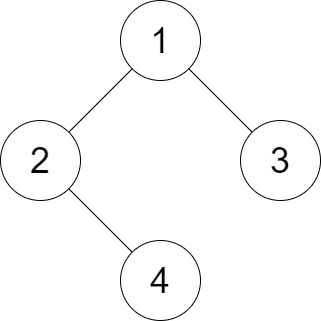
Input: root = [1,2,3,null,4], distance = 3
Output: 1
Explanation: The leaf nodes of the tree are 3 and 4 and the length of the shortest path between them is 3. This is the only good pair.
Example 2:
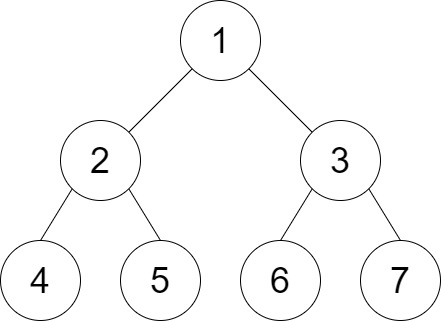
Input: root = [1,2,3,4,5,6,7], distance = 3
Output: 2
Explanation: The good pairs are [4,5] and [6,7] with shortest path = 2. The pair [4,6] is not good because the length of ther shortest path between them is 4.
Example 3:
Input: root = [7,1,4,6,null,5,3,null,null,null,null,null,2], distance = 3
Output: 1
Explanation: The only good pair is [2,5].
Constraints:
- The number of nodes in the
treeis in the range[1, 210]. 1 <= Node.val <= 1001 <= distance <= 10
Approach Overview
Problem Overview: Given a binary tree and an integer distance, count pairs of leaf nodes whose shortest path length is less than or equal to that distance. The path length is measured by the number of edges between the two leaves.
Approach 1: DFS with Distance Array (O(n · d²) time, O(h · d) space)
Use a postorder depth-first search to aggregate distances from leaf nodes upward. Each recursive call returns an array where index i represents how many leaf nodes exist at distance i from the current node. For leaf nodes, return an array with distance 1. When processing an internal node, combine the left and right arrays: iterate through all pairs of distances i and j and count pairs where i + j ≤ distance. Then build a new array for the parent by shifting distances by one edge. The key insight is that every valid pair must have its lowest common ancestor at some node visited during DFS, so counting during the merge step captures all valid pairs efficiently.
This approach keeps the distance arrays capped at the maximum allowed distance, which keeps the merge step small. Since distance ≤ 10 in constraints, the nested loop over distances is effectively constant. The algorithm visits each node once and performs small merges, giving near-linear performance for practical inputs.
Approach 2: Preprocessing with Dynamic Programming (O(n · d²) time, O(n · d) space)
Another strategy treats each node as a subproblem and stores the number of leaves at each distance within its subtree. Using tree-based dynamic programming, compute a DP table where dp[node][k] represents how many leaf nodes exist at distance k from that node. Build this table bottom-up during a traversal of the tree. When combining children, compute cross-subtree leaf pairs by checking all i from the left subtree and j from the right subtree where i + j ≤ distance. Then shift distances by one to populate the current node's DP row.
This method makes the state explicit and can be easier to reason about if you think in terms of subtree summaries. The tradeoff is higher memory usage since each node keeps its own distance table instead of returning temporary arrays.
Recommended for interviews: DFS with distance arrays. It demonstrates strong understanding of tree traversal, subtree aggregation, and lowest common ancestor reasoning. Interviewers expect candidates to recognize that valid leaf pairs must meet at an internal node and can be counted during a postorder merge. Explaining the brute force idea (checking all leaf pairs with LCA or BFS) shows baseline understanding, but the DFS aggregation approach shows stronger algorithmic design.
Complexity Analysis
| Approach | Time | Space | When to Use |
|---|---|---|---|
| DFS with Distance Array | O(n · d²) | O(h · d) | Best general solution for interviews and coding platforms; efficient when the distance limit is small. |
| Preprocessing with Dynamic Programming | O(n · d²) | O(n · d) | Useful when you want explicit subtree DP states or need reusable distance data for additional queries. |