
Minimum Number of Operations to Sort a Binary Tree by Level - Video Solutions
Minimum Number of Operations to Sort a Binary Tree by Level | Leetcode 2471 | codestorywithMIK
Minimum Number of Operations to Sort a Binary Tree by Level - Video Solution
Watch 10 video solutions for Minimum Number of Operations to Sort a Binary Tree by Level, a medium level problem involving Tree, Breadth-First Search, Binary Tree. This walkthrough by codestorywithMIK has 8,797 views views. Want to try solving it yourself? Practice on FleetCode or read the detailed text solution.
Problem Statement
You are given the root of a binary tree with unique values.
In one operation, you can choose any two nodes at the same level and swap their values.
Return the minimum number of operations needed to make the values at each level sorted in a strictly increasing order.
The level of a node is the number of edges along the path between it and the root node.
Example 1:
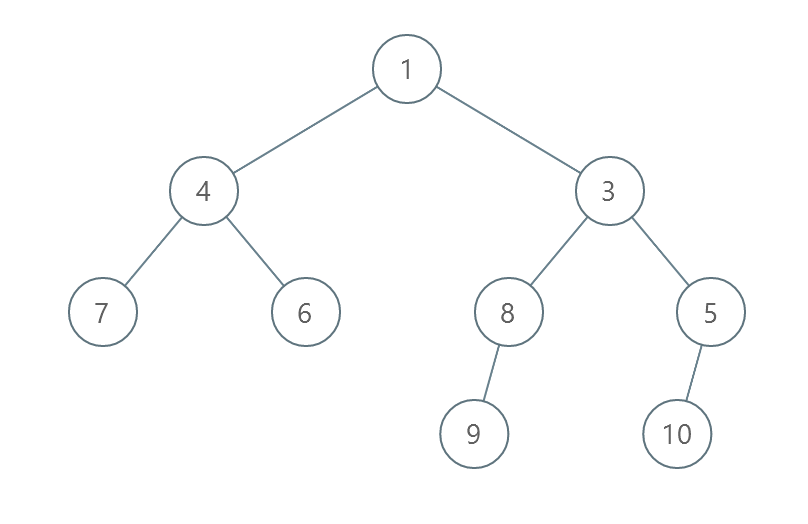
Input: root = [1,4,3,7,6,8,5,null,null,null,null,9,null,10]
Output: 3
Explanation:
- Swap 4 and 3. The 2nd level becomes [3,4].
- Swap 7 and 5. The 3rd level becomes [5,6,8,7].
- Swap 8 and 7. The 3rd level becomes [5,6,7,8].
We used 3 operations so return 3.
It can be proven that 3 is the minimum number of operations needed.
Example 2:
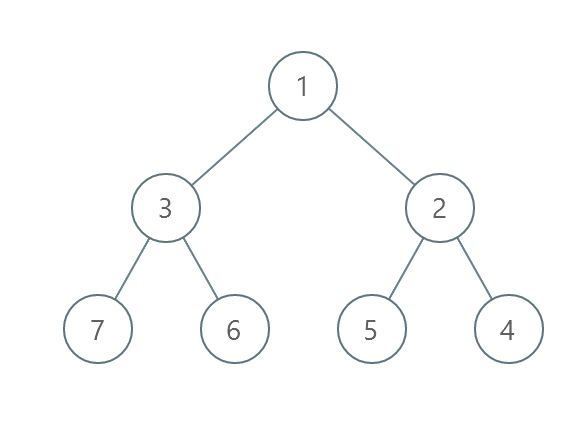
Input: root = [1,3,2,7,6,5,4]
Output: 3
Explanation:
- Swap 3 and 2. The 2nd level becomes [2,3].
- Swap 7 and 4. The 3rd level becomes [4,6,5,7].
- Swap 6 and 5. The 3rd level becomes [4,5,6,7].
We used 3 operations so return 3.
It can be proven that 3 is the minimum number of operations needed.
Example 3:
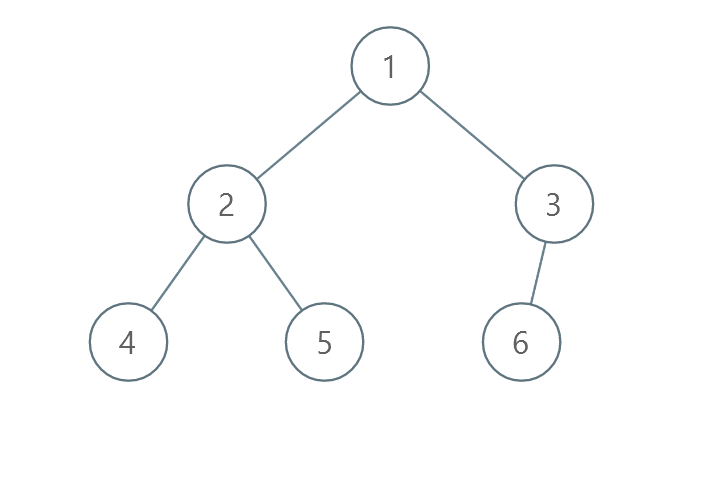
Input: root = [1,2,3,4,5,6]
Output: 0
Explanation: Each level is already sorted in increasing order so return 0.
Constraints:
- The number of nodes in the tree is in the range
[1, 105]. 1 <= Node.val <= 105- All the values of the tree are unique.
Approach Overview
Problem Overview: Each level of a binary tree must be sorted in strictly increasing order. You can swap values between any two nodes within the same level. The goal is to compute the minimum number of swaps required across all levels.
Approach 1: BFS + Cycle Detection (O(n log n) time, O(n) space)
Traverse the tree level by level using Breadth-First Search. For each level, collect node values into an array. To determine the minimum swaps required to sort that array, pair each value with its original index, sort by value, then detect permutation cycles. A cycle of length k requires k - 1 swaps. Summing swaps for all cycles gives the minimum operations for that level.
The key insight: sorting defines the target position of every element, and the mismatch between current and sorted indices forms permutation cycles. BFS naturally isolates each level, while cycle detection converts the reordering problem into a minimum swap count. Sorting each level costs O(m log m) where m is the level size, leading to O(n log n) overall.
Approach 2: DFS Level Collection + In-Place Reordering (O(n log n) time, O(n) space)
Run a DFS on the tree while tracking depth. Store values for each depth in a list so you reconstruct level order without BFS. Once all levels are collected, process each array independently. Build a sorted copy, map values to indices, and perform in-place swaps until every element reaches its sorted position.
This approach separates traversal from sorting logic. DFS builds level buckets, and the swap phase repeatedly places the correct value at index i. Each swap fixes at least one element, ensuring minimal operations. Like the BFS method, sorting dominates runtime at O(n log n). Space usage remains linear due to recursion stack and level storage. The tree traversal itself relies on standard binary tree recursion.
Recommended for interviews: The BFS + cycle detection approach is the most direct and typically expected. Interviewers want to see two insights: process the tree level-by-level and compute minimum swaps using permutation cycles. The DFS variant demonstrates flexibility in traversal strategies, but the BFS solution communicates the level-based nature of the problem more clearly.
Complexity Analysis
| Approach | Time | Space | When to Use |
|---|---|---|---|
| BFS + Cycle Detection | O(n log n) | O(n) | Best general solution when processing tree level by level |
| DFS Level Collection + In-Place Reordering | O(n log n) | O(n) | Useful when DFS traversal is already implemented or preferred |