
Frog Position After T Seconds - Video Solutions
Leetcode 1377(Hard) Frog Position After T Seconds : Simple C++ Solution
Frog Position After T Seconds - Video Solution
Watch 10 video solutions for Frog Position After T Seconds, a hard level problem involving Tree, Depth-First Search, Breadth-First Search. This walkthrough by Shivam Patel has 2,548 views views. Want to try solving it yourself? Practice on FleetCode or read the detailed text solution.
Problem Statement
Given an undirected tree consisting of n vertices numbered from 1 to n. A frog starts jumping from vertex 1. In one second, the frog jumps from its current vertex to another unvisited vertex if they are directly connected. The frog can not jump back to a visited vertex. In case the frog can jump to several vertices, it jumps randomly to one of them with the same probability. Otherwise, when the frog can not jump to any unvisited vertex, it jumps forever on the same vertex.
The edges of the undirected tree are given in the array edges, where edges[i] = [ai, bi] means that exists an edge connecting the vertices ai and bi.
Return the probability that after t seconds the frog is on the vertex target. Answers within 10-5 of the actual answer will be accepted.
Example 1:
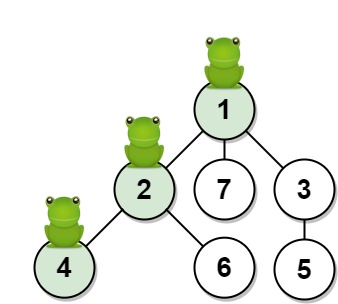
Input: n = 7, edges = [[1,2],[1,3],[1,7],[2,4],[2,6],[3,5]], t = 2, target = 4
Output: 0.16666666666666666
Explanation: The figure above shows the given graph. The frog starts at vertex 1, jumping with 1/3 probability to the vertex 2 after second 1 and then jumping with 1/2 probability to vertex 4 after second 2. Thus the probability for the frog is on the vertex 4 after 2 seconds is 1/3 * 1/2 = 1/6 = 0.16666666666666666.
Example 2:
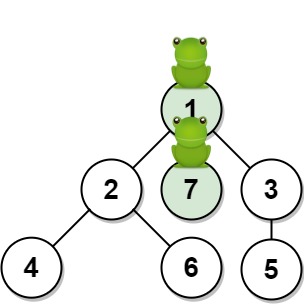
Input: n = 7, edges = [[1,2],[1,3],[1,7],[2,4],[2,6],[3,5]], t = 1, target = 7
Output: 0.3333333333333333
Explanation: The figure above shows the given graph. The frog starts at vertex 1, jumping with 1/3 = 0.3333333333333333 probability to the vertex 7 after second 1.
Constraints:
1 <= n <= 100edges.length == n - 1edges[i].length == 21 <= ai, bi <= n1 <= t <= 501 <= target <= n
Approach Overview
Problem Overview: You are given an undirected tree with n nodes. A frog starts at node 1 and every second jumps to one of its unvisited neighbors with equal probability. After t seconds, compute the probability that the frog is at the target node. The challenge is modeling the probability flow across the tree while respecting the rule that the frog cannot revisit nodes.
Approach 1: Recursive DFS with Probability Tracking (O(n) time, O(n) space)
This approach treats the tree as a probability flow problem. Build an adjacency list and run a DFS from node 1. At each node, count how many unvisited neighbors are available. If the frog has k choices, each branch receives probability current_prob / k. The recursion continues until either the time reaches t or the frog reaches a leaf. Special handling is required when the frog reaches the target before time runs out: the probability is valid only if the node has no unvisited neighbors left (the frog stays put). DFS works well because it naturally follows paths while carrying probability and time as parameters. The traversal touches each node once, giving O(n) time and O(n) recursion stack space. This approach fits naturally with problems involving trees and probabilistic branching, similar to many Depth-First Search patterns.
Approach 2: BFS with Level Tracking (O(n) time, O(n) space)
A BFS simulation models the frog’s movement second by second. Start with a queue containing (node=1, probability=1.0). Each BFS level represents one second of time. When processing a node, compute how many unvisited neighbors it has and distribute the probability evenly among them before pushing them into the queue. Mark nodes as visited to enforce the rule that the frog never jumps backward. If a node has no unvisited neighbors, its probability remains at that node for the remaining time steps. BFS is often easier to reason about because the queue already aligns with time progression. Each edge is processed at most once, resulting in O(n) time and O(n) queue storage. This technique is common when working with Breadth-First Search on a graph where state evolves per level.
Recommended for interviews: Both DFS and BFS achieve optimal O(n) complexity. Interviewers usually expect the DFS probability propagation because it shows strong reasoning about tree traversal and branching probabilities. BFS is equally valid and sometimes easier to implement without recursion. Showing both approaches demonstrates that you understand tree traversal patterns and how probability flows through a graph structure.
Complexity Analysis
| Approach | Time | Space | When to Use |
|---|---|---|---|
| Recursive DFS with Probability Tracking | O(n) | O(n) | When exploring paths with probability propagation in trees |
| BFS with Level Tracking | O(n) | O(n) | When modeling movement step-by-step across time levels |