
Difference Between Maximum and Minimum Price Sum - Video Solutions
In Out DFS | Difference Between Maximum and Minimum Price Sum | Weekly Contest 328
Difference Between Maximum and Minimum Price Sum - Video Solution
Watch 10 video solutions for Difference Between Maximum and Minimum Price Sum, a hard level problem involving Array, Dynamic Programming, Tree. This walkthrough by codingMohan has 3,145 views views. Want to try solving it yourself? Practice on FleetCode or read the detailed text solution.
Problem Statement
There exists an undirected and initially unrooted tree with n nodes indexed from 0 to n - 1. You are given the integer n and a 2D integer array edges of length n - 1, where edges[i] = [ai, bi] indicates that there is an edge between nodes ai and bi in the tree.
Each node has an associated price. You are given an integer array price, where price[i] is the price of the ith node.
The price sum of a given path is the sum of the prices of all nodes lying on that path.
The tree can be rooted at any node root of your choice. The incurred cost after choosing root is the difference between the maximum and minimum price sum amongst all paths starting at root.
Return the maximum possible cost amongst all possible root choices.
Example 1:
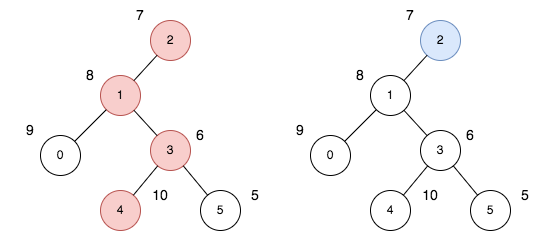
Input: n = 6, edges = [[0,1],[1,2],[1,3],[3,4],[3,5]], price = [9,8,7,6,10,5]
Output: 24
Explanation: The diagram above denotes the tree after rooting it at node 2. The first part (colored in red) shows the path with the maximum price sum. The second part (colored in blue) shows the path with the minimum price sum.
- The first path contains nodes [2,1,3,4]: the prices are [7,8,6,10], and the sum of the prices is 31.
- The second path contains the node [2] with the price [7].
The difference between the maximum and minimum price sum is 24. It can be proved that 24 is the maximum cost.
Example 2:
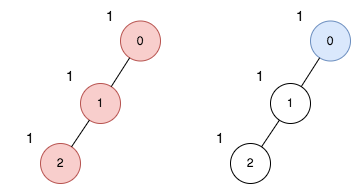
Input: n = 3, edges = [[0,1],[1,2]], price = [1,1,1]
Output: 2
Explanation: The diagram above denotes the tree after rooting it at node 0. The first part (colored in red) shows the path with the maximum price sum. The second part (colored in blue) shows the path with the minimum price sum.
- The first path contains nodes [0,1,2]: the prices are [1,1,1], and the sum of the prices is 3.
- The second path contains node [0] with a price [1].
The difference between the maximum and minimum price sum is 2. It can be proved that 2 is the maximum cost.
Constraints:
1 <= n <= 105edges.length == n - 10 <= ai, bi <= n - 1edgesrepresents a valid tree.price.length == n1 <= price[i] <= 105
Approach Overview
Problem Overview: You are given a tree where each node has a price. Choose any node as the root. From that root, consider all paths that start at the root and end at some node in the tree. The score for that root is the difference between the maximum path price sum and the minimum path price sum. The task is to compute the maximum possible score across all choices of root.
Approach 1: DFS Based Path Sum Calculation (O(n) time, O(n) space)
The key observation is that the difference between maximum and minimum path sums can be transformed into a tree dynamic programming problem. During a Depth-First Search, track two values for every node: the best path sum that must end at a leaf in its subtree and the best path sum that can end at any node. These states allow you to model the minimum and maximum path choices. While traversing children, combine subtree results and update a global answer representing the best possible difference. This approach processes each edge once, making it linear time.
Implementation builds an adjacency list for the tree, then runs a recursive DFS. Each recursive call returns the best downward sums for the current node. While merging results from different children, compute candidate differences by pairing paths that represent the minimum-side constraint (ending at a leaf) and the maximum-side freedom (ending anywhere). The algorithm is essentially a tree DP with two states per node.
Approach 2: Centroid Decomposition (O(n log n) time, O(n) space)
Centroid decomposition treats the tree as a hierarchy of balanced components. At each centroid, compute path sums from the centroid into each subtree using DFS. By aggregating subtree results and comparing maximum and minimum path contributions, you can evaluate candidate differences that pass through the centroid. After processing, remove the centroid and recursively process the remaining components.
This method is useful when problems involve path queries or combinations of paths across different subtrees. Each level of decomposition handles paths that pass through a particular centroid, ensuring no path is processed more than O(log n) times overall. Although more complex than the DFS DP approach, it generalizes well for many advanced tree path problems.
Recommended for interviews: The DFS-based tree dynamic programming solution. It runs in O(n) time, requires only one traversal, and demonstrates strong understanding of path aggregation in trees. Centroid decomposition is powerful but usually unnecessary unless the interviewer explicitly pushes toward advanced tree techniques.
Complexity Analysis
| Approach | Time | Space | When to Use |
|---|---|---|---|
| DFS Based Path Sum Calculation | O(n) | O(n) | Best general solution for trees; single DFS with tree DP states |
| Centroid Decomposition | O(n log n) | O(n) | Useful for complex path aggregation problems or reusable centroid frameworks |