
Check If a String Is a Valid Sequence from Root to Leaves Path in a Binary Tree - Video Solutions
Valid sequence from root to leaf in a binary tree | Leetcode
Check If a String Is a Valid Sequence from Root to Leaves Path in a Binary Tree - Video Solution
Watch 10 video solutions for Check If a String Is a Valid Sequence from Root to Leaves Path in a Binary Tree, a medium level problem involving Tree, Depth-First Search, Breadth-First Search. This walkthrough by Techdose has 7,009 views views. Want to try solving it yourself? Practice on FleetCode or read the detailed text solution.
Problem Statement
Given a binary tree where each path going from the root to any leaf form a valid sequence, check if a given string is a valid sequence in such binary tree.
We get the given string from the concatenation of an array of integers arr and the concatenation of all values of the nodes along a path results in a sequence in the given binary tree.
Example 1:
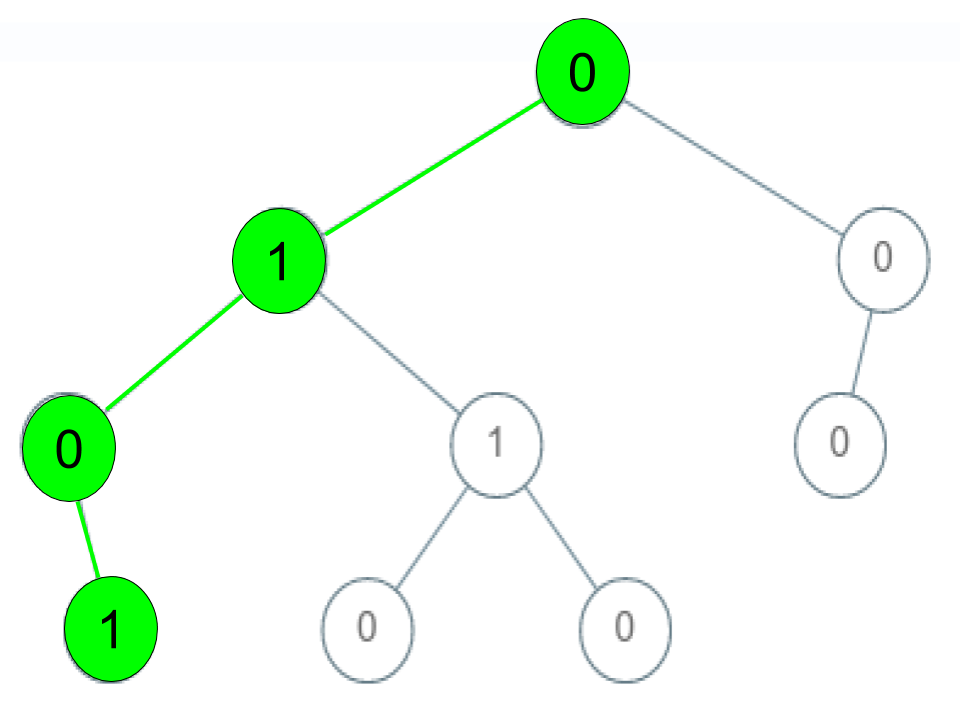
Input: root = [0,1,0,0,1,0,null,null,1,0,0], arr = [0,1,0,1]
Output: true
Explanation:
The path 0 -> 1 -> 0 -> 1 is a valid sequence (green color in the figure).
Other valid sequences are:
0 -> 1 -> 1 -> 0
0 -> 0 -> 0
Example 2:
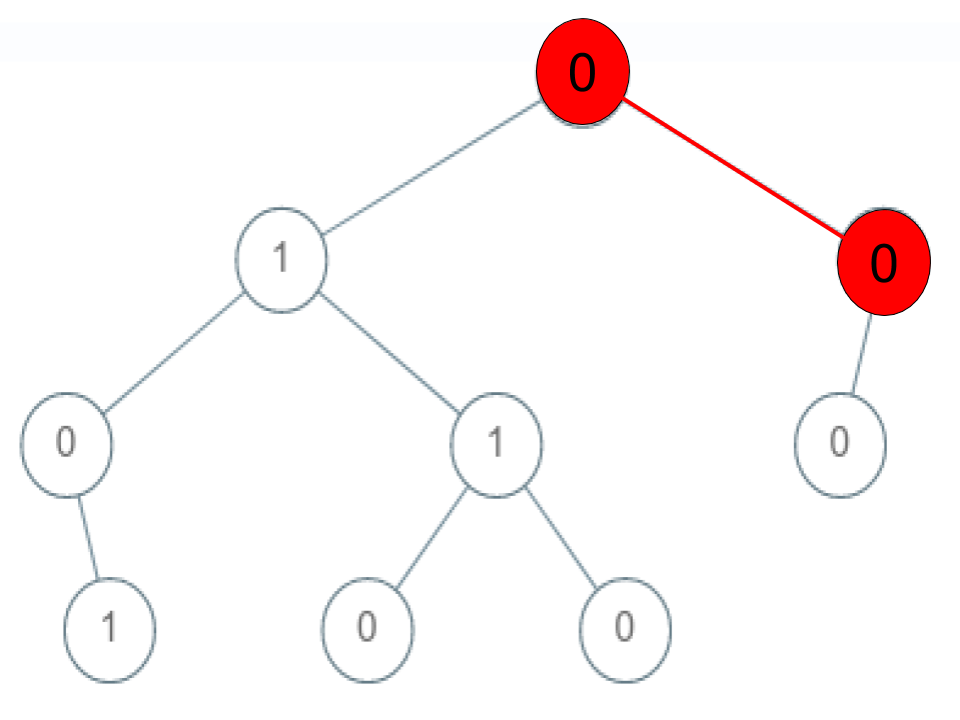
Input: root = [0,1,0,0,1,0,null,null,1,0,0], arr = [0,0,1]
Output: false
Explanation: The path 0 -> 0 -> 1 does not exist, therefore it is not even a sequence.
Example 3:
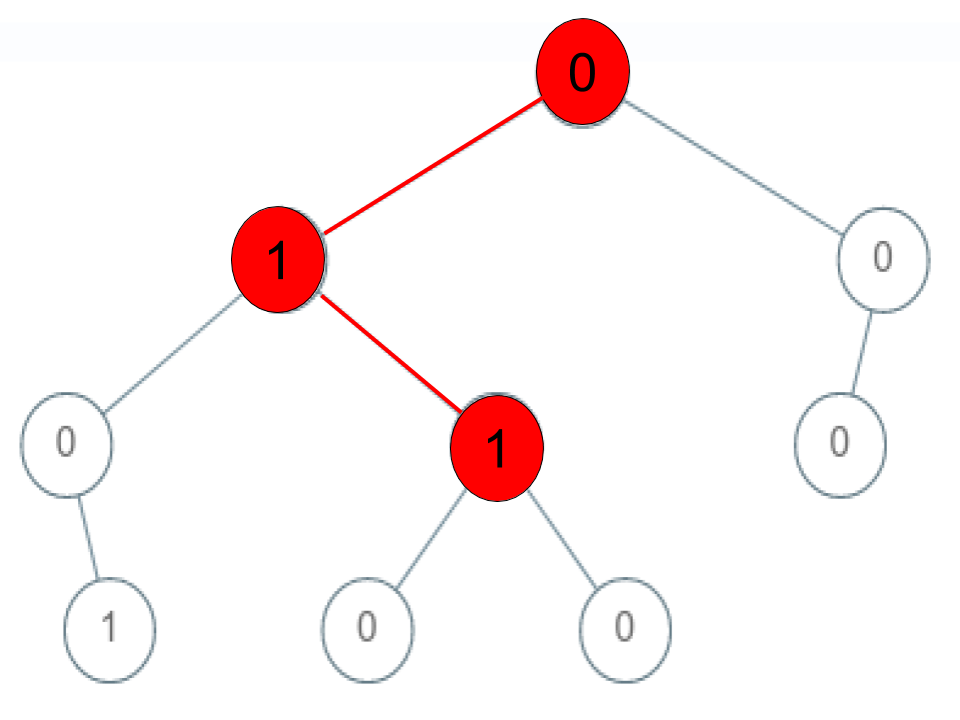
Input: root = [0,1,0,0,1,0,null,null,1,0,0], arr = [0,1,1]
Output: false
Explanation: The path 0 -> 1 -> 1 is a sequence, but it is not a valid sequence.
Constraints:
1 <= arr.length <= 50000 <= arr[i] <= 9- Each node's value is between [0 - 9].
Approach Overview
Problem Overview: You are given a binary tree and an integer array. The task is to check whether the array represents a valid path starting from the root and ending exactly at a leaf node. Each element in the array must match the node values along the path, and the path must terminate at a leaf.
Approach 1: Depth-First Search Path Matching (O(n) time, O(h) space)
The most direct solution uses recursive Depth-First Search. Start from the root and compare the current node value with the corresponding element in the array. If they match, recursively explore the left and right children while advancing the index in the array. The key condition is that when you reach the last element of the array, the current node must also be a leaf node. If the node value mismatches or the array index exceeds bounds, the path is invalid and you backtrack.
This approach works because DFS naturally follows root-to-leaf paths in a binary tree. Each recursive call verifies one step in the sequence, and the search stops early when a mismatch occurs. The algorithm visits each node at most once in the worst case, giving O(n) time complexity where n is the number of nodes. The recursion stack uses O(h) space, where h is the tree height.
Approach 2: Breadth-First Search with Index Tracking (O(n) time, O(n) space)
An iterative alternative uses Breadth-First Search. Maintain a queue storing pairs of (node, index), where index represents the position in the array that must match the node's value. Start with the root and index 0. When processing a node, check if its value equals arr[index]. If it does not match, discard that path. If it matches and the node is a leaf while index is the last array position, a valid sequence exists.
If the sequence is not finished, push the node's children into the queue with index + 1. BFS explores multiple candidate paths simultaneously and guarantees that every valid root-to-leaf candidate is examined. The time complexity remains O(n) because each node is processed once, but the queue can store many nodes at the same level, resulting in O(n) auxiliary space in the worst case.
Recommended for interviews: The recursive DFS solution is what interviewers typically expect. It directly models the root-to-leaf path validation and keeps the code concise. Mentioning BFS as an alternative demonstrates that you understand multiple traversal strategies in tree problems. DFS is usually preferred because it uses less memory and aligns naturally with path-based checks.
Complexity Analysis
| Approach | Time | Space | When to Use |
|---|---|---|---|
| DFS Recursive Path Matching | O(n) | O(h) | Best general solution for validating root-to-leaf paths with minimal memory |
| BFS with Queue and Index Tracking | O(n) | O(n) | Useful when exploring multiple candidate paths iteratively or avoiding recursion |