
Binary Tree Zigzag Level Order Traversal - Video Solutions
Binary Tree Zigzag Level Order Traversal - Leetcode 103 - Python
Binary Tree Zigzag Level Order Traversal - Video Solution
Watch 10 video solutions for Binary Tree Zigzag Level Order Traversal, a medium level problem involving Tree, Breadth-First Search, Binary Tree. This walkthrough by NeetCodeIO has 30,794 views views. Want to try solving it yourself? Practice on FleetCode or read the detailed text solution.
Problem Statement
Given the root of a binary tree, return the zigzag level order traversal of its nodes' values. (i.e., from left to right, then right to left for the next level and alternate between).
Example 1:
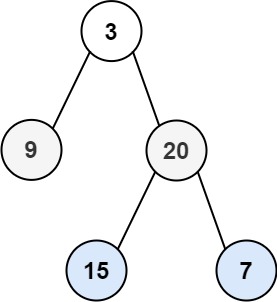
Input: root = [3,9,20,null,null,15,7]
Output: [[3],[20,9],[15,7]]
Example 2:
Input: root = [1]
Output: [[1]]
Example 3:
Input: root = []
Output: []
Constraints:
- The number of nodes in the tree is in the range
[0, 2000]. -100 <= Node.val <= 100
Approach Overview
Problem Overview: Given the root of a binary tree, return the level order traversal of its nodes where the direction alternates on every level. The first level is left-to-right, the next right-to-left, then left-to-right again, forming a zigzag pattern.
Approach 1: Breadth-First Search with Direction Toggle (O(n) time, O(n) space)
This approach performs a standard Breadth-First Search using a queue to process the tree level by level. For each level, collect node values in an array. Maintain a boolean flag that tracks traversal direction. When the flag indicates right-to-left, reverse the collected level values before adding them to the result (or insert at the front while building the level). Every node is visited exactly once, so the time complexity is O(n), and the queue plus result storage requires O(n) space.
The key insight is that zigzag order does not require changing the traversal itself. The queue still processes nodes left-to-right. Only the way values are stored for each level changes. This makes the implementation simple and reliable for any Tree or Binary Tree level traversal problem.
Approach 2: Depth-First Search with Depth Registration (O(n) time, O(n) space)
This approach uses recursive DFS while tracking the current depth. Maintain a list of lists where each index represents a level. When visiting a node, check the depth: if the level does not exist yet, create a new list. For even depths, append the value normally; for odd depths, insert the value at the beginning of the list. This produces the zigzag order during traversal without reversing later.
DFS explores nodes using recursion but still ensures every node is processed exactly once. The recursion stack can grow up to the tree height, giving O(h) stack usage, while the result structure stores all nodes for O(n) total space.
Recommended for interviews: The BFS solution is the most common and expected answer. Interviewers want to see that you recognize this as a level-order traversal problem and apply a direction toggle. DFS with depth tracking shows deeper understanding of tree traversal patterns, but BFS is typically clearer and easier to implement under interview time constraints.
Complexity Analysis
| Approach | Time | Space | When to Use |
|---|---|---|---|
| Breadth-First Search with Direction Toggle | O(n) | O(n) | Best general solution for level-order traversal problems and the most common interview answer |
| Depth-First Search with Depth Registration | O(n) | O(n) | Useful when you prefer recursion or want to build levels during DFS traversal |