
Binary Tree Upside Down - Video Solutions
LeetCode 156. Binary Tree Upside Down
Binary Tree Upside Down - Video Solution
Watch 10 video solutions for Binary Tree Upside Down, a medium level problem involving Tree, Depth-First Search, Binary Tree. This walkthrough by Happy Coding has 6,685 views views. Want to try solving it yourself? Practice on FleetCode or read the detailed text solution.
Problem Statement
Given the root of a binary tree, turn the tree upside down and return the new root.
You can turn a binary tree upside down with the following steps:
- The original left child becomes the new root.
- The original root becomes the new right child.
- The original right child becomes the new left child.

The mentioned steps are done level by level. It is guaranteed that every right node has a sibling (a left node with the same parent) and has no children.
Example 1:
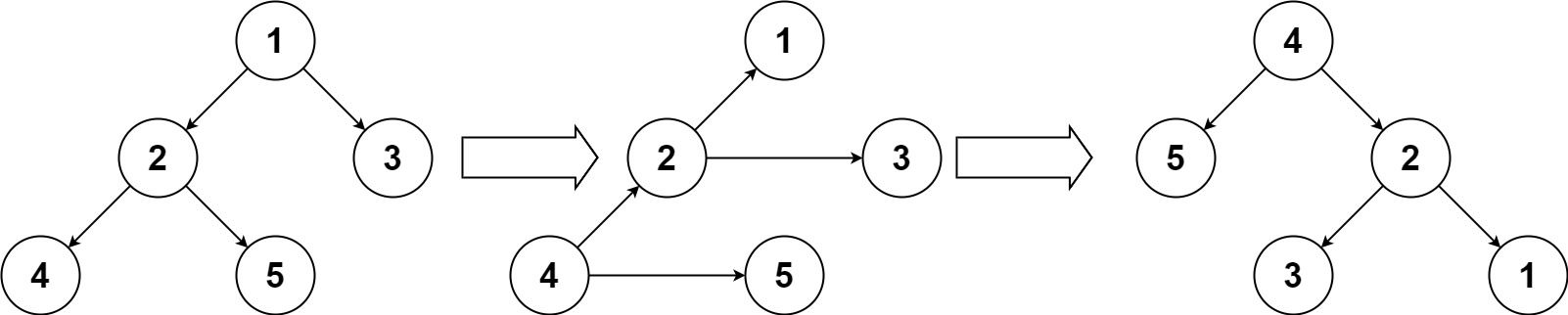
Input: root = [1,2,3,4,5]
Output: [4,5,2,null,null,3,1]
Example 2:
Input: root = []
Output: []
Example 3:
Input: root = [1]
Output: [1]
Constraints:
- The number of nodes in the tree will be in the range
[0, 10]. 1 <= Node.val <= 10- Every right node in the tree has a sibling (a left node that shares the same parent).
- Every right node in the tree has no children.
Approach Overview
Problem Overview: You are given a binary tree where every right child is either null or a leaf with a sibling. The task is to flip the tree upside down so the leftmost node becomes the new root. During the transformation, the original parent becomes the right child and the original right sibling becomes the left child.
Approach 1: Recursive DFS Re-linking (O(n) time, O(h) space)
This method uses recursion to reach the leftmost node, which will become the new root of the flipped tree. Starting from the root, recursively process root.left until the base case (a node with no left child). While the recursion unwinds, rewire pointers: the original left child's left pointer becomes the original right child, and its right pointer becomes the original parent. After rewiring, clear the original node’s left and right references to avoid cycles. The algorithm visits each node exactly once, giving O(n) time complexity. The recursion stack uses O(h) space where h is the height of the tree. This approach fits naturally with Depth-First Search patterns and is often the clearest way to reason about pointer transformations in a Binary Tree.
Approach 2: Iterative Pointer Reversal (O(n) time, O(1) space)
The iterative version performs the same transformation but avoids recursion by tracking previous nodes. Traverse down the left spine of the tree using a loop. Maintain three references: the current node, the previous parent, and the previous right child. At each step, store the next left node, then rotate pointers so the current node’s left becomes the previous right child and its right becomes the previous parent. Update the tracking pointers and continue moving left. This effectively reverses the structure layer by layer until the traversal reaches the leftmost node, which becomes the new root. Because the algorithm only stores a few pointers, it runs in O(n) time with O(1) extra space. This technique resembles linked list reversal applied along the left spine of a Tree.
Recommended for interviews: The recursive DFS solution is usually the expected explanation because it clearly expresses the structural transformation and demonstrates comfort with recursion on trees. The iterative pointer-reversal variant shows deeper understanding of pointer manipulation and space optimization. Start with the recursive explanation to demonstrate correctness, then mention the iterative O(1) space improvement if time allows.
Complexity Analysis
| Approach | Time | Space | When to Use |
|---|---|---|---|
| Recursive DFS Re-linking | O(n) | O(h) | Best for clarity and typical interview explanations using recursion |
| Iterative Pointer Reversal | O(n) | O(1) | When minimizing extra memory or demonstrating advanced pointer manipulation |