
Water Bottles II - Solution & Explanation
Problem Statement
You are given two integers numBottles and numExchange.
numBottles represents the number of full water bottles that you initially have. In one operation, you can perform one of the following operations:
- Drink any number of full water bottles turning them into empty bottles.
- Exchange
numExchangeempty bottles with one full water bottle. Then, increasenumExchangeby one.
Note that you cannot exchange multiple batches of empty bottles for the same value of numExchange. For example, if numBottles == 3 and numExchange == 1, you cannot exchange 3 empty water bottles for 3 full bottles.
Return the maximum number of water bottles you can drink.
Example 1:
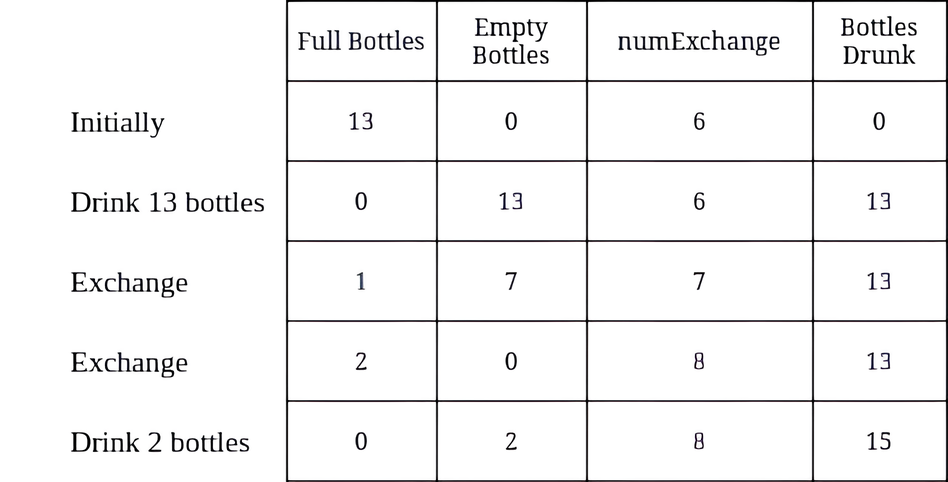
Input: numBottles = 13, numExchange = 6
Output: 15
Explanation: The table above shows the number of full water bottles, empty water bottles, the value of numExchange, and the number of bottles drunk.
Example 2:
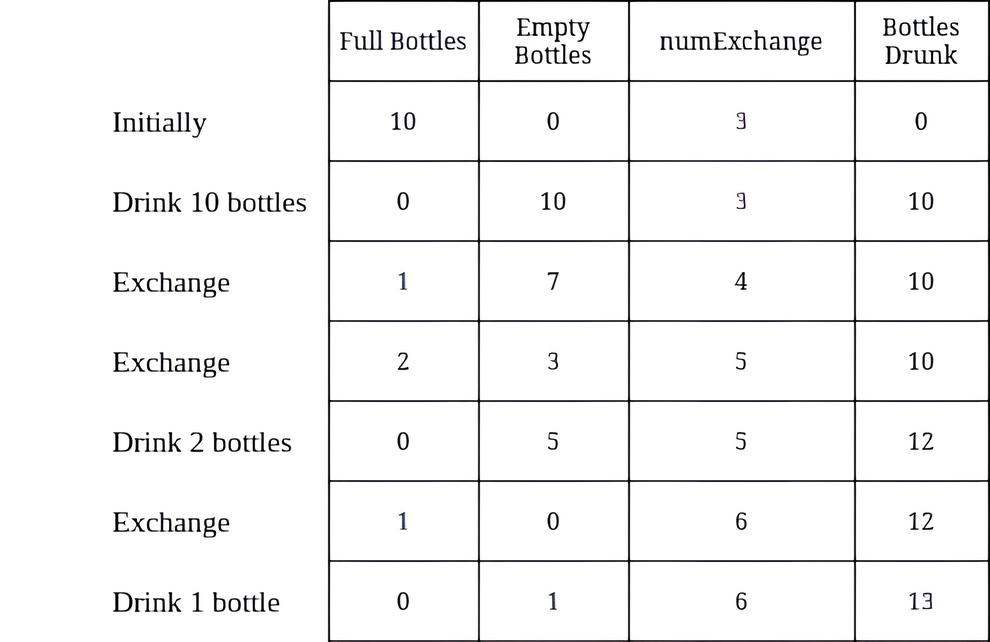
Input: numBottles = 10, numExchange = 3
Output: 13
Explanation: The table above shows the number of full water bottles, empty water bottles, the value of numExchange, and the number of bottles drunk.
Constraints:
1 <= numBottles <= 1001 <= numExchange <= 100
Approach Overview
Problem Overview: You start with numBottles full bottles and can exchange empty bottles for a new full one. The catch: after every exchange, the number of empties required increases by 1. The task is to compute the maximum number of bottles you can drink.
Approach 1: Iterative Simulation (Time: O(k), Space: O(1))
This approach directly simulates the process described in the problem. Start by drinking all initial bottles, which gives you the same number of empty bottles. While the number of empty bottles is at least the current exchange requirement (numExchange), perform an exchange: spend the required empties, gain one full bottle, drink it, and increase the exchange cost by one. Each iteration represents a single exchange operation. The logic is simple and mirrors the rules exactly, making it easy to reason about and implement using basic simulation. Time complexity is O(k), where k is the number of exchanges performed, and space complexity is O(1).
The key insight is that every exchange consumes cost empty bottles but returns one new empty after drinking the obtained bottle. The net change in empties per exchange is therefore -(cost - 1). As the required exchange cost keeps increasing, the loop eventually terminates when there are not enough empty bottles left.
Approach 2: Mathematical Optimization (Time: O(1), Space: O(1))
The simulation can be replaced with a mathematical observation. Suppose you perform k exchanges. The exchange costs form an increasing sequence: numExchange, numExchange + 1, ..., numExchange + k - 1. The total number of empty bottles spent is the sum of this arithmetic progression. Each exchange also produces one new empty bottle after drinking the obtained bottle. Using math, the remaining empty bottles after k exchanges can be expressed as:
empties = numBottles - (numExchange + (numExchange+1) + ... + (numExchange+k-1)) + k
This simplifies to numBottles - (k * numExchange + k(k-1)/2) + k. The valid number of exchanges is the largest k such that before each step you still have enough empties to pay the required cost. Solving this inequality allows you to compute k directly using arithmetic progression formulas. The final answer becomes numBottles + k. This approach eliminates iteration entirely and relies on arithmetic reasoning, which is common in problems tagged with Math.
Recommended for interviews: The iterative simulation is usually expected first because it clearly follows the rules of the problem and is easy to verify. It demonstrates solid reasoning and careful state updates. The mathematical optimization is a strong follow‑up that shows deeper insight into arithmetic progressions and constraint analysis. In most interviews, presenting the simulation first and then deriving the constant‑time optimization shows both correctness and problem‑solving depth.
Approach 1: Iterative Simulation
This approach simulates the process of drinking water bottles and exchanging empty ones iteratively. We keep track of the number of full and empty bottles and perform exchanges as long as possible. In each iteration, all full bottles are consumed, and empty bottles are exchanged for new full bottles. Note that each time we perform an exchange, we increment the exchange rate by one, which affects the number of exchanges possible in future iterations.
This C code continuously drinks bottles by reducing the number of full bottles to zero in each iteration. It then calculates how many new full bottles can be obtained by exchanging empty bottles, and updates the exchange rate for future iterations.
Complexity
Time Complexity: O(log(numBottles))
Space Complexity: O(1)
Approach 2: Mathematical Optimization
This approach computes the total number of water bottles through a mathematical lens, given the initial bottle count and exchange rate. Instead of simulating each drink and exchange operation, it leverages mathematical calculation to determine the upper bound of bottles that can be consumed and exchanged within given rules and conditions.
In this method, while maintaining a count of total bottles drunk, we keep track of empty bottles, using integer division to calculate full bottles. The exchange rate is incremented at each step as per rules, and results calculated in fewer operations by concentrating on full/empty relationships.
Complexity
Time Complexity: O(log(numBottles))
Space Complexity: O(1)
Approach 3: Simulation
We can drink all the full water bottles at the beginning, so initially the amount of water we drink is numBottles. Then, we repeatedly perform the following operations:
- If we currently have
numExchangeempty bottles, we can exchange them for one full bottle. After the exchange, the value ofnumExchangeincreases by1. Then, we drink this bottle, increasing the total amount of water drunk by1, and the number of empty bottles increases by1. - If we do not have
numExchangeempty bottles, we cannot exchange for more water and should stop.
We repeat the above process until we can no longer exchange bottles. The total amount of water drunk is the answer.
The time complexity is O(\sqrt{n}), where n is the initial number of full bottles. The space complexity is O(1).
Complexity Comparison
| Approach | Complexity |
|---|---|
| Iterative Simulation | Time Complexity: O(log(numBottles)) |
| Mathematical Optimization | Time Complexity: O(log(numBottles)) |
| Simulation | — |
Detailed Complexity Analysis
| Approach | Time | Space | When to Use |
|---|---|---|---|
| Iterative Simulation | O(k) | O(1) | Best for clarity and interviews where straightforward simulation of the rules is expected. |
| Mathematical Optimization | O(1) | O(1) | When you recognize the arithmetic progression pattern and want a constant-time calculation. |
Video Solution
Water Bottles II | 2 Approaches | Sridharacharya formula | Leetcode 3100 | codestorywithMIK • codestorywithMIK • 4,131 views views
Watch 9 more video solutions →Frequently Asked Questions
Is Water Bottles II easy or hard?
Water Bottles II Python/Java solution
How to solve Water Bottles II in O(1)?
What is the best approach for Water Bottles II?
Is Water Bottles II asked at Google/Amazon/Meta?
What data structure is used in Water Bottles II?
What is the time complexity of Water Bottles II?
Ready to solve this problem?
Practice Water Bottles II with our built-in code editor and test cases.
Practice on FleetCodeTable of Contents
Practice this problem
Open in Editor