
Sudoku Solver - Solution & Explanation
Problem Statement
Write a program to solve a Sudoku puzzle by filling the empty cells.
A sudoku solution must satisfy all of the following rules:
- Each of the digits
1-9must occur exactly once in each row. - Each of the digits
1-9must occur exactly once in each column. - Each of the digits
1-9must occur exactly once in each of the 93x3sub-boxes of the grid.
The '.' character indicates empty cells.
Example 1:
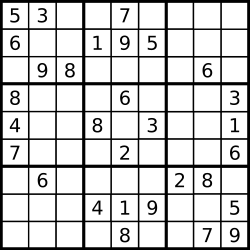
Input: board = [["5","3",".",".","7",".",".",".","."],["6",".",".","1","9","5",".",".","."],[".","9","8",".",".",".",".","6","."],["8",".",".",".","6",".",".",".","3"],["4",".",".","8",".","3",".",".","1"],["7",".",".",".","2",".",".",".","6"],[".","6",".",".",".",".","2","8","."],[".",".",".","4","1","9",".",".","5"],[".",".",".",".","8",".",".","7","9"]]
Output: [["5","3","4","6","7","8","9","1","2"],["6","7","2","1","9","5","3","4","8"],["1","9","8","3","4","2","5","6","7"],["8","5","9","7","6","1","4","2","3"],["4","2","6","8","5","3","7","9","1"],["7","1","3","9","2","4","8","5","6"],["9","6","1","5","3","7","2","8","4"],["2","8","7","4","1","9","6","3","5"],["3","4","5","2","8","6","1","7","9"]]
Explanation: The input board is shown above and the only valid solution is shown below:
Constraints:
board.length == 9board[i].length == 9board[i][j]is a digit or'.'.- It is guaranteed that the input board has only one solution.
Approach Overview
Problem Overview: Sudoku Solver asks you to fill a partially completed 9×9 board so that every row, column, and 3×3 subgrid contains digits 1–9 exactly once. Empty cells are marked with '.'. The challenge is finding a valid assignment that satisfies all constraints without modifying the fixed cells.
The board naturally forms a matrix, and each placement must respect three constraints: unique numbers per row, column, and 3×3 box. Because every empty cell can potentially take multiple values, the search space grows quickly. The core strategy is to try candidates, verify constraints, and backtrack when a choice leads to an invalid state.
Approach 1: Backtracking (Exponential Time, O(9^(n)) worst case, O(81) space)
This approach treats Sudoku as a constraint satisfaction problem solved using backtracking. Iterate through the board to find an empty cell. Try digits 1–9 one by one and check whether placing the digit violates row, column, or 3×3 box rules. If the placement is valid, recursively attempt to solve the remaining cells. If a later step fails, revert the cell and try the next digit.
Validation is typically done by scanning the row, column, and subgrid each time you place a number. Although the theoretical complexity can reach O(9^(81)), pruning invalid placements dramatically reduces the search space in practice. The recursion depth is bounded by the number of empty cells, so the extra space is mainly the recursion stack, around O(81).
Approach 2: Constraint Propagation with Backtracking (Exponential Time, O(9^(n)) worst case, O(81) space)
This optimization improves the basic backtracking strategy by tracking constraints explicitly using sets or bitmasks. Maintain three structures that record which digits are already used in each row, column, and box. These can be implemented with arrays, hash tables, or bitmasks. When you place a digit, update the corresponding row, column, and box constraints instantly.
Instead of scanning the entire row or column every time, you perform constant-time checks against these constraint structures. This dramatically reduces repeated work and prunes invalid candidates earlier. Some implementations also choose the next cell with the fewest valid candidates (a common constraint propagation heuristic), which further shrinks the branching factor.
The worst‑case complexity remains exponential because Sudoku solving is fundamentally a search problem. However, constraint propagation makes the solver significantly faster in real cases by avoiding unnecessary recursion and repeated validation scans.
Recommended for interviews: Interviewers expect a clean backtracking solution that validates row, column, and box constraints correctly. Showing the baseline recursive search demonstrates understanding of the problem structure. Adding constraint tracking with sets or bitmasks shows stronger problem‑solving skills and awareness of optimization techniques commonly used in constraint satisfaction problems.
Approach 1: Backtracking Approach
The backtracking approach is a classic method to solve problems like Sudoku that require exploring all configurations to find a valid solution. This involves recursively trying all numbers from 1 to 9 in each cell and verifying if they meet Sudoku rules. If a number fits, move to the next cell. If stuck, backtrack to the previous cell and try a different number. This method ensures all constraints are respected at each step.
This solution implements a backtracking algorithm in C. The isValid function checks if placing a digit in a particular cell violates Sudoku rules. The solveSudokuHelper function tries placing digits and uses recursion to backtrack if necessary until the board is completely filled.
Complexity
Time Complexity: O(9^(N*N)), where N = 9 (the size of the board), as each empty cell has 9 possibilities.
Space Complexity: O(N*N) for the recursion stack.
Approach 2: Constraint Propagation with Backtracking
This approach enhances the basic backtracking method by introducing constraint propagation. Before choosing a number for a cell, it checks constraints upfront, reducing unnecessary exploration by propagating constraints once a number is filled. This technique decreases the number of options that need to be tried, thereby optimizing the backtracking process.
This Python solution incorporates constraint propagation into the backtracking method. It attempts to minimize choices by evaluating constraints before any number is placed, helping to reduce the branching factor in the search tree. If a valid scenario is found using propagation, it progresses further in solving the Sudoku.
Code
Python
Complexity
Time Complexity: Expected better than O(9^(N*N)), depending on effectiveness of constraint propagation reducing possible combinations.
Space Complexity: O(N*N), influenced by recursion.
Approach 3: Backtracking
We use arrays row, col, and box to record whether each number has appeared in each row, each column, and each 3x3 sub-box, respectively. If the number i has appeared in row r, column c, or the b-th 3x3 sub-box, then row[r][i], col[c][i], and box[b][i] are all set to true.
We iterate over every empty cell in the board and enumerate the possible numbers v that can be filled in. If v has not appeared in the current row, column, or 3x3 sub-box, we can try filling in v and continue searching for the next empty cell. If we reach the end and all cells are filled, it means we have found a valid solution.
Complexity Comparison
| Approach | Complexity |
|---|---|
| Backtracking Approach | Time Complexity: O(9^(N*N)), where N = 9 (the size of the board), as each empty cell has 9 possibilities. |
| Constraint Propagation with Backtracking | Time Complexity: Expected better than O(9^(N*N)), depending on effectiveness of constraint propagation reducing possible combinations. |
| Backtracking | — |
Detailed Complexity Analysis
| Approach | Time | Space | When to Use |
|---|---|---|---|
| Basic Backtracking | O(9^(n)) worst case | O(81) | Best for understanding the core recursion and constraint checks during interviews |
| Constraint Propagation + Backtracking | O(9^(n)) worst case but faster in practice | O(81) | Preferred for optimized implementations using row/column/box tracking or bitmasks |
Video Solution
Implement A Sudoku Solver - Sudoku Solving Backtracking Algorithm ("Sudoku Solver" on LeetCode) • Back To Back SWE • 130,354 views views
Watch 9 more video solutions →Frequently Asked Questions
Is Sudoku Solver easy or hard?
Sudoku Solver Python/Java solution
How to solve Sudoku Solver in O(n)?
What is the best approach for Sudoku Solver?
Is Sudoku Solver asked at Google/Amazon/Meta?
What data structure is used in Sudoku Solver?
What is the time complexity of Sudoku Solver?
Ready to solve this problem?
Practice Sudoku Solver with our built-in code editor and test cases.
Practice on FleetCodeProblem Info
Table of Contents
Practice this problem
Open in Editor