
Sliding Puzzle - Solution & Explanation
Problem Statement
On an 2 x 3 board, there are five tiles labeled from 1 to 5, and an empty square represented by 0. A move consists of choosing 0 and a 4-directionally adjacent number and swapping it.
The state of the board is solved if and only if the board is [[1,2,3],[4,5,0]].
Given the puzzle board board, return the least number of moves required so that the state of the board is solved. If it is impossible for the state of the board to be solved, return -1.
Example 1:
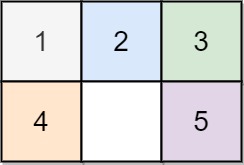
Input: board = [[1,2,3],[4,0,5]]
Output: 1
Explanation: Swap the 0 and the 5 in one move.
Example 2:
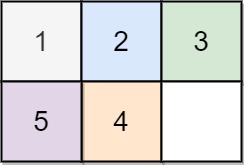
Input: board = [[1,2,3],[5,4,0]]
Output: -1
Explanation: No number of moves will make the board solved.
Example 3:
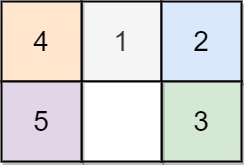
Input: board = [[4,1,2],[5,0,3]]
Output: 5
Explanation: 5 is the smallest number of moves that solves the board.
An example path:
After move 0: [[4,1,2],[5,0,3]]
After move 1: [[4,1,2],[0,5,3]]
After move 2: [[0,1,2],[4,5,3]]
After move 3: [[1,0,2],[4,5,3]]
After move 4: [[1,2,0],[4,5,3]]
After move 5: [[1,2,3],[4,5,0]]
Constraints:
board.length == 2board[i].length == 30 <= board[i][j] <= 5- Each value
board[i][j]is unique.
Approach Overview
Problem Overview: You are given a 2x3 board containing numbers 1–5 and an empty tile represented by 0. Each move swaps the empty tile with one of its adjacent tiles. The task is to determine the minimum number of moves required to reach the target configuration [[1,2,3],[4,5,0]]. If the configuration cannot reach the goal state, return -1.
Approach 1: Breadth-First Search (BFS) (Time: O((m*n)!), Space: O((m*n)!))
This puzzle naturally forms a graph where each board configuration is a node and each valid tile swap is an edge. Breadth-First Search works well because every move has equal cost, and BFS guarantees the shortest path to the goal. Convert the board into a string such as "123450" so configurations can be stored in a hash set for fast visited checks. For every state, locate the index of 0, generate neighbors by swapping it with valid adjacent indices, and push unseen states into the queue. Since the puzzle has at most 6! = 720 states, BFS quickly explores all reachable configurations. This approach is straightforward and reliable for interview settings.
The board itself can be treated like a flattened array, and adjacency rules define which indices the blank tile can swap with. Using a visited set prevents revisiting states and avoids exponential blow‑up.
Approach 2: A* Search Algorithm (Time: O(b^d) worst case, typically faster; Space: O(b^d))
A* search improves exploration efficiency by prioritizing states closer to the goal. Each state is assigned a score f(n) = g(n) + h(n), where g(n) is the number of moves taken so far and h(n) is a heuristic estimating remaining distance. A common heuristic for sliding puzzles is the Manhattan distance between each tile’s current and target positions in the matrix. The algorithm stores states in a priority queue ordered by the smallest estimated total cost.
When expanding nodes, generate neighboring configurations the same way as BFS by swapping the blank tile. The heuristic guides the search toward promising states instead of exploring blindly. For larger sliding puzzles (like 8‑puzzle or 15‑puzzle), A* dramatically reduces the number of explored states compared to BFS. Even for the 2x3 variant, it demonstrates how heuristic search works in pathfinding problems.
Recommended for interviews: BFS is usually the expected solution because it clearly models the puzzle as an unweighted graph and guarantees the minimum number of moves. Implementing BFS with a queue and visited set demonstrates solid understanding of state‑space traversal. A* is a strong follow‑up optimization that shows deeper knowledge of heuristic search and algorithm design.
Approach 1: Breadth-First Search (BFS) Approach
This Python code uses a BFS approach to solve the sliding puzzle. We convert the board into a string and use a map to determine swap positions for '0'. Initially, each configuration is enqueued with its depth. The goal is to find the shortest path to the solved state.
Complexity
Time Complexity: O(1) - There are a constant number of states (720) due to permutation limits.
Space Complexity: O(1) - As with time, space usage peaks at 720 given state permutations.
Approach 2: A* Search Algorithm
This Java code implements the A* search algorithm to tackle the sliding puzzle. Nodes are compared based on the cost estimation which combines depth and heuristic calculations. Using Manhattan distance as a heuristic ensures the solution is efficiently discovered through optimal path estimation.
Complexity
Time Complexity: O((6! = 720) log(720))
Space Complexity: O(720), based on the number of states handled.
Approach 3: Default Approach
Try this approach in the editor →Complexity Comparison
| Approach | Complexity |
|---|---|
| Breadth-First Search (BFS) Approach | Time Complexity: O(1) - There are a constant number of states (720) due to permutation limits. |
| A* Search Algorithm | Time Complexity: O((6! = 720) log(720)) |
| Default Approach | — |
Detailed Complexity Analysis
| Approach | Time | Space | When to Use |
|---|---|---|---|
| Breadth-First Search (BFS) | O((m*n)!) ≈ O(720) for 2x3 board | O((m*n)!) | Best general solution for shortest path in an unweighted puzzle state graph |
| A* Search Algorithm | O(b^d) worst case, typically faster with heuristic | O(b^d) | When heuristic guidance (like Manhattan distance) can reduce explored states |
Video Solution
Sliding Puzzle - Leetcode 773 - Python • NeetCodeIO • 13,451 views views
Watch 9 more video solutions →Frequently Asked Questions
Is Sliding Puzzle easy or hard?
Sliding Puzzle Python/Java solution
How to solve Sliding Puzzle in O(n)?
What is the best approach for Sliding Puzzle?
Is Sliding Puzzle asked at Google/Amazon/Meta?
What data structure is used in Sliding Puzzle?
What is the time complexity of Sliding Puzzle?
Ready to solve this problem?
Practice Sliding Puzzle with our built-in code editor and test cases.
Practice on FleetCode