
Even Odd Tree - Solution & Explanation
Problem Statement
A binary tree is named Even-Odd if it meets the following conditions:
- The root of the binary tree is at level index
0, its children are at level index1, their children are at level index2, etc. - For every even-indexed level, all nodes at the level have odd integer values in strictly increasing order (from left to right).
- For every odd-indexed level, all nodes at the level have even integer values in strictly decreasing order (from left to right).
Given the root of a binary tree, return true if the binary tree is Even-Odd, otherwise return false.
Example 1:
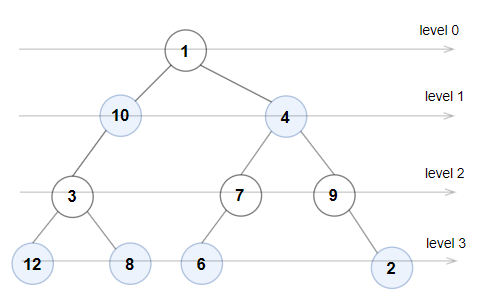
Input: root = [1,10,4,3,null,7,9,12,8,6,null,null,2]
Output: true
Explanation: The node values on each level are:
Level 0: [1]
Level 1: [10,4]
Level 2: [3,7,9]
Level 3: [12,8,6,2]
Since levels 0 and 2 are all odd and increasing and levels 1 and 3 are all even and decreasing, the tree is Even-Odd.
Example 2:
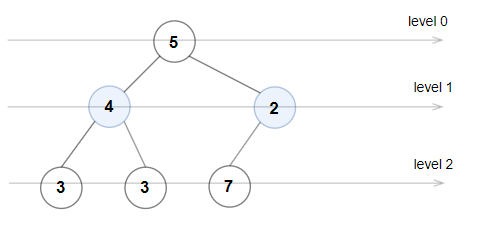
Input: root = [5,4,2,3,3,7]
Output: false
Explanation: The node values on each level are:
Level 0: [5]
Level 1: [4,2]
Level 2: [3,3,7]
Node values in level 2 must be in strictly increasing order, so the tree is not Even-Odd.
Example 3:
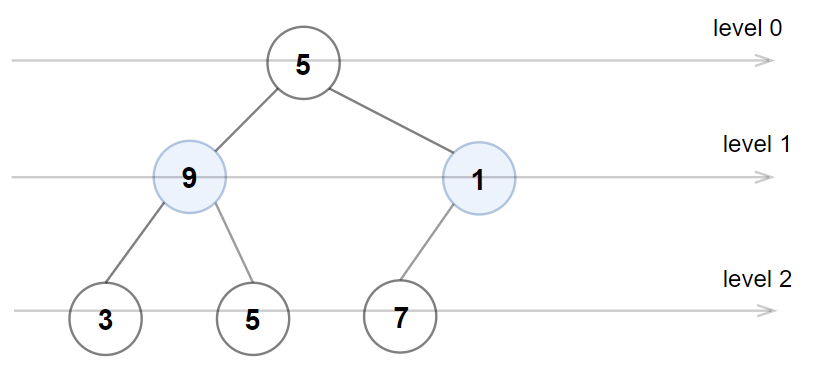
Input: root = [5,9,1,3,5,7]
Output: false
Explanation: Node values in the level 1 should be even integers.
Constraints:
- The number of nodes in the tree is in the range
[1, 105]. 1 <= Node.val <= 106
Approach Overview
Problem Overview: You are given the root of a binary tree. The tree must follow strict level rules: nodes at even-indexed levels contain odd values in strictly increasing order, while nodes at odd-indexed levels contain even values in strictly decreasing order. The task is to verify whether the entire tree satisfies these constraints.
Approach 1: Level Order Traversal (BFS) (Time: O(n), Space: O(w))
This approach uses a queue to perform level order traversal, which naturally processes nodes level by level. For each level, track the previous value seen and enforce two constraints: parity (odd vs even) and ordering (increasing or decreasing). On even levels, each value must be odd and strictly greater than the previous value. On odd levels, each value must be even and strictly smaller than the previous value. Because every node is visited exactly once and checked with constant-time comparisons, the total time complexity is O(n), where n is the number of nodes. The queue may hold up to the width of the tree, giving O(w) space complexity.
This is the most intuitive method because level constraints map directly to breadth-first traversal. If you're comfortable with Breadth-First Search on a binary tree, the implementation is straightforward.
Approach 2: Depth First Search (DFS) with Level Tracking (Time: O(n), Space: O(h))
Instead of processing nodes level by level, DFS explores the tree recursively while tracking the current depth. Maintain a structure (usually a vector or map) storing the last value seen at each level. When visiting a node, check the parity rule for that level and compare its value with the stored previous value to ensure the correct ordering. If the constraint fails, terminate early.
DFS still visits each node once, so the time complexity remains O(n). The recursion stack grows up to the height of the tree, resulting in O(h) auxiliary space. This approach works well when you prefer recursive traversal patterns common in tree problems.
Recommended for interviews: The BFS level order traversal is the expected approach. The problem explicitly defines rules per level, and BFS processes nodes exactly in that order, making the validation logic simple and readable. Showing the DFS version demonstrates deeper understanding of tree traversal patterns, but BFS is typically the cleaner interview solution.
Approach 1: Level Order Traversal (BFS)
This approach employs a breadth-first search (BFS) to traverse the binary tree level by level. We maintain a queue to keep track of the nodes at each level, examining their values to ensure compliance with the Even-Odd criteria:
- For even-indexed levels, node values should be odd and in strictly increasing order.
- For odd-indexed levels, node values should be even and in strictly decreasing order.
The solution employs a queue for level-order traversal. On each level, it examines the nodes' values to ensure conformity with the problem's even-odd level requirements.
Code
Python
JavaScript
Complexity
Time Complexity: O(N), where N is the number of nodes, as each node is inspected once.
Space Complexity: O(M), where M is the maximum number of nodes at any level in the tree (width of the tree), due to the BFS queue.
Approach 2: Depth First Search (DFS) with Level Tracking
This approach applies a depth-first search (DFS) method, maintaining level information to confirm constraints. We use recursion to explore the tree, while an array stores the last value seen on each level to validate order constraints.
In the C++ solution, we use a recursive function to perform DFS while maintaining the last meaningful value for level validation in an array. This array ensures all nodes at each level meet the Even-Odd Tree constraints.
Complexity
Time Complexity: O(N), with N being the number of nodes.
Space Complexity: O(H), where H is the height of the tree, accounting for recursion stack and the array storing last values at each level.
Approach 3: BFS
BFS traverses level by level. Each level is judged by its parity. The node values at each level are either all even or all odd, and they are strictly increasing or decreasing.
The time complexity is O(n), and the space complexity is O(n), where n is the number of nodes in the binary tree.
Approach 4: DFS
DFS performs a pre-order traversal of the binary tree, and similarly judges whether it meets the conditions based on the parity of the layer where the node is located. During the traversal, a hash table is used to record the node value that was most recently visited at each layer.
The time complexity is O(n), and the space complexity is O(n), where n is the number of nodes in the binary tree.
Complexity Comparison
| Approach | Complexity |
|---|---|
| Level Order Traversal (BFS) | Time Complexity: O(N), where N is the number of nodes, as each node is inspected once. |
| Depth First Search (DFS) with Level Tracking | Time Complexity: O(N), with N being the number of nodes. |
| BFS | — |
| DFS | — |
Detailed Complexity Analysis
| Approach | Time | Space | When to Use |
|---|---|---|---|
| Level Order Traversal (BFS) | O(n) | O(w) | Best when validating constraints defined per tree level |
| DFS with Level Tracking | O(n) | O(h) | Useful when implementing recursive tree traversal patterns |
Video Solution
Even Odd Tree - Leetcode 1609 - Python • NeetCodeIO • 14,839 views views
Watch 9 more video solutions →Frequently Asked Questions
Is Even Odd Tree easy or hard?
Even Odd Tree Python/Java solution
How to solve Even Odd Tree in O(n)?
What is the best approach for Even Odd Tree?
Is Even Odd Tree asked at Google/Amazon/Meta?
What data structure is used in Even Odd Tree?
What is the time complexity of Even Odd Tree?
Ready to solve this problem?
Practice Even Odd Tree with our built-in code editor and test cases.
Practice on FleetCodeTable of Contents
Practice this problem
Open in Editor