
Employee Importance - Solution & Explanation
Problem Statement
You have a data structure of employee information, including the employee's unique ID, importance value, and direct subordinates' IDs.
You are given an array of employees employees where:
employees[i].idis the ID of theithemployee.employees[i].importanceis the importance value of theithemployee.employees[i].subordinatesis a list of the IDs of the direct subordinates of theithemployee.
Given an integer id that represents an employee's ID, return the total importance value of this employee and all their direct and indirect subordinates.
Example 1:
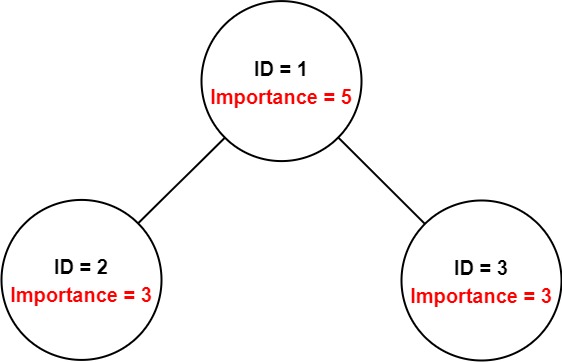
Input: employees = [[1,5,[2,3]],[2,3,[]],[3,3,[]]], id = 1
Output: 11
Explanation: Employee 1 has an importance value of 5 and has two direct subordinates: employee 2 and employee 3.
They both have an importance value of 3.
Thus, the total importance value of employee 1 is 5 + 3 + 3 = 11.
Example 2:
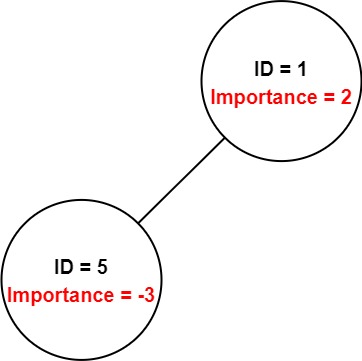
Input: employees = [[1,2,[5]],[5,-3,[]]], id = 5
Output: -3
Explanation: Employee 5 has an importance value of -3 and has no direct subordinates.
Thus, the total importance value of employee 5 is -3.
Constraints:
1 <= employees.length <= 20001 <= employees[i].id <= 2000- All
employees[i].idare unique. -100 <= employees[i].importance <= 100- One employee has at most one direct leader and may have several subordinates.
- The IDs in
employees[i].subordinatesare valid IDs.
Approach Overview
Problem Overview: You’re given a list of employees where each employee has an id, an importance value, and a list of direct subordinates. The task is to compute the total importance for a given employee, including the importance of all direct and indirect subordinates in the hierarchy.
The structure naturally forms a management tree. Each employee points to their children (subordinates). The main challenge is quickly locating employees by ID and traversing the hierarchy without repeatedly scanning the entire array.
Approach 1: Depth-First Search (DFS) using Recursion (Time: O(n), Space: O(n))
First build a hash map that maps employee id to the corresponding employee object. This allows constant-time lookup when you need to find a subordinate. Starting from the target employee ID, perform a recursive depth-first search through all subordinates. For each employee visited, add their importance and recursively process each subordinate ID.
The key insight: every employee is visited exactly once. The recursion naturally follows the management hierarchy, which behaves like a tree. Time complexity is O(n) because each employee is processed once. Space complexity is O(n) due to the hash map and recursion stack in the worst case. This approach directly applies concepts from Depth-First Search and Hash Table usage.
Approach 2: Breadth-First Search (BFS) using Queue (Time: O(n), Space: O(n))
The same preprocessing step applies: build a map from employee ID to employee object. Instead of recursion, use a queue to perform a breadth-first traversal of the hierarchy. Start by pushing the target employee ID into the queue. While the queue is not empty, pop an employee, add their importance to the total, and push all their subordinates into the queue.
This approach processes employees level by level in the management hierarchy. Each employee still gets visited exactly once, so the time complexity remains O(n). The queue can hold up to all employees in the worst case, giving O(n) space complexity. BFS is often preferred if you want to avoid recursion depth issues or when working iteratively. It demonstrates standard Breadth-First Search traversal on a tree-like hierarchy.
Recommended for interviews: Both DFS and BFS solutions are optimal with O(n) time. Interviewers typically expect the DFS solution because it maps directly to the recursive structure of the hierarchy. Showing the hash map optimization is critical; without it, repeated scans of the employee list would degrade performance. Implementing either DFS or BFS cleanly demonstrates strong understanding of graph/tree traversal.
Approach 1: Depth-First Search (DFS) using Recursion
The problem can be approached by using a Depth-First Search (DFS). The main idea is to accumulate the importance of an employee and all of their direct and indirect subordinates. We use a recursive function to traverse the subordinates of each employee. The base case is when an employee has no subordinates (leaf node). Each recursion step accumulates importance from the current employee and proceeds to accumulate from its subordinates.
This Python solution defines a recursive dfs function that fetches an employee from a map (created for fast lookup) and calculates their total importance including their subordinates recursively.
Code
Python
C++
Java
C#
JavaScript
Complexity
Time Complexity: O(N), where N is the number of employees, as each employee is visited once.
Space Complexity: O(N), due to the recursion stack and storage in the map for employees.
Approach 2: Breadth-First Search (BFS) using Queue
An alternative method involves using Breadth-First Search (BFS). In this approach, a queue is used to iteratively explore each level of employee hierarchy starting from the given employee ID. One processes each employee by summing their importance and enqueuing their subordinates. This technique assures visiting all employees in a breadth-wise manner and eventually collecting the cumulative importance value.
This Python code uses a BFS approach. We employ a queue where we enqueue employees as we visit them and total their importance. Every dequeued employee adds their importance to the result and their subordinates to the queue.
Code
Python
C++
Java
C#
JavaScript
Complexity
Time Complexity: O(N), as it processes each employee once.
Space Complexity: O(N), due to the queue and employee mapping storage.
Approach 3: Hash Table + DFS
We use a hash table d to store all employee information, where the key is the employee's ID, and the value is the employee object. Then we start a depth-first search from the given employee ID. Each time we traverse to an employee, we add the employee's importance to the answer, and recursively traverse all the subordinates of the employee, adding the importance of the subordinates to the answer as well.
The time complexity is O(n), and the space complexity is O(n). Where n is the number of employees.
Code
Python
Java
C++
Go
TypeScript
JavaScript
Complexity Comparison
| Approach | Complexity |
|---|---|
| Depth-First Search (DFS) using Recursion | Time Complexity: O(N), where N is the number of employees, as each employee is visited once. |
| Breadth-First Search (BFS) using Queue | Time Complexity: O(N), as it processes each employee once. |
| Hash Table + DFS | — |
Detailed Complexity Analysis
| Approach | Time | Space | When to Use |
|---|---|---|---|
| DFS using Recursion + Hash Map | O(n) | O(n) | Most common interview solution. Clean recursive traversal of the hierarchy. |
| BFS using Queue + Hash Map | O(n) | O(n) | Preferred when avoiding recursion or when iterative traversal is required. |
Video Solution
花花酱 LeetCode 690. Employee Importance - 刷题找工作 EP75 • Hua Hua • 3,181 views views
Watch 9 more video solutions →Frequently Asked Questions
Is Employee Importance easy or hard?
Employee Importance Python/Java solution
How to solve Employee Importance in O(n)?
What is the best approach for Employee Importance?
Is Employee Importance asked at Google/Amazon/Meta?
What data structure is used in Employee Importance?
What is the time complexity of Employee Importance?
Ready to solve this problem?
Practice Employee Importance with our built-in code editor and test cases.
Practice on FleetCode