Given the postfix tokens of an arithmetic expression, build and return the binary expression tree that represents this expression.
Postfix notation is a notation for writing arithmetic expressions in which the operands (numbers) appear before their operators. For example, the postfix tokens of the expression 4*(5-(7+2)) are represented in the array postfix = ["4","5","7","2","+","-","*"].
The class Node is an interface you should use to implement the binary expression tree. The returned tree will be tested using the evaluate function, which is supposed to evaluate the tree's value. You should not remove the Node class; however, you can modify it as you wish, and you can define other classes to implement it if needed.
A binary expression tree is a kind of binary tree used to represent arithmetic expressions. Each node of a binary expression tree has either zero or two children. Leaf nodes (nodes with 0 children) correspond to operands (numbers), and internal nodes (nodes with two children) correspond to the operators '+' (addition), '-' (subtraction), '*' (multiplication), and '/' (division).
It's guaranteed that no subtree will yield a value that exceeds 109 in absolute value, and all the operations are valid (i.e., no division by zero).
Follow up: Could you design the expression tree such that it is more modular? For example, is your design able to support additional operators without making changes to your existing evaluate implementation?
Example 1:
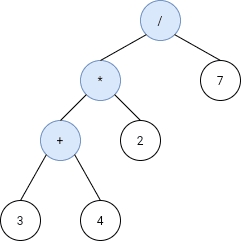
Input: s = ["3","4","+","2","*","7","/"]
Output: 2
Explanation: this expression evaluates to the above binary tree with expression ((3+4)*2)/7) = 14/7 = 2.
Example 2:
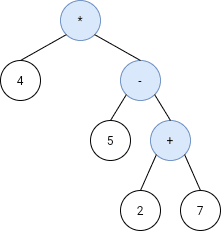
Input: s = ["4","5","2","7","+","-","*"]
Output: -16
Explanation: this expression evaluates to the above binary tree with expression 4*(5-(2+7)) = 4*(-4) = -16.
Constraints:
1 <= s.length < 100s.length is odd.s consists of numbers and the characters '+', '-', '*', and '/'.s[i] is a number, its integer representation is no more than 105.s is a valid expression.109.Problem Overview: You receive a postfix (Reverse Polish Notation) expression and must build an expression tree that can evaluate itself. Each node represents either an operand (number) or an operator (+, -, *, /). The goal is to design the tree structure and implement an evaluate() method that computes the expression result.
Approach 1: Stack-Based Expression Tree Construction (O(n) time, O(n) space)
The postfix expression naturally fits a stack-based algorithm. Iterate through each token in the array. If the token is a number, create a node and push it onto the stack. If the token is an operator, pop two nodes from the stack (right operand first, then left), create a new operator node, and attach the popped nodes as children. Push the new subtree root back onto the stack. After processing all tokens, the stack contains the root of the complete binary tree. Implement evaluate() recursively: leaf nodes return their integer value, while operator nodes evaluate left and right subtrees and apply the stored operator.
This approach works because postfix notation guarantees that operands appear before the operator that uses them. The stack always maintains partially built subtrees until an operator combines them.
Approach 2: Recursive Evaluation on Constructed Tree (O(n) time, O(h) space)
Once the expression tree is built, evaluation becomes a standard tree traversal problem. Each operator node depends on the results of its children, which makes a postorder traversal ideal. Recursively call evaluate() on the left and right children, then apply the operator stored in the current node. Operands immediately return their numeric value.
This recursion uses the call stack proportional to the tree height h. In the worst case (skewed tree) space becomes O(n), but typical expression trees are balanced, keeping recursion depth smaller.
The combination of stack-based construction and recursive evaluation cleanly separates responsibilities: building the structure first, then computing results using tree semantics. This design pattern appears frequently in compiler parsing and interpreter implementations.
Recommended for interviews: The stack-based construction combined with recursive evaluation is the expected solution. It demonstrates understanding of postfix parsing, tree design, and recursion. A brute-force evaluation of the postfix expression alone would miss the key requirement of designing the expression tree class.
| Approach | Time | Space | When to Use |
|---|---|---|---|
| Stack-Based Tree Construction + Recursive Evaluation | O(n) | O(n) | General case; clean and standard approach for building expression trees from postfix notation |
| Postorder Recursive Evaluation of Tree | O(n) | O(h) | When the expression tree is already built and only evaluation logic is required |
1628. Design an Expression Tree With Evaluate Function (Leetcode Medium) • Programming Live with Larry • 535 views views
Watch 1 more video solutions →Practice Design an Expression Tree With Evaluate Function with our built-in code editor and test cases.
Practice on FleetCode