
Minimum Flips in Binary Tree to Get Result - Solution & Explanation
Problem Statement
You are given the root of a binary tree with the following properties:
- Leaf nodes have either the value
0or1, representingfalseandtruerespectively. - Non-leaf nodes have either the value
2,3,4, or5, representing the boolean operationsOR,AND,XOR, andNOT, respectively.
You are also given a boolean result, which is the desired result of the evaluation of the root node.
The evaluation of a node is as follows:
- If the node is a leaf node, the evaluation is the value of the node, i.e.
trueorfalse. - Otherwise, evaluate the node's children and apply the boolean operation of its value with the children's evaluations.
In one operation, you can flip a leaf node, which causes a false node to become true, and a true node to become false.
Return the minimum number of operations that need to be performed such that the evaluation of root yields result. It can be shown that there is always a way to achieve result.
A leaf node is a node that has zero children.
Note: NOT nodes have either a left child or a right child, but other non-leaf nodes have both a left child and a right child.
Example 1:
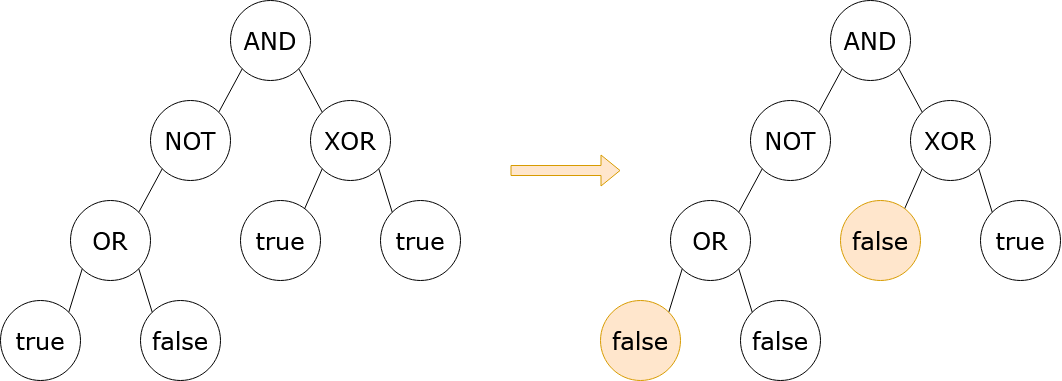
Input: root = [3,5,4,2,null,1,1,1,0], result = true
Output: 2
Explanation:
It can be shown that a minimum of 2 nodes have to be flipped to make the root of the tree
evaluate to true. One way to achieve this is shown in the diagram above.
Example 2:
Input: root = [0], result = false
Output: 0
Explanation:
The root of the tree already evaluates to false, so 0 nodes have to be flipped.
Constraints:
- The number of nodes in the tree is in the range
[1, 105]. 0 <= Node.val <= 5OR,AND, andXORnodes have2children.NOTnodes have1child.- Leaf nodes have a value of
0or1. - Non-leaf nodes have a value of
2,3,4, or5.
Approach Overview
Problem Overview: You are given a binary tree representing a boolean expression. Internal nodes represent operators like AND, OR, XOR, or NOT, while leaves contain boolean values. You can flip a leaf value (0 to 1 or 1 to 0). The goal is to compute the minimum number of flips required so the entire tree evaluates to the desired result.
Approach 1: Brute Force Expression Re-evaluation (Exponential Time)
The naive idea is to try flipping different combinations of leaf nodes and re-evaluating the expression tree each time. For every subset of leaves, you flip values and run a full evaluation of the tree from the bottom up. If the root equals the target, track the minimum flips used. This requires exploring up to 2^L combinations where L is the number of leaves, and each evaluation costs O(n). The total time complexity becomes O(n * 2^L) with O(h) recursion space, which is impractical for large trees.
Approach 2: Tree DP + Case Analysis (O(n) time, O(h) space)
The optimal strategy uses dynamic programming on the tree with a postorder DFS. For each node, compute two values: the minimum flips needed for the subtree to evaluate to 0 and the minimum flips needed to evaluate to 1. For leaf nodes, the cost is straightforward: if the current value is already the target, cost is 0; otherwise 1. For internal nodes, combine results from children based on the operator type.
During DFS, each operator has specific cases. For example, an OR node becomes 1 if either child is 1, so the minimum cost is the minimum combination producing that state. For AND, both children must be 1. For XOR, children must differ. A NOT node simply swaps the costs of its child. By evaluating these combinations using constant-time comparisons, each node is processed once.
This approach naturally fits a Depth-First Search traversal over the Binary Tree. The DP state stores the minimal flips for both boolean outcomes, which is a common pattern in Dynamic Programming on trees. Since each node contributes constant work, the total time complexity is O(n) and space complexity is O(h) for the recursion stack.
Recommended for interviews: The Tree DP approach is what interviewers expect. The brute-force idea shows you understand the problem structure, but recognizing that each subtree only needs two DP states (cost for 0 and 1) demonstrates strong algorithmic thinking and comfort with DFS-based dynamic programming.
Solution
We define a function dfs(root), which returns an array of length 2. The first element represents the minimum number of flips needed to change the value of the root node to false, and the second element represents the minimum number of flips needed to change the value of the root node to true. The answer is dfs(root)[result].
The implementation of the function dfs(root) is as follows:
If root is null, return [+infty, +infty].
Otherwise, let x be the value of root, l be the return value of the left subtree, and r be the return value of the right subtree. Then we discuss the following cases:
- If
x \in {0, 1}, return[x, x \oplus 1]. - If
x = 2, which means the boolean operator isOR, to make the value ofrootfalse, we need to make both the left and right subtreesfalse. Therefore, the first element of the return value isl[0] + r[0]. To make the value ofroottrue, we need at least one of the left or right subtrees to betrue. Therefore, the second element of the return value ismin(l[0] + r[1], l[1] + r[0], l[1] + r[1]). - If
x = 3, which means the boolean operator isAND, to make the value ofrootfalse, we need at least one of the left or right subtrees to befalse. Therefore, the first element of the return value ismin(l[0] + r[0], l[0] + r[1], l[1] + r[0]). To make the value ofroottrue, we need both the left and right subtrees to betrue. Therefore, the second element of the return value isl[1] + r[1]. - If
x = 4, which means the boolean operator isXOR, to make the value ofrootfalse, we need both the left and right subtrees to be eitherfalseortrue. Therefore, the first element of the return value ismin(l[0] + r[0], l[1] + r[1]). To make the value ofroottrue, we need the left and right subtrees to be different. Therefore, the second element of the return value ismin(l[0] + r[1], l[1] + r[0]). - If
x = 5, which means the boolean operator isNOT, to make the value ofrootfalse, we need at least one of the left or right subtrees to betrue. Therefore, the first element of the return value ismin(l[1], r[1]). To make the value ofroottrue, we need at least one of the left or right subtrees to befalse. Therefore, the second element of the return value ismin(l[0], r[0]).
The time complexity is O(n), and the space complexity is O(n). Where n is the number of nodes in the binary tree.
Code
Python
Java
C++
Go
TypeScript
Detailed Complexity Analysis
| Approach | Time | Space | When to Use |
|---|---|---|---|
| Brute Force Leaf Flips | O(n * 2^L) | O(h) | Conceptual baseline when exploring all flip combinations on small trees |
| Tree DP + Case Analysis (DFS) | O(n) | O(h) | General optimal solution; computes minimum flips for both boolean states per node |
Video Solution
Leetcode Minimum Flips in Binary Tree to Get Result • Maximize Your Software Engineering Career • 3,869 views views
Watch 1 more video solutions →Frequently Asked Questions
Is Minimum Flips in Binary Tree to Get Result easy or hard?
Minimum Flips in Binary Tree to Get Result Python/Java solution
How to solve Minimum Flips in Binary Tree to Get Result in O(n)?
What is the best approach for Minimum Flips in Binary Tree to Get Result?
Is Minimum Flips in Binary Tree to Get Result asked at Google/Amazon/Meta?
What data structure is used in Minimum Flips in Binary Tree to Get Result?
What is the time complexity of Minimum Flips in Binary Tree to Get Result?
Ready to solve this problem?
Practice Minimum Flips in Binary Tree to Get Result with our built-in code editor and test cases.
Practice on FleetCode