
Count Good Nodes in Binary Tree - Solution & Explanation
Problem Statement
Given a binary tree root, a node X in the tree is named good if in the path from root to X there are no nodes with a value greater than X.
Return the number of good nodes in the binary tree.
Example 1:
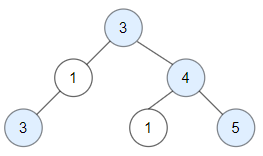
Input: root = [3,1,4,3,null,1,5]
Output: 4
Explanation: Nodes in blue are good.
Root Node (3) is always a good node.
Node 4 -> (3,4) is the maximum value in the path starting from the root.
Node 5 -> (3,4,5) is the maximum value in the path
Node 3 -> (3,1,3) is the maximum value in the path.
Example 2:
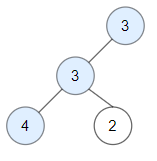
Input: root = [3,3,null,4,2]
Output: 3
Explanation: Node 2 -> (3, 3, 2) is not good, because "3" is higher than it.
Example 3:
Input: root = [1]
Output: 1
Explanation: Root is considered as good.
Constraints:
- The number of nodes in the binary tree is in the range
[1, 10^5]. - Each node's value is between
[-10^4, 10^4].
Approach Overview
Problem Overview: You are given the root of a binary tree. A node is considered good if no node on the path from the root to that node has a value greater than it. The task is to count how many such nodes exist in the tree.
Approach 1: Recursive Depth First Search (DFS) (Time: O(n), Space: O(h))
Traverse the tree using DFS while carrying the maximum value seen on the path from the root to the current node. When visiting a node, compare its value with the running maximum. If node.val >= max_so_far, the node is good and you increment the count. Update the running maximum with max(max_so_far, node.val) before continuing the recursion to the left and right children. Every node is visited exactly once, giving O(n) time complexity. The recursion stack uses O(h) space where h is the tree height (worst case O(n), balanced tree O(log n)). This approach naturally fits problems involving path-based constraints in a binary tree and is the most common interview solution using depth-first search.
Approach 2: Iterative Breadth First Search (BFS) (Time: O(n), Space: O(n))
The same idea can be implemented iteratively with a queue using breadth-first search. Store pairs in the queue: the current node and the maximum value seen along the path to that node. When dequeuing, check if the node value is greater than or equal to the stored maximum. If it is, count it as a good node and update the path maximum for its children. Push each child into the queue with the updated maximum value. Since each node is processed once, the traversal runs in O(n) time. The queue may hold up to an entire level of the tree, giving O(n) auxiliary space in the worst case.
Recommended for interviews: Recursive DFS is typically expected. It directly models the path constraint by passing the current maximum down the recursion. Interviewers often want to see that you recognize the pattern of carrying state along a root-to-node path. The BFS version demonstrates the same idea iteratively and is useful if recursion depth could become an issue.
Approach 1: Recursive Depth First Search (DFS)
This solution defines a helper function dfs that performs the depth-first search. It takes parameters for the current node and the maximum value encountered so far. It returns the total count of good nodes.
Complexity
Time Complexity: O(n), where n is the number of nodes in the binary tree.
Space Complexity: O(h), where h is the height of the tree due to the recursion stack.
Approach 2: Iterative Breadth First Search (BFS)
The C solution implements an iterative BFS using a custom queue structure. Each item in the queue stores a node and the maximum value along the path from the root to that node. The algorithm iterates over the queue, evaluating each node's value against the max value, updating good nodes count accordingly.
Complexity
Time Complexity: O(n), where n is the number of nodes in the tree.
Space Complexity: O(w), where w is the maximum width of the tree.
Approach 3: Default Approach
Code
Python
Java
C++
Go
TypeScript
Complexity Comparison
| Approach | Complexity |
|---|---|
| Recursive Depth First Search (DFS) | Time Complexity: O(n), where n is the number of nodes in the binary tree. |
| Iterative Breadth First Search (BFS) | Time Complexity: O(n), where n is the number of nodes in the tree. |
| Default Approach | — |
Detailed Complexity Analysis
| Approach | Time | Space | When to Use |
|---|---|---|---|
| Recursive Depth First Search (DFS) | O(n) | O(h) | Preferred interview solution. Clean recursion and natural for path-based tree problems. |
| Iterative Breadth First Search (BFS) | O(n) | O(n) | Useful when avoiding recursion or when processing nodes level by level. |
Video Solution
Microsoft's Most Asked Question 2021 - Count Good Nodes in a Binary Tree - Leetcode 1448 - Python • NeetCode • 149,763 views views
Watch 9 more video solutions →Frequently Asked Questions
Is Count Good Nodes in Binary Tree easy or hard?
Count Good Nodes in Binary Tree Python/Java solution
How to solve Count Good Nodes in Binary Tree in O(n)?
What is the best approach for Count Good Nodes in Binary Tree?
Is Count Good Nodes in Binary Tree asked at Google/Amazon/Meta?
What data structure is used in Count Good Nodes in Binary Tree?
What is the time complexity of Count Good Nodes in Binary Tree?
Ready to solve this problem?
Practice Count Good Nodes in Binary Tree with our built-in code editor and test cases.
Practice on FleetCodeProblem Info
Table of Contents
Practice this problem
Open in Editor