
Construct String from Binary Tree - Solution & Explanation
Problem Statement
Given the root node of a binary tree, your task is to create a string representation of the tree following a specific set of formatting rules. The representation should be based on a preorder traversal of the binary tree and must adhere to the following guidelines:
-
Node Representation: Each node in the tree should be represented by its integer value.
-
Parentheses for Children: If a node has at least one child (either left or right), its children should be represented inside parentheses. Specifically:
- If a node has a left child, the value of the left child should be enclosed in parentheses immediately following the node's value.
- If a node has a right child, the value of the right child should also be enclosed in parentheses. The parentheses for the right child should follow those of the left child.
-
Omitting Empty Parentheses: Any empty parentheses pairs (i.e.,
()) should be omitted from the final string representation of the tree, with one specific exception: when a node has a right child but no left child. In such cases, you must include an empty pair of parentheses to indicate the absence of the left child. This ensures that the one-to-one mapping between the string representation and the original binary tree structure is maintained.In summary, empty parentheses pairs should be omitted when a node has only a left child or no children. However, when a node has a right child but no left child, an empty pair of parentheses must precede the representation of the right child to reflect the tree's structure accurately.
Example 1:
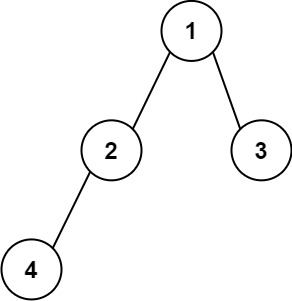
Input: root = [1,2,3,4]
Output: "1(2(4))(3)"
Explanation: Originally, it needs to be "1(2(4)())(3()())", but you need to omit all the empty parenthesis pairs. And it will be "1(2(4))(3)".
Example 2:
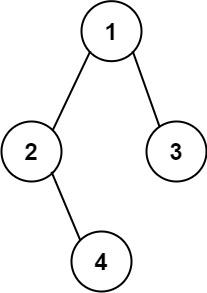
Input: root = [1,2,3,null,4] Output: "1(2()(4))(3)" Explanation: Almost the same as the first example, except the()after2is necessary to indicate the absence of a left child for2and the presence of a right child.
Constraints:
- The number of nodes in the tree is in the range
[1, 104]. -1000 <= Node.val <= 1000
Approach Overview
Problem Overview: Given a binary tree, build a string using preorder traversal where each node is written as value(left)(right). Empty parentheses are omitted unless needed to preserve the one‑to‑one mapping between the string and the tree structure.
Approach 1: Recursive Tree Traversal (DFS) (Time: O(n), Space: O(h))
The most natural solution uses preorder depth‑first traversal. Visit the current node, append its value to the result string, then recursively process the left and right children. The tricky rule: if a node has a right child but no left child, you must add an empty pair () to represent the missing left subtree. This preserves the structure so the tree can be uniquely reconstructed. Every node is processed once, giving O(n) time complexity. The recursion stack stores at most the tree height h, so the auxiliary space is O(h). This approach directly mirrors the definition of preorder traversal in a binary tree and is the most concise implementation.
Approach 2: Iterative Approach Using Stack (Time: O(n), Space: O(n))
An iterative version simulates DFS using an explicit stack. Push the root node and process nodes in preorder order while building the string. Track visited nodes so you know when to append closing parentheses. When pushing children, push the right child first and the left child second so the left subtree is processed first. If a node has a right child but no left child, explicitly append () before handling the right subtree. Each node enters and leaves the stack once, so the runtime remains O(n). The stack may hold multiple nodes simultaneously, leading to O(n) worst‑case space.
This problem mainly tests understanding of preorder depth‑first search and careful handling of string construction. Managing parentheses correctly is the core challenge rather than the traversal itself. The resulting algorithm builds the string incrementally while traversing the tree.
Recommended for interviews: The recursive DFS approach is what interviewers usually expect. It shows you understand preorder traversal and edge cases like missing left children when a right child exists. Mentioning the iterative stack version demonstrates deeper knowledge of how recursion can be simulated and how DFS works internally.
Approach 1: Recursive Tree Traversal
This approach uses a recursive depth-first traversal starting from the root. For each node, construct the string representation by first adding the node's value. Then recursively obtain the string for the left and right subtrees. Handle empty parentheses carefully to meet problem constraints, particularly when a node has a right child but no left child.
The code defines a function tree2str that recursively traverses the tree. For each node, it checks if there's a need to include the left and/or right children in the string. If a right child exists without a left child, it includes an empty set of parentheses before the right child. Memory allocation is handled dynamically to accommodate the resultant string's size, given the constraints. The function returns the constructed string after processing all nodes.
Complexity
Time Complexity: O(n), where n is the number of nodes in the tree, as each node is visited once.
Space Complexity: O(h), where h is the height of the tree, due to the recursive call stack.
Approach 2: Iterative Approach Using Stack
This approach leverages an iterative traversal using a stack to emulate the recursive call stack. This can be beneficial in languages without native recursion optimization or for learning alternative tree traversal methods. The stack helps manage nodes and their parents as we build the string representation iteratively.
The iterative Python solution uses a stack to manage tree traversal and construct the string. Each node's value is appended as we pop it from the stack. Special handling ensures proper insertion of parentheses to reflect tree structure accurately without recursion.
Code
Python
Complexity
Time Complexity: O(n)
Space Complexity: O(n), as the stack can store every node.
Approach 3: Default Approach
Try this approach in the editor →Complexity Comparison
| Approach | Complexity |
|---|---|
| Recursive Tree Traversal | Time Complexity: O(n), where n is the number of nodes in the tree, as each node is visited once. |
| Iterative Approach Using Stack | Time Complexity: O(n) |
| Default Approach | — |
Detailed Complexity Analysis
| Approach | Time | Space | When to Use |
|---|---|---|---|
| Recursive Tree Traversal (DFS) | O(n) | O(h) | Best general solution. Clean and concise when recursion depth is manageable. |
| Iterative DFS Using Stack | O(n) | O(n) | Useful when avoiding recursion or when stack‑based DFS is preferred. |
Video Solution
Construct String from Binary Tree - Leetcode 606 - Python • NeetCode • 42,274 views views
Watch 9 more video solutions →Frequently Asked Questions
Is Construct String from Binary Tree easy or hard?
Construct String from Binary Tree Python/Java solution
How to solve Construct String from Binary Tree in O(n)?
What is the best approach for Construct String from Binary Tree?
Is Construct String from Binary Tree asked at Google/Amazon/Meta?
What data structure is used in Construct String from Binary Tree?
What is the time complexity of Construct String from Binary Tree?
Ready to solve this problem?
Practice Construct String from Binary Tree with our built-in code editor and test cases.
Practice on FleetCodeTable of Contents
Practice this problem
Open in Editor