
Construct Binary Tree from String - Solution & Explanation
Problem Statement
You need to construct a binary tree from a string consisting of parenthesis and integers.
The whole input represents a binary tree. It contains an integer followed by zero, one or two pairs of parenthesis. The integer represents the root's value and a pair of parenthesis contains a child binary tree with the same structure.
You always start to construct the left child node of the parent first if it exists.
Example 1:
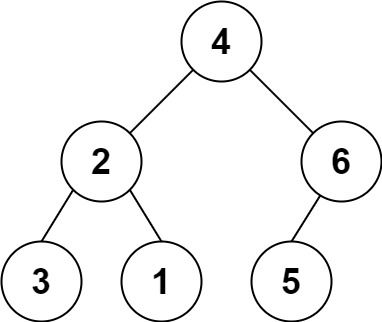
Input: s = "4(2(3)(1))(6(5))"
Output: [4,2,6,3,1,5]
Example 2:
Input: s = "4(2(3)(1))(6(5)(7))"
Output: [4,2,6,3,1,5,7]
Example 3:
Input: s = "-4(2(3)(1))(6(5)(7))"
Output: [-4,2,6,3,1,5,7]
Constraints:
0 <= s.length <= 3 * 104sconsists of digits,'(',')', and'-'only.- All numbers in the tree have value at most than
230.
Approach Overview
Problem Overview: You are given a string representing a binary tree where integers denote node values and parentheses describe child relationships. Your task is to parse the string and reconstruct the corresponding binary tree structure. For example, "4(2(3)(1))(6(5))" represents a tree with root 4, left subtree rooted at 2, and right subtree rooted at 6.
Approach 1: Recursive DFS Parsing (O(n) time, O(n) space)
This method walks through the string and recursively builds nodes while tracking the current index. When you read digits (and possible minus signs), you form the node value. If the next character is (, you recursively construct the left child, and if another ( appears afterward, you construct the right child. Each recursive call consumes the portion of the string representing that subtree. Since every character is processed once, the time complexity is O(n). The recursion stack can grow to the tree height, giving O(n) worst-case space for skewed trees. This approach mirrors the natural structure of the tree and is easy to reason about during a depth-first search style reconstruction.
Approach 2: Stack-Based Iterative Construction (O(n) time, O(n) space)
The iterative approach processes the string left to right and uses a stack to maintain the current path of nodes. When you encounter a number, create a new node and attach it as the left child if the parent doesn't have one yet; otherwise attach it as the right child. Push the new node onto the stack. When a closing parenthesis ) appears, it signals the end of a subtree, so you pop the top node from the stack. This method avoids recursion and still visits each character exactly once, producing O(n) time complexity and O(n) auxiliary space for the stack.
The core challenge in this problem is parsing the string while maintaining the correct parent-child relationships in the binary tree. Both methods rely on recognizing that parentheses define subtree boundaries.
Recommended for interviews: The stack-based solution is often preferred because it avoids recursion depth issues and clearly shows how you track the current parent while parsing the string. However, implementing the recursive DFS parser first demonstrates strong understanding of tree structure and recursive decomposition. Most interviewers accept either approach as long as you achieve the optimal O(n) traversal and correctly parse multi-digit values.
Solution
Try this approach in the editor →Detailed Complexity Analysis
| Approach | Time | Space | When to Use |
|---|---|---|---|
| Recursive DFS Parsing | O(n) | O(n) | When recursion is acceptable and you want a solution that mirrors tree structure naturally |
| Stack-Based Iterative Construction | O(n) | O(n) | Preferred in interviews to avoid recursion depth and explicitly track parent nodes |
Video Solution
leetcode 536 Construct Binary Tree from String • Codebix • 18,598 views views
Watch 9 more video solutions →Frequently Asked Questions
Is Construct Binary Tree from String easy or hard?
Construct Binary Tree from String Python/Java solution
How to solve Construct Binary Tree from String in O(n)?
What is the best approach for Construct Binary Tree from String?
Is Construct Binary Tree from String asked at Google/Amazon/Meta?
What data structure is used in Construct Binary Tree from String?
What is the time complexity of Construct Binary Tree from String?
Ready to solve this problem?
Practice Construct Binary Tree from String with our built-in code editor and test cases.
Practice on FleetCodeTable of Contents
Practice this problem
Open in Editor