3787. Find Diameter Endpoints of a Tree
You are given an undirected tree with n nodes, numbered from 0 to n - 1. It is represented by a 2D integer array edges of length n - 1, where edges[i] = [ai, bi] indicates that there is an edge between nodes ai and bi in the tree.
A node is called special if it is an endpoint of any diameter path of the tree.
Return a binary string s of length n, where s[i] = '1' if node i is special, and s[i] = '0' otherwise.
A diameter path of a tree is the longest simple path between any two nodes. A tree may have multiple diameter paths.
An endpoint of a path is the first or last node on that path.
Example 1:

Input: n = 3, edges = [[0,1],[1,2]]
Output: "101"
Explanation:
- The diameter of this tree consists of 2 edges.
- The only diameter path is the path from node 0 to node 2
- The endpoints of this path are nodes 0 and 2, so they are special.
Example 2:
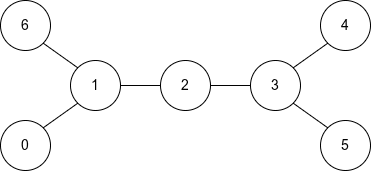
Input: n = 7, edges = [[0,1],[1,2],[2,3],[3,4],[3,5],[1,6]]
Output: "1000111"
Explanation:
The diameter of this tree consists of 4 edges. There are 4 diameter paths:
- The path from node 0 to node 4
- The path from node 0 to node 5
- The path from node 6 to node 4
- The path from node 6 to node 5
The special nodes are nodes 0, 4, 5, 6, as they are endpoints in at least one diameter path.
Example 3:
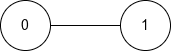
Input: n = 2, edges = [[0,1]]
Output: "11"
Explanation:
- The diameter of this tree consists of 1 edge.
- The only diameter path is the path from node 0 to node 1
- The endpoints of this path are nodes 0 and 1, so they are special.
Constraints:
2 <= n <= 105edges.length == n - 1edges[i] = [ai, bi]0 <= ai, bi < n- The input is generated such that
edgesrepresents a valid tree.
Loading editor...
3
[[0,1],[1,2]]