Determine if a 9 x 9 Sudoku board is valid. Only the filled cells need to be validated according to the following rules:
1-9 without repetition.1-9 without repetition.3 x 3 sub-boxes of the grid must contain the digits 1-9 without repetition.Note:
Example 1:
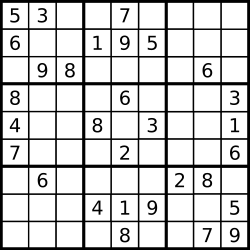
Input: board =
[["5","3",".",".","7",".",".",".","."]
,["6",".",".","1","9","5",".",".","."]
,[".","9","8",".",".",".",".","6","."]
,["8",".",".",".","6",".",".",".","3"]
,["4",".",".","8",".","3",".",".","1"]
,["7",".",".",".","2",".",".",".","6"]
,[".","6",".",".",".",".","2","8","."]
,[".",".",".","4","1","9",".",".","5"]
,[".",".",".",".","8",".",".","7","9"]]
Output: true
Example 2:
Input: board =
[["8","3",".",".","7",".",".",".","."]
,["6",".",".","1","9","5",".",".","."]
,[".","9","8",".",".",".",".","6","."]
,["8",".",".",".","6",".",".",".","3"]
,["4",".",".","8",".","3",".",".","1"]
,["7",".",".",".","2",".",".",".","6"]
,[".","6",".",".",".",".","2","8","."]
,[".",".",".","4","1","9",".",".","5"]
,[".",".",".",".","8",".",".","7","9"]]
Output: false
Explanation: Same as Example 1, except with the 5 in the top left corner being modified to 8. Since there are two 8's in the top left 3x3 sub-box, it is invalid.
Constraints:
board.length == 9board[i].length == 9board[i][j] is a digit 1-9 or '.'.Problem Overview: You are given a partially filled 9x9 Sudoku board. The task is to determine whether the board configuration is valid. A valid board means each row, each column, and each 3x3 subgrid contains digits 1–9 without duplicates. Empty cells are represented by . and should be ignored during validation.
Approach 1: Hash Set Validation (Time: O(n^2), Space: O(n^2))
This approach tracks numbers seen in each row, column, and 3x3 box using hash sets. Iterate through the board cell by cell. When you encounter a digit, check whether it already exists in the corresponding row set, column set, or box set. If it does, the board is invalid. Otherwise insert the value into all three sets and continue scanning.
The key insight is treating rows, columns, and subgrids as independent constraints. A simple hash lookup (O(1)) detects duplicates immediately. You can compute the box index using (row / 3) * 3 + col / 3. This approach is straightforward and widely used in interview solutions involving hash tables and grid traversal problems built on arrays and matrix structures.
Approach 2: Bit Manipulation (Time: O(n^2), Space: O(1))
Bit manipulation compresses the same validation logic into integer bitmasks. Instead of hash sets, maintain three arrays: rows[9], cols[9], and boxes[9]. Each integer acts as a 9-bit mask representing digits 1–9. When processing a digit d, compute mask = 1 << (d - 1). If the mask already exists in the corresponding row, column, or box using a bitwise AND check, a duplicate was found.
If the digit is new, update the masks using bitwise OR. This technique eliminates dynamic data structures and reduces memory overhead while keeping constant-time checks. Bitmasking is common in constraint validation problems where the value range is small and fixed.
Recommended for interviews: The hash set solution is the most common answer and clearly communicates the validation logic. Interviewers expect you to recognize that rows, columns, and boxes must be tracked separately. The bit manipulation version demonstrates stronger optimization skills and understanding of low-level operations. Both run in O(n^2) time for a 9×9 board, but the bitmask approach achieves O(1) auxiliary space.
This approach uses hash sets to track the unique numbers found in each row, column, and 3x3 sub-box. We iterate over each cell in the board, and check if the current value has been seen before in the current row, column, or sub-box. If it has, we return false. Otherwise, we add the value to the respective sets.
This solution uses three dictionaries, each containing sets, to keep track of seen values in rows, columns, and boxes. The key for the boxes dictionary is a tuple representing the box index. As we iterate, we skip any empty cells and check if the number already exists in any of its corresponding set. If it does, the Sudoku is invalid. Otherwise, we add the number to the corresponding sets and continue.
Time Complexity: O(1) because the board size is constant (9x9).
Space Complexity: O(1) due to the fixed size of additional data structures used.
This approach seeks to replace sets with bit manipulations to compress space usage for tracking seen numbers. We increment bits in an integer representing whether a digit has been seen in rows, columns, or boxes.
This solution uses integers to record seen numbers in binary form. Each place represents whether a number has been seen (responding to the power of 2 in terms of bit location).
Time Complexity: O(1) as the board size and iteration steps remain constant.
Space Complexity: O(1) due to the integer used for tracking positions, which is constant.
| Approach | Complexity |
|---|---|
| Approach 1: Hash Set Validation | Time Complexity: O(1) because the board size is constant (9x9). |
| Approach 2: Bit Manipulation | Time Complexity: O(1) as the board size and iteration steps remain constant. |
| Approach | Time | Space | When to Use |
|---|---|---|---|
| Hash Set Validation | O(n^2) | O(n^2) | Best for readability and interviews; straightforward duplicate detection using hash lookups |
| Bit Manipulation | O(n^2) | O(1) | Memory‑efficient solution when the value range is fixed (digits 1–9) |
Valid Sudoku - Amazon Interview Question - Leetcode 36 - Python • NeetCode • 505,509 views views
Watch 9 more video solutions →Practice Valid Sudoku with our built-in code editor and test cases.
Practice on FleetCodePractice this problem
Open in Editor