You are given a root, which is the root of a special binary tree with n nodes. The nodes of the special binary tree are numbered from 1 to n. Suppose the tree has k leaves in the following order: b1 < b2 < ... < bk.
The leaves of this tree have a special property! That is, for every leaf bi, the following conditions hold:
bi is bi + 1 if i < k, and b1 otherwise.bi is bi - 1 if i > 1, and bk otherwise.Return the height of the given tree.
Note: The height of a binary tree is the length of the longest path from the root to any other node.
Example 1:
Input: root = [1,2,3,null,null,4,5]
Output: 2
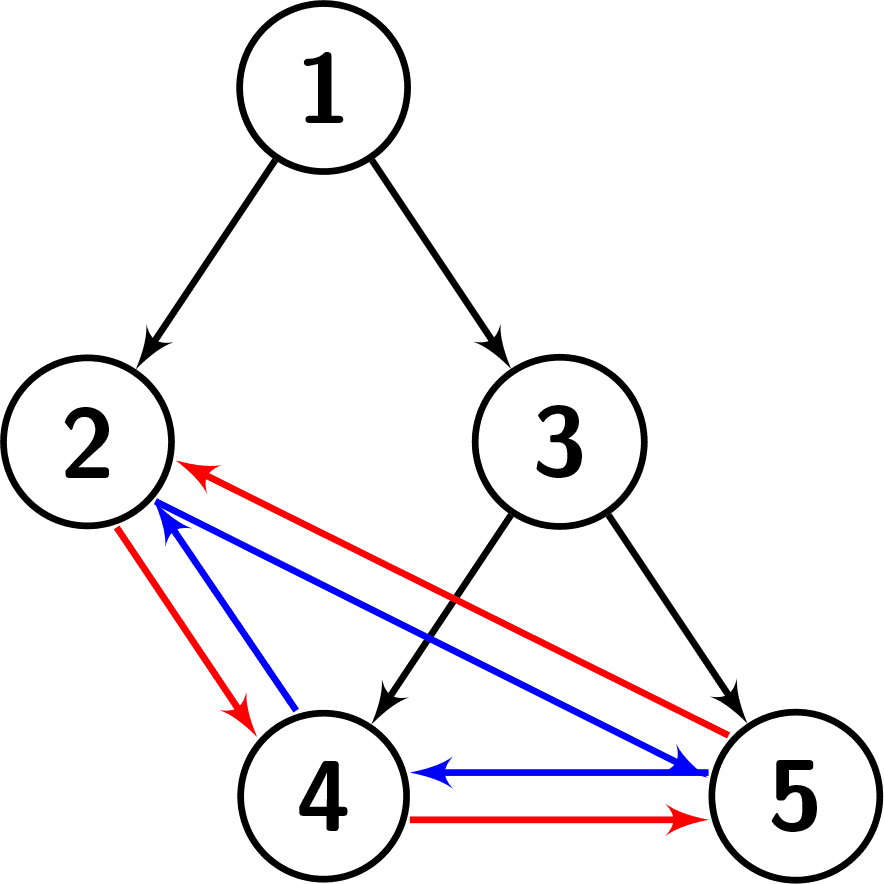
Explanation: The given tree is shown in the following picture. Each leaf's left child is the leaf to its left (shown with the blue edges). Each leaf's right child is the leaf to its right (shown with the red edges). We can see that the graph has a height of 2.
Example 2:
Input: root = [1,2]
Output: 1
Explanation: The given tree is shown in the following picture. There is only one leaf, so it doesn't have any left or right child. We can see that the graph has a height of 1.

Example 3:
Input: root = [1,2,3,null,null,4,null,5,6]
Output: 3
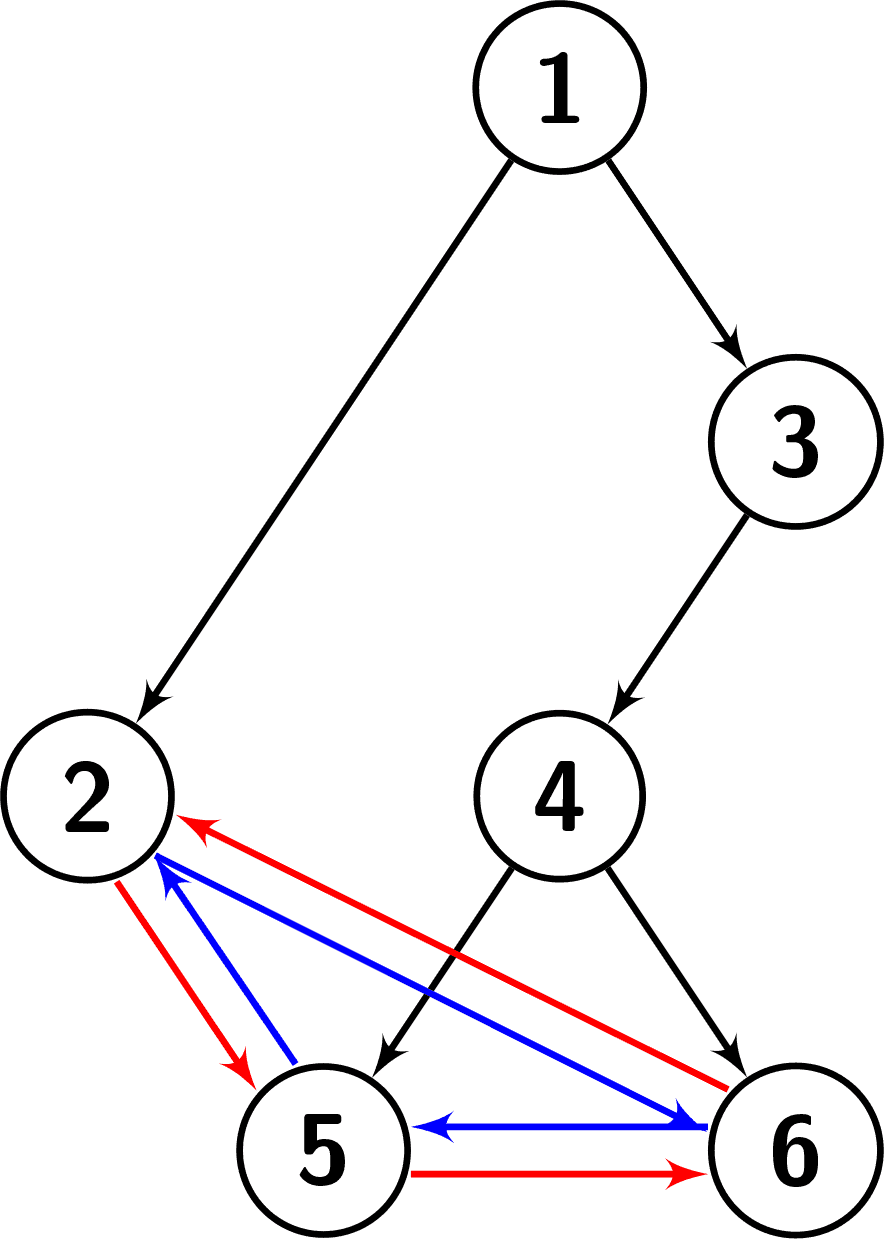
Explanation: The given tree is shown in the following picture. Each leaf's left child is the leaf to its left (shown with the blue edges). Each leaf's right child is the leaf to its right (shown with the red edges). We can see that the graph has a height of 3.
Constraints:
n == number of nodes in the tree2 <= n <= 1041 <= node.val <= nnode.val is unique.Problem Overview: You are given the root of a special binary tree. In this structure, leaf nodes are connected together in a circular doubly linked list using their left and right pointers. Those links are not real child edges, so they must be ignored while computing the tree height. The task is to return the maximum number of nodes on a path from the root to a valid leaf.
Approach 1: Depth-First Search (DFS) Traversal (O(n) time, O(h) space)
The cleanest solution uses a recursive DFS over the tree. Traverse from the root and compute the height of the left and right subtrees. The tricky part is identifying the fake edges created by the circular leaf list. If node.left exists and node.left.right == node, that pointer belongs to the leaf list and should not be explored. Similarly, if node.right exists and node.right.left == node, it is also part of the leaf linkage. Treat those as null children. After filtering those edges, compute the height using 1 + max(leftHeight, rightHeight). This approach visits each node exactly once, giving O(n) time complexity and O(h) recursion stack space where h is the tree height.
This solution maps directly to standard recursive patterns used in Depth-First Search on a binary tree. The only additional logic is detecting the circular leaf connections before recursing.
Approach 2: Breadth-First Search (Level Order) (O(n) time, O(w) space)
A level-order traversal using a queue also works. Start from the root and process nodes level by level, increasing a height counter after finishing each layer. Before pushing children into the queue, filter out the special leaf links using the same checks: ignore node.left if node.left.right == node and ignore node.right if node.right.left == node. Because each node is enqueued at most once, the traversal runs in O(n) time. The queue can hold up to one level of the tree, giving O(w) space where w is the maximum width.
This approach is easier to visualize because the height naturally corresponds to the number of processed levels. It fits well when you already use Breadth-First Search patterns for tree problems.
Recommended for interviews: The DFS solution is typically expected. It demonstrates that you recognize the circular leaf structure and can safely prune those edges during recursion. Mentioning the BFS alternative shows a solid understanding of traversal strategies, but the recursive DFS version is shorter and easier to implement under interview pressure.
The key to the problem is how to determine whether a node is a leaf node. We design a function dfs(root, d), where root represents the current node, and d represents the depth of the current node. Each time we search, we update the answer ans = max(ans, d), and then determine whether the current node is a leaf node. If the current node has a left child, and the right child of the left child is not the current node, then we recursively call dfs(root.left, d + 1). If the current node has a right child, and the left child of the right child is not the current node, then we recursively call dfs(root.right, d + 1).
The time complexity is O(n), and the space complexity is O(n). Where n is the number of nodes in the binary tree.
Python
Java
C++
Go
TypeScript
| Approach | Time | Space | When to Use |
|---|---|---|---|
| DFS Recursive Traversal | O(n) | O(h) | General solution for computing tree height; clean and interview-friendly |
| BFS Level Order Traversal | O(n) | O(w) | Useful when reasoning about tree levels or when recursion depth may be large |
L14. Maximum Depth in Binary Tree | Height of Binary Tree | C++ | Java • take U forward • 383,855 views views
Watch 9 more video solutions →Practice Height of Special Binary Tree with our built-in code editor and test cases.
Practice on FleetCodePractice this problem
Open in Editor