

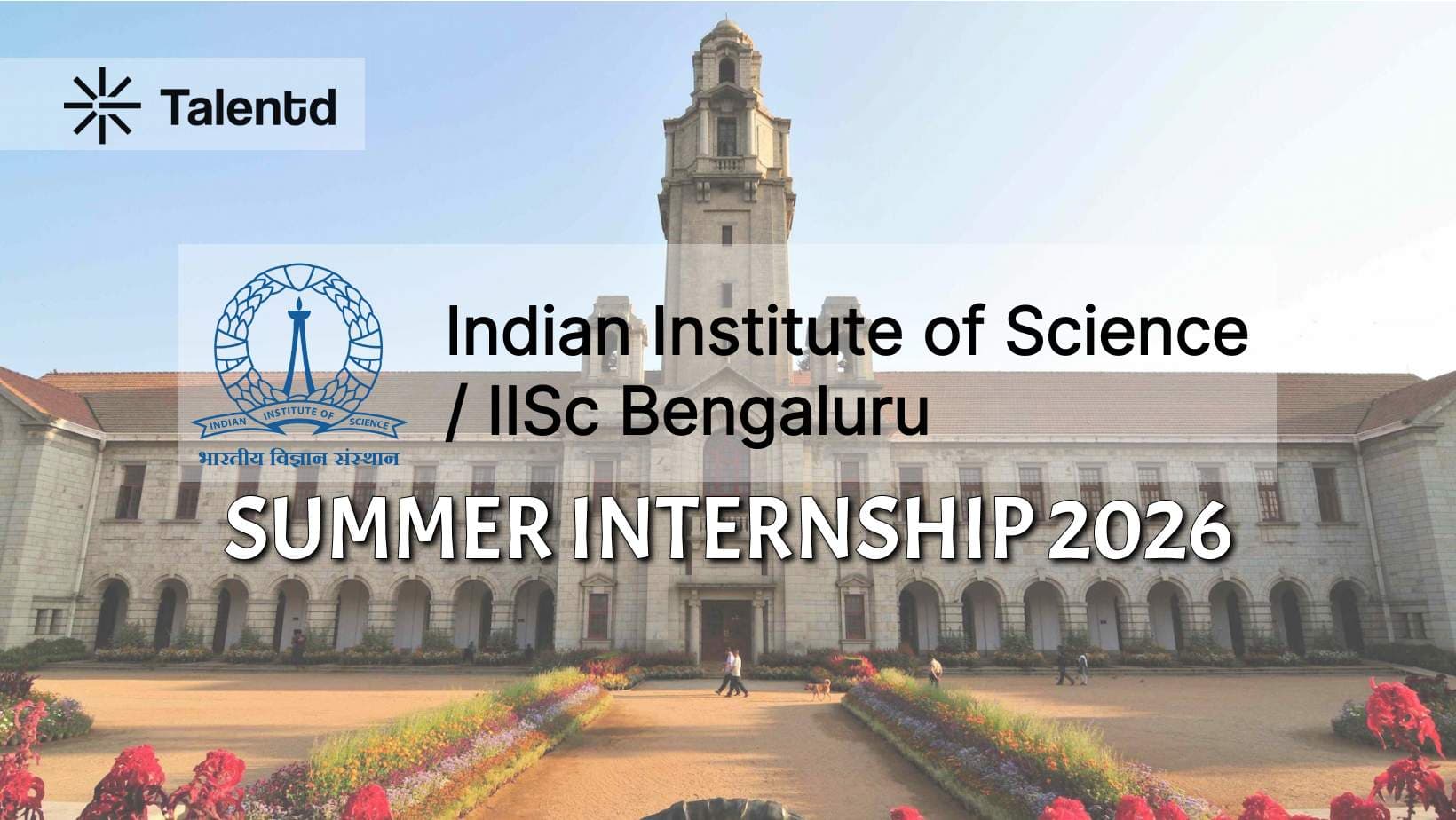
INR 25,000 per month (Master’s); INR 20,000 per month (Bachelor’s)
3 months (Preferably 1 May – 31 July 2026)
Final-year Master’s (MSc/MTech/ME/MCA) or final-year Bachelor’s (BSc/BTech/BE) students with interest in brain research and coding skills in Python or R
Official no-objection certificate from department or institution head (required if selected)
Table of Contents(8 headings)
If you’re searching for a serious research internship at IISc, this one deserves your attention. The IISc CBRAIN Internship applications for the 2026 cycle closed on 23 March 2026. The next cycle is expected around the same time next year.
This internship at the Centre for Brain Research (CBR), IISc Bangalore, focuses on aging brain research, multimodal health data, and machine learning. Applications for the 2026 cycle closed on 23 March 2026. If you missed it, the next cycle is expected around the same time next year.
You can use this time to review the eligibility criteria and prepare your documents. Being ready when the next application window opens will save you time.
IISc CBRAIN Internship: At a Glance
| Particulars | Details |
|---|---|
| Program Name | CBRAIN Internship Program |
| Institution | Centre for Brain Research (CBR), IISc Bangalore |
| Internship Duration | 3 months (Preferably 1 May – 31 July) |
| Mode | In-person (No remote option) |
| Stipend (Master’s) | INR 25,000 per month |
| Stipend (Bachelor’s) | INR 20,000 per month |
| Application Deadline | 23 March (for the 2026 cycle; next cycle expected around the same time next year) |
| Result Announcement | Early April (on CBR website for the 2026 cycle) |
What is IISc CBRAIN Internship About?
The IISc CBRAIN Internship is in its fourth edition. It is designed for students passionate about aging brain research and neurodegenerative diseases.
This year, the focus was on handling, integrating, and analysing large-scale multimodal health data. That includes publicly available datasets and CBR’s own longitudinal cohort studies on brain aging.
You won’t just clean Excel sheets. Interns apply machine learning algorithms to predict cognitive impairment using state-of-the-art datasets, including multi-omics data. If you enjoy Python notebooks more than PowerPoint slides, you’ll feel at home here.
And yes, you’ll work directly with neuroscientists, clinicians, and data scientists. That exposure matters.
IISc CBRAIN Internship Eligibility Criteria
Before you get excited, check if you’re eligible.
- Currently in the final year of a Master’s degree (M.Sc / M.Tech / M.E / MCA or equivalent) at an Indian institution.
- Preferably from Biostatistics, Bioinformatics, Data Science, or related quantitative disciplines.
- Final-year Bachelor’s students (B.Sc / B.Tech / B.E or equivalent) may also apply.
- Strong interest in brain aging or neurodegenerative disease research.
- Basic to intermediate coding skills in Python or R preferred.
- Experience in AI/ML will be viewed favourably.
Students from other backgrounds can apply too, provided they have demonstrable experience working with data, especially in health or biological sciences.
Quick heads-up: This is not a beginner-level internship. They expect you to engage rigorously with complex datasets.
Rs 25,000/Month Stipend Details
Let’s talk money.
Master’s students selected for the IISc CBRAIN Internship receive a consolidated stipend of INR 25,000 per month. Bachelor’s students receive INR 20,000 per month.
The internship duration is typically three months, preferably from 1 May to 31 July. Shorter internships may not be feasible. In select cases, longer engagements may be considered.
However, interns must arrange their own accommodation and travel. Keep that in mind while budgeting for Bangalore.
Internship Mode, Location & Expectations
This internship is strictly in person at the Centre for Brain Research, IISc campus, Bengaluru. Remote participation is not allowed.
During the program, interns must adhere to CBR’s working hours and institutional norms. You will also participate in journal clubs, research seminars, and interdisciplinary discussions.
At the end, each intern must submit a detailed report summarising their training and accomplishments. There may also be additional requirements such as a poster presentation. Completion of these is necessary to receive the internship certificate.
I’ve seen students underestimate the final report requirement in research internships. Don’t. Treat it seriously.
IISc CBRAIN Internship Application Process
The application is detailed. And yes, they read it carefully.
- Step 1: Check the deadline
Applications for the 2026 cycle closed on 23 March 2026 (11:59 PM). Late applications are not entertained. The next cycle is expected around the same time next year. - Step 2: Prepare your academic details
You’ll need your CGPA (on a 10-point scale) or percentage, Class 10 and 12 performance, past degrees, and expected year of graduation. - Step 3: Fill the official online form
Head to the IISc CBRAIN Internship application form and complete all four pages carefully. The form does not have a “Save and Close” option, so keep all information ready before starting. - Step 4: Answer research questions thoughtfully
You must write short descriptive responses about your research interests, prior internships, data analysis experience, awards, publications, and motivation for applying. Word limits range from 50 to 300 words. Stick to them. - Step 5: Provide referee details
You need to mention the full name, affiliation, and official email address of a referee. Recommendation letters are not required at the initial stage. Submit them only if requested. - Step 6: Wait for results
Results for the 2026 cycle were announced on the CBR website in early April 2026. The decision of CBR is final.
If selected, you must submit an official no-objection certificate from your department or institution head.
What Makes IISc CBRAIN Internship Stand Out?
Three things.
First, the focus on multimodal and multi-omics datasets. That’s cutting-edge research exposure, not routine coding tasks.
Second, mentorship from leading scientists and data analysis teams at IISc. Access like this can shape your academic trajectory.
Third, real-world health data. Working on cognitive impairment prediction using machine learning is highly relevant if you're planning a PhD or a research-driven career.
Internships that combine neuroscience and data science at this level are rare in India.
How to Strengthen Your Application
Your SOP-style answers will decide everything.
- Clearly explain your experience with datasets. Mention tools like Python, R, ML libraries, or statistical methods if applicable.
- Connect your past work to aging brain research, even if indirectly.
- Be specific about career goals. Vague answers don’t work in research applications.
- Keep within word limits. They’ve clearly defined them for a reason.
If possible, review CBR faculty profiles before writing your areas of interest. It shows intent.
Guide
Explore all IISc Internships
Frequently Asked Questions
What is the last date to apply for the IISc CBRAIN Internship 2026?
What stipend is offered in the IISc CBRAIN Internship 2026?
Who is eligible to apply for the IISc CBRAIN Internship 2026?
Is the IISc CBRAIN Internship 2026 remote or in-person?
What is the duration of the IISc CBRAIN Internship 2026?
When will the IISc CBRAIN Internship 2026 results be announced?
Tags
About the Author

Azhar Khan
Founder | Editor | Senior Fullstack Engineer
Azhar Khan is the founder of Talentd, and a Sr. FullStack Engineer, currently working for USA Fintech company. Passionate about helping people find their dream jobs and grow their careers.
Discussion
What would you add?
If you've been through this yourself, your tip could save someone else real time.
Related Articles
DRDO MTRDC JRF 2026: ₹37,000 Stipend & Walk-In Interview
DRDO MTRDC in Bengaluru is inviting eligible candidates for a walk-in interview for Junior Research Fellow posts. This is a paid research opportunity with a ₹37,000 monthly stipend, ideal for engineering and science graduates.
DRDO DYSL-SM JRF 2026: ₹37,000 Stipend & Walk-In Interview
DRDO Young Scientists’ Laboratory for Smart Materials (DYSL-SM) in Hyderabad is offering a Junior Research Fellowship (JRF) for Mechanical/Mechatronics Engineering graduates. This paid opportunity comes with a ₹37,000/month stipend and an initial two-year tenure, with walk-in interviews scheduled for October 6, 2026. Don't miss this chance to contribute to defence technology.

DRDO LRDE JRF 2026: ₹37,000 Stipend & Walk-In Interview
DRDO LRDE in Bengaluru is offering Junior Research Fellowships (JRF) for 2026 in Electronics & Communication Engineering. Selected candidates receive a ₹37,000 monthly stipend. Apply by email before September 25, 2026, for the walk-in interview.

DRDO NPOL JRF 2026: ₹37,000 Stipend & Walk-In Details
DRDO's Naval Physical and Oceanographic Laboratory (NPOL) in Kochi is hiring Junior Research Fellows (JRFs) with a stipend of Rs 37,000/month. Engineering and science graduates with valid GATE/NET scores can attend the walk-in interview on October 10, 2026.
DRDO DEBEL Bengaluru JRF 2026: Eligibility, Stipend & How to Apply
DRDO DEBEL Bengaluru invites applications for Junior Research Fellow (JRF) positions in Mechanical Engineering. Apply by September 18, 2026, for this research opportunity.