
Web Crawler - Video Solutions
Web Crawler LeetCode 2020 07 15
Web Crawler - Video Solution
Watch 6 video solutions for Web Crawler, a medium level problem involving String, Depth-First Search, Breadth-First Search. This walkthrough by Vivek Sharma has 3,614 views views. Want to try solving it yourself? Practice on FleetCode or read the detailed text solution.
Problem Statement
Given a url startUrl and an interface HtmlParser, implement a web crawler to crawl all links that are under the same hostname as startUrl.
Return all urls obtained by your web crawler in any order.
Your crawler should:
- Start from the page:
startUrl - Call
HtmlParser.getUrls(url)to get all urls from a webpage of given url. - Do not crawl the same link twice.
- Explore only the links that are under the same hostname as
startUrl.
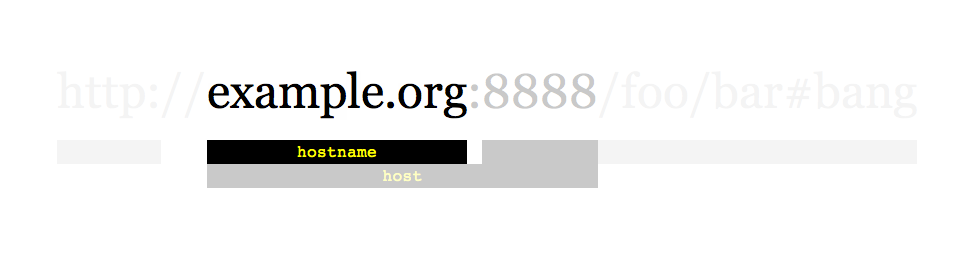
As shown in the example url above, the hostname is example.org. For simplicity sake, you may assume all urls use http protocol without any port specified. For example, the urls http://leetcode.com/problems and http://leetcode.com/contest are under the same hostname, while urls http://example.org/test and http://example.com/abc are not under the same hostname.
The HtmlParser interface is defined as such:
interface HtmlParser {
  // Return a list of all urls from a webpage of given url.
  public List<String> getUrls(String url);
}
Below are two examples explaining the functionality of the problem, for custom testing purposes you'll have three variables urls, edges and startUrl. Notice that you will only have access to startUrl in your code, while urls and edges are not directly accessible to you in code.
Note: Consider the same URL with the trailing slash "/" as a different URL. For example, "http://news.yahoo.com", and "http://news.yahoo.com/" are different urls.
Example 1:
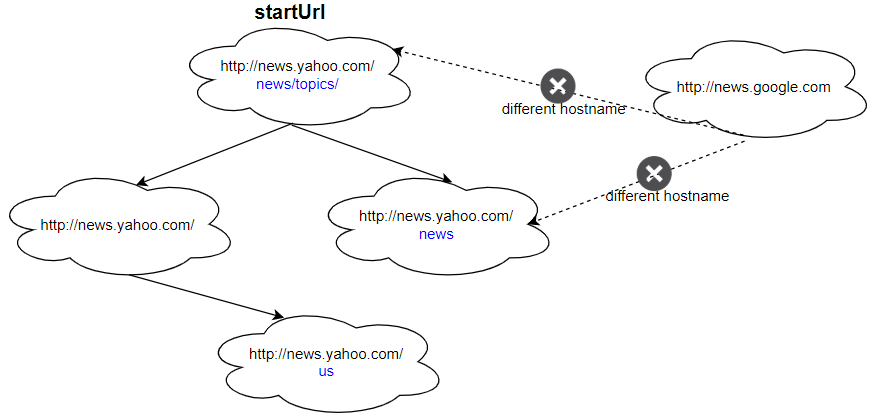
Input:
urls = [
  "http://news.yahoo.com",
  "http://news.yahoo.com/news",
  "http://news.yahoo.com/news/topics/",
  "http://news.google.com",
  "http://news.yahoo.com/us"
]
edges = [[2,0],[2,1],[3,2],[3,1],[0,4]]
startUrl = "http://news.yahoo.com/news/topics/"
Output: [
  "http://news.yahoo.com",
  "http://news.yahoo.com/news",
  "http://news.yahoo.com/news/topics/",
  "http://news.yahoo.com/us"
]
Example 2:

Input:
urls = [
  "http://news.yahoo.com",
  "http://news.yahoo.com/news",
  "http://news.yahoo.com/news/topics/",
  "http://news.google.com"
]
edges = [[0,2],[2,1],[3,2],[3,1],[3,0]]
startUrl = "http://news.google.com"
Output: ["http://news.google.com"]
Explanation: The startUrl links to all other pages that do not share the same hostname.
Constraints:
1 <= urls.length <= 10001 <= urls[i].length <= 300startUrlis one of theurls.- Hostname label must be from 1 to 63 characters long, including the dots, may contain only the ASCII letters from 'a' to 'z', digits from '0' to '9' and the hyphen-minus character ('-').
- The hostname may not start or end with the hyphen-minus character ('-').
- See: https://en.wikipedia.org/wiki/Hostname#Restrictions_on_valid_hostnames
- You may assume there're no duplicates in url library.
Approach Overview
Problem Overview: Starting from startUrl, crawl every reachable page that belongs to the same hostname. The only way to discover links is through the provided HtmlParser.getUrls(url) API, so the problem becomes a graph traversal where URLs are nodes and hyperlinks are edges.
Approach 1: Breadth-First Search (BFS) Traversal (Time: O(N + E), Space: O(N))
Treat each URL as a node in a graph. Use a queue to perform breadth-first search starting from startUrl. Extract the hostname from the starting URL, then repeatedly dequeue a URL, call getUrls, and enqueue any discovered link that shares the same hostname and hasn’t been visited. A set tracks visited URLs to avoid infinite loops caused by cyclic links. BFS is straightforward and processes pages level by level, which mirrors how many real crawlers explore the web.
Approach 2: Depth-First Search (DFS) Traversal (Time: O(N + E), Space: O(N))
Another option is recursive or iterative depth-first search. Start with startUrl, store the hostname, and recursively visit every neighbor returned by getUrls. Before visiting a URL, check two conditions: it matches the original hostname and it hasn’t been visited before. DFS explores one branch fully before moving to another, which keeps the implementation concise with recursion and a visited set. From a complexity standpoint, DFS and BFS are identical because each valid URL is processed once.
Hostname filtering is the key constraint. Extract the domain portion of the starting URL and compare it with each discovered link. This ensures the crawler never leaves the target site even if external links appear in the page list. Since URL comparison and hostname parsing involve string operations, efficient substring checks keep overhead minimal.
Recommended for interviews: Either BFS or DFS is acceptable since both run in O(N + E) time and O(N) space. BFS with a queue and visited set is the most commonly expected approach because it clearly demonstrates graph traversal fundamentals and avoids recursion depth concerns. Mentioning DFS as an alternative shows strong understanding of traversal patterns.
Complexity Analysis
| Approach | Time | Space | When to Use |
|---|---|---|---|
| Breadth-First Search (Queue) | O(N + E) | O(N) | General case. Preferred in interviews for clear level-by-level graph traversal. |
| Depth-First Search (Recursive/Stack) | O(N + E) | O(N) | Cleaner implementation with recursion when stack depth is manageable. |