
The Time When the Network Becomes Idle - Video Solutions
2039. The Time When the Network Becomes Idle (Leetcode Medium)
The Time When the Network Becomes Idle - Video Solution
Watch 2 video solutions for The Time When the Network Becomes Idle, a medium level problem involving Array, Breadth-First Search, Graph. This walkthrough by Programming Live with Larry has 2,022 views views. Want to try solving it yourself? Practice on FleetCode or read the detailed text solution.
Problem Statement
There is a network of n servers, labeled from 0 to n - 1. You are given a 2D integer array edges, where edges[i] = [ui, vi] indicates there is a message channel between servers ui and vi, and they can pass any number of messages to each other directly in one second. You are also given a 0-indexed integer array patience of length n.
All servers are connected, i.e., a message can be passed from one server to any other server(s) directly or indirectly through the message channels.
The server labeled 0 is the master server. The rest are data servers. Each data server needs to send its message to the master server for processing and wait for a reply. Messages move between servers optimally, so every message takes the least amount of time to arrive at the master server. The master server will process all newly arrived messages instantly and send a reply to the originating server via the reversed path the message had gone through.
At the beginning of second 0, each data server sends its message to be processed. Starting from second 1, at the beginning of every second, each data server will check if it has received a reply to the message it sent (including any newly arrived replies) from the master server:
- If it has not, it will resend the message periodically. The data server
iwill resend the message everypatience[i]second(s), i.e., the data serveriwill resend the message ifpatience[i]second(s) have elapsed since the last time the message was sent from this server. - Otherwise, no more resending will occur from this server.
The network becomes idle when there are no messages passing between servers or arriving at servers.
Return the earliest second starting from which the network becomes idle.
Example 1:
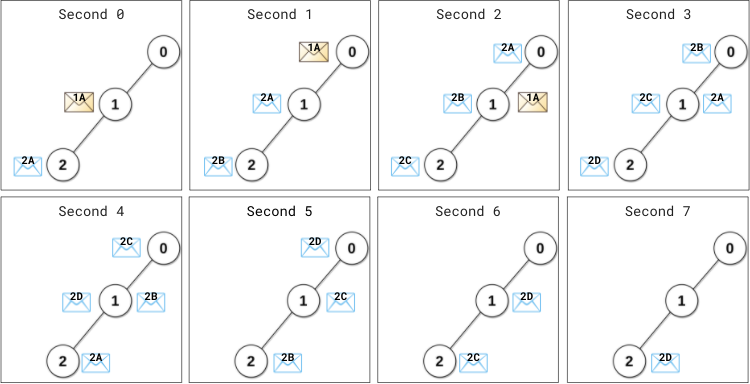
Input: edges = [[0,1],[1,2]], patience = [0,2,1]
Output: 8
Explanation:
At (the beginning of) second 0,
- Data server 1 sends its message (denoted 1A) to the master server.
- Data server 2 sends its message (denoted 2A) to the master server.

At second 1,
- Message 1A arrives at the master server. Master server processes message 1A instantly and sends a reply 1A back.
- Server 1 has not received any reply. 1 second (1 < patience[1] = 2) elapsed since this server has sent the message, therefore it does not resend the message.
- Server 2 has not received any reply. 1 second (1 == patience[2] = 1) elapsed since this server has sent the message, therefore it resends the message (denoted 2B).

At second 2,
- The reply 1A arrives at server 1. No more resending will occur from server 1.
- Message 2A arrives at the master server. Master server processes message 2A instantly and sends a reply 2A back.
- Server 2 resends the message (denoted 2C).
...
At second 4,
- The reply 2A arrives at server 2. No more resending will occur from server 2.
...
At second 7, reply 2D arrives at server 2.

Starting from the beginning of the second 8, there are no messages passing between servers or arriving at servers.
This is the time when the network becomes idle.
Example 2:
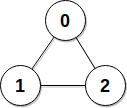
Input: edges = [[0,1],[0,2],[1,2]], patience = [0,10,10]
Output: 3
Explanation: Data servers 1 and 2 receive a reply back at the beginning of second 2.
From the beginning of the second 3, the network becomes idle.
Constraints:
n == patience.length2 <= n <= 105patience[0] == 01 <= patience[i] <= 105for1 <= i < n1 <= edges.length <= min(105, n * (n - 1) / 2)edges[i].length == 20 <= ui, vi < nui != vi- There are no duplicate edges.
- Each server can directly or indirectly reach another server.
Approach Overview
Problem Overview: You are given an undirected network of servers where server 0 is the main server. Every other server repeatedly sends messages to server 0 until it receives a reply. The task is to determine the earliest second when no messages are being transmitted anywhere in the network.
Approach 1: BFS to Find Shortest Path and Calculate Idle Time (O(n + m) time, O(n + m) space)
This approach models the system as a graph and computes the shortest distance from the main server to every other server using Breadth-First Search. Since each edge takes one second to traverse, the shortest path gives the minimum round-trip time for messages. For each server i, calculate the round-trip time 2 * dist[i]. If the server’s patience[i] is smaller than this round-trip time, the server resends messages periodically before receiving the reply. The last message sent is determined using ((roundTrip - 1) // patience[i]) * patience[i]. Add the round-trip time to that send moment to get the final reply arrival time. Track the maximum across all servers and add one second to determine when the network becomes idle. BFS works well here because the graph is unweighted and guarantees shortest paths efficiently.
Approach 2: DFS Mimicking BFS for Recursive Traversal (O(n + m) time, O(n + m) space)
This method performs a depth-first traversal while explicitly tracking distance levels from the root to mimic BFS behavior. The graph is stored using adjacency lists built from the edges array. During recursion, maintain the current distance from server 0 and propagate it through neighbors that have not been visited. Once distances are determined, apply the same resend timing formula used in the BFS solution to compute when the last reply arrives. Although DFS can compute distances, it requires careful handling to avoid revisiting nodes and does not naturally guarantee shortest paths unless the traversal is controlled level by level. In practice, BFS is cleaner for shortest-path problems in unweighted graph structures.
Recommended for interviews: The BFS shortest-path solution is the expected approach. Interviewers want to see that you immediately recognize the problem as an unweighted graph shortest-path scenario. Computing resend timing afterward shows understanding of message scheduling and arithmetic edge cases. A DFS-based implementation can work but is less intuitive; BFS demonstrates stronger mastery of graph traversal patterns commonly used in systems and networking problems.
Complexity Analysis
| Approach | Time | Space | When to Use |
|---|---|---|---|
| BFS Shortest Path + Idle Time Calculation | O(n + m) | O(n + m) | Best general solution for unweighted graphs where shortest path from a source is required |
| DFS Mimicking BFS Distance Tracking | O(n + m) | O(n + m) | Useful if implementing recursive traversal, though less natural than BFS for shortest paths |