
Sum of Matrix After Queries - Video Solutions
Leetcode Weekly contest 348 - Medium - Sum of Matrix After Queries
Sum of Matrix After Queries - Video Solution
Watch 10 video solutions for Sum of Matrix After Queries, a medium level problem involving Array, Hash Table. This walkthrough by Prakhar Agrawal has 2,143 views views. Want to try solving it yourself? Practice on FleetCode or read the detailed text solution.
Problem Statement
You are given an integer n and a 0-indexed 2D array queries where queries[i] = [typei, indexi, vali].
Initially, there is a 0-indexed n x n matrix filled with 0's. For each query, you must apply one of the following changes:
- if
typei == 0, set the values in the row withindexitovali, overwriting any previous values. - if
typei == 1, set the values in the column withindexitovali, overwriting any previous values.
Return the sum of integers in the matrix after all queries are applied.
Example 1:
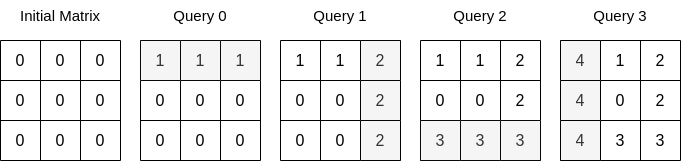
Input: n = 3, queries = [[0,0,1],[1,2,2],[0,2,3],[1,0,4]]
Output: 23
Explanation: The image above describes the matrix after each query. The sum of the matrix after all queries are applied is 23.
Example 2:
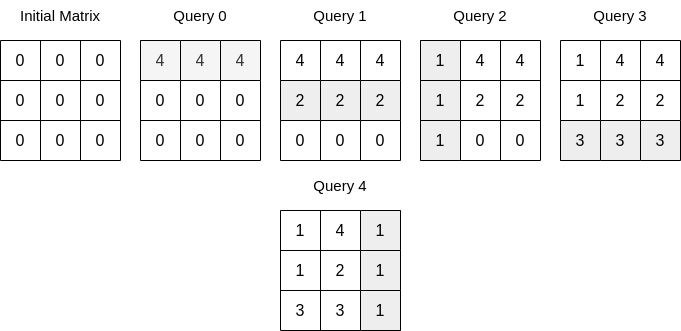
Input: n = 3, queries = [[0,0,4],[0,1,2],[1,0,1],[0,2,3],[1,2,1]]
Output: 17
Explanation: The image above describes the matrix after each query. The sum of the matrix after all queries are applied is 17.
Constraints:
1 <= n <= 1041 <= queries.length <= 5 * 104queries[i].length == 30 <= typei <= 10 <= indexi < n0 <= vali <= 105
Approach Overview
Problem Overview: You start with an n x n matrix filled with zeros. Each query assigns a value to an entire row or column. After processing all queries, return the total sum of the matrix. The challenge is avoiding an expensive full matrix update for every query.
Approach 1: Direct Simulation with Efficient Storage (O(q * n) time, O(n) space)
The straightforward strategy simulates each query as it appears. For a row assignment, iterate across all n columns and update the row values; for a column assignment, iterate through all rows. Instead of storing the entire matrix, you can maintain row and column structures that represent current values and compute contributions to the total sum while applying updates. This reduces memory overhead but still performs O(n) work per query. When the number of queries is small or n is limited, this approach is simple and easy to implement using basic array operations.
Approach 2: Optimized Reverse Simulation (O(q) time, O(n) space)
The key observation: the last assignment to a row or column determines the final value of its cells. Instead of simulating forward, iterate through the queries in reverse. Maintain two hash table or set structures: one for rows already processed and one for columns already processed. When you encounter a row assignment that hasn’t been processed yet, it contributes value * (n - processedCols) to the total because only columns not finalized will keep that value. Mark the row as processed. Similarly, a column assignment contributes value * (n - processedRows). This eliminates repeated overwrites and ensures each row and column is counted at most once.
Reverse simulation works because later queries override earlier ones. By processing from the end, you capture only the assignments that actually survive in the final matrix. The algorithm touches each query once and performs constant-time lookups using sets, which makes it highly scalable even when n and the query count are large.
Recommended for interviews: The reverse simulation approach is what interviewers expect. Writing the direct simulation first shows you understand the mechanics of the problem, but recognizing that only the last assignment matters demonstrates stronger algorithmic insight. Efficient tracking with sets and careful counting of remaining rows or columns leads to the optimal O(q) solution.
Complexity Analysis
| Approach | Time | Space | When to Use |
|---|---|---|---|
| Direct Simulation with Efficient Storage | O(q * n) | O(n) | When constraints are small or when implementing a quick baseline solution |
| Optimized Reverse Simulation | O(q) | O(n) | Best for large inputs where many queries overwrite previous updates |