
Reorder Routes to Make All Paths Lead to the City Zero - Video Solutions
Leetcode 1466 - REORDER ROUTES TO MAKE ALL PATHS LEAD TO THE CITY ZERO
Reorder Routes to Make All Paths Lead to the City Zero - Video Solution
Watch 10 video solutions for Reorder Routes to Make All Paths Lead to the City Zero, a medium level problem involving Depth-First Search, Breadth-First Search, Graph. This walkthrough by NeetCode has 62,215 views views. Want to try solving it yourself? Practice on FleetCode or read the detailed text solution.
Problem Statement
There are n cities numbered from 0 to n - 1 and n - 1 roads such that there is only one way to travel between two different cities (this network form a tree). Last year, The ministry of transport decided to orient the roads in one direction because they are too narrow.
Roads are represented by connections where connections[i] = [ai, bi] represents a road from city ai to city bi.
This year, there will be a big event in the capital (city 0), and many people want to travel to this city.
Your task consists of reorienting some roads such that each city can visit the city 0. Return the minimum number of edges changed.
It's guaranteed that each city can reach city 0 after reorder.
Example 1:
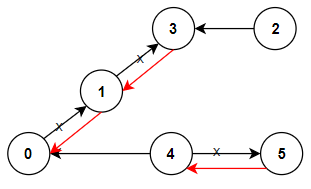
Input: n = 6, connections = [[0,1],[1,3],[2,3],[4,0],[4,5]]
Output: 3
Explanation: Change the direction of edges show in red such that each node can reach the node 0 (capital).
Example 2:

Input: n = 5, connections = [[1,0],[1,2],[3,2],[3,4]]
Output: 2
Explanation: Change the direction of edges show in red such that each node can reach the node 0 (capital).
Example 3:
Input: n = 3, connections = [[1,0],[2,0]]
Output: 0
Constraints:
2 <= n <= 5 * 104connections.length == n - 1connections[i].length == 20 <= ai, bi <= n - 1ai != bi
Approach Overview
Problem Overview: You are given n cities connected by n - 1 directed roads forming a tree. Some roads point away from city 0. The goal is to reverse the minimum number of roads so every city has a path leading to city 0. The core challenge is detecting which edges point in the wrong direction when traversing from the capital.
Approach 1: Depth First Search (DFS) with Edge Direction Tracking (O(n) time, O(n) space)
Convert the directed graph into an adjacency list that keeps track of edge directions. For each connection (u, v), store two entries: (u → v, needsReversal = 1) and (v → u, needsReversal = 0). This representation allows traversal in both directions while remembering whether the original edge pointed away from city 0. Start a DFS from node 0, visiting neighbors while avoiding the parent node. Each time DFS follows an edge marked with needsReversal = 1, increment the counter because that road must be reversed to allow travel toward the capital.
This works because the underlying structure is a tree, so every edge is visited exactly once. DFS naturally explores the entire graph while accumulating the number of incorrect directions. The approach relies on standard Depth-First Search traversal over a graph representation.
Approach 2: Breadth First Search (BFS) with Direction Flags (O(n) time, O(n) space)
The BFS approach uses the same adjacency representation but processes nodes level by level starting from city 0. Initialize a queue with node 0 and mark it visited. For each node dequeued, iterate through its neighbors. If the stored direction flag indicates the edge originally pointed away from the current node toward the neighbor, it must be reversed, so increment the counter.
Each neighbor is then added to the queue if it has not been visited. Because the graph is a tree with n - 1 edges, BFS visits each node once and inspects each edge once, resulting in linear time. This version is often easier to reason about when you prefer iterative traversal using a queue. It follows the classic pattern of Breadth-First Search on graphs while tracking edge orientation.
Recommended for interviews: Both DFS and BFS achieve the optimal O(n) time complexity since every node and edge is processed once. Interviewers typically expect the DFS solution because it is concise and demonstrates strong understanding of graph traversal and edge direction modeling. Showing the adjacency trick (storing both directions with a cost flag) demonstrates that you can convert a directed tree into a traversal-friendly structure. BFS is equally valid and often preferred in iterative implementations.
Complexity Analysis
| Approach | Time | Space | When to Use |
|---|---|---|---|
| DFS with Edge Direction Tracking | O(n) | O(n) | Most common interview solution. Concise recursion and natural tree traversal. |
| BFS with Direction Flags | O(n) | O(n) | Useful when preferring iterative traversal or avoiding recursion depth issues. |