
Rank Transform of a Matrix - Video Solutions
Leetcode 1632. Rank Transform of a Matrix
Rank Transform of a Matrix - Video Solution
Watch 10 video solutions for Rank Transform of a Matrix, a hard level problem involving Array, Union Find, Graph. This walkthrough by Fraz has 9,732 views views. Want to try solving it yourself? Practice on FleetCode or read the detailed text solution.
Problem Statement
Given an m x n matrix, return a new matrix answer where answer[row][col] is the rank of matrix[row][col].
The rank is an integer that represents how large an element is compared to other elements. It is calculated using the following rules:
- The rank is an integer starting from
1. - If two elements
pandqare in the same row or column, then:- If
p < qthenrank(p) < rank(q) - If
p == qthenrank(p) == rank(q) - If
p > qthenrank(p) > rank(q)
- If
- The rank should be as small as possible.
The test cases are generated so that answer is unique under the given rules.
Example 1:
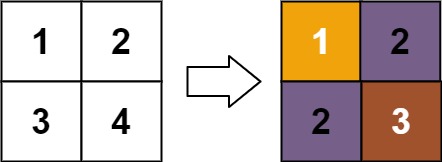
Input: matrix = [[1,2],[3,4]]
Output: [[1,2],[2,3]]
Explanation:
The rank of matrix[0][0] is 1 because it is the smallest integer in its row and column.
The rank of matrix[0][1] is 2 because matrix[0][1] > matrix[0][0] and matrix[0][0] is rank 1.
The rank of matrix[1][0] is 2 because matrix[1][0] > matrix[0][0] and matrix[0][0] is rank 1.
The rank of matrix[1][1] is 3 because matrix[1][1] > matrix[0][1], matrix[1][1] > matrix[1][0], and both matrix[0][1] and matrix[1][0] are rank 2.
Example 2:
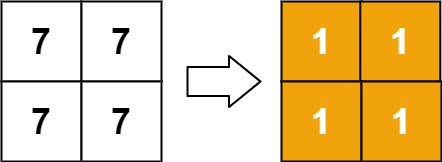
Input: matrix = [[7,7],[7,7]]
Output: [[1,1],[1,1]]
Example 3:
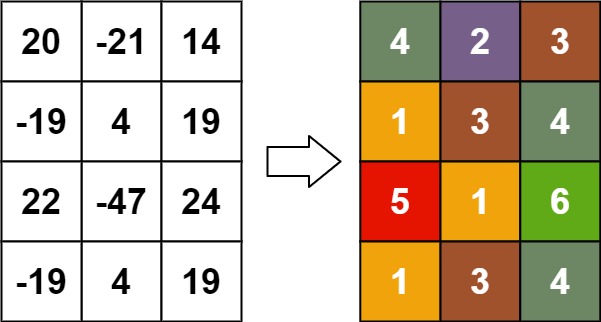
Input: matrix = [[20,-21,14],[-19,4,19],[22,-47,24],[-19,4,19]]
Output: [[4,2,3],[1,3,4],[5,1,6],[1,3,4]]
Constraints:
m == matrix.lengthn == matrix[i].length1 <= m, n <= 500-109 <= matrix[row][col] <= 109
Approach Overview
Problem Overview: Given an m x n matrix, assign a rank to every cell. A cell’s rank depends on its value relative to other cells in the same row or column. If two cells share the same value and are connected through rows or columns, they must receive the same rank. Larger values must receive strictly larger ranks than smaller ones within the same row or column.
Approach 1: Sorting Rows and Columns (O(mn log(mn)) time, O(mn) space)
Start by sorting all cells by value. Process values in increasing order so smaller elements establish rank constraints first. For each value group, inspect the maximum rank already assigned in its row and column, then assign rank = max(rowRank, colRank) + 1. Update row and column rank trackers after assigning ranks. This approach is straightforward but requires careful handling when multiple cells share the same value to avoid violating equality constraints. It relies mainly on sorting and row/column bookkeeping.
Approach 2: Coordinate Compression with Union-Find (O(mn log(mn)) time, O(mn) space)
Cells with the same value that share a row or column must have identical ranks. Build groups using Union-Find. For each distinct value, connect its row index and column index in a disjoint set. This forms components representing cells that must share rank. After grouping, compute the rank for each component using the maximum rank already assigned to involved rows and columns. Sorting the values ensures constraints propagate correctly from smaller numbers to larger ones. This approach handles equality relationships cleanly and is widely considered the canonical solution.
Approach 3: Union-Find and Coordinate Compression (O(mn log(mn)) time, O(mn) space)
Another implementation of the same core idea compresses row and column indices into a single coordinate space and unions them when a cell appears. Processing values in sorted order ensures dependencies are resolved first. Each connected component represents a set of equal-valued cells tied by row/column relations. Compute the component rank using previously recorded row and column maximum ranks. This variant simplifies mapping and improves implementation clarity when working with arrays and large matrices.
Approach 4: BFS Rank Propagation (O(mn log(mn)) time, O(mn) space)
Model the problem as a graph where nodes represent rows and columns. Cells with the same value create edges between their row and column nodes. For each value group, build connected components and run BFS to propagate the rank constraint across the component. The rank assigned equals one more than the maximum rank already present among participating rows and columns. This approach resembles graph traversal and sometimes appears alongside topological ordering explanations because ranks must respect dependency ordering.
Recommended for interviews: The Union-Find with coordinate compression approach is what most interviewers expect. It cleanly handles equal-value constraints and demonstrates strong understanding of disjoint sets and dependency ordering. A basic sorting-based attempt shows you understand the row/column rank rule, but the optimized Union-Find solution proves you can model relationships between matrix elements efficiently.
Complexity Analysis
| Approach | Time | Space | When to Use |
|---|---|---|---|
| Sorting Rows and Columns | O(mn log(mn)) | O(mn) | Good for understanding the ranking rule and dependency ordering before introducing union-find. |
| Coordinate Compression with Union-Find | O(mn log(mn)) | O(mn) | Best general solution when equal values must share ranks across rows and columns. |
| Union-Find and Coordinate Compression | O(mn log(mn)) | O(mn) | Cleaner implementation when mapping rows and columns into a single union-find structure. |
| BFS Rank Propagation | O(mn log(mn)) | O(mn) | Useful when modeling the problem as a graph and propagating rank constraints through components. |