
Populating Next Right Pointers in Each Node II - Video Solutions
Populating Next Right Pointers in Each Node II | Live Coding with Explanation | Leetcode - 117
Populating Next Right Pointers in Each Node II - Video Solution
Watch 10 video solutions for Populating Next Right Pointers in Each Node II, a medium level problem involving Linked List, Tree, Depth-First Search. This walkthrough by Algorithms Made Easy has 27,361 views views. Want to try solving it yourself? Practice on FleetCode or read the detailed text solution.
Problem Statement
Given a binary tree
struct Node {
  int val;
  Node *left;
  Node *right;
  Node *next;
}
Populate each next pointer to point to its next right node. If there is no next right node, the next pointer should be set to NULL.
Initially, all next pointers are set to NULL.
Example 1:
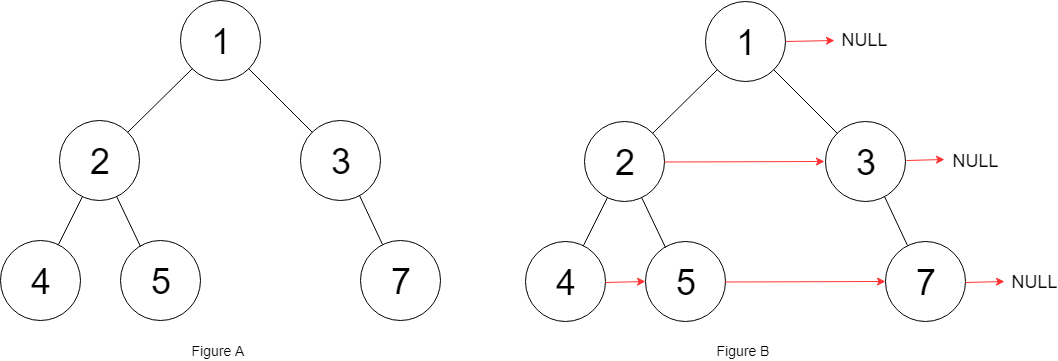
Input: root = [1,2,3,4,5,null,7]
Output: [1,#,2,3,#,4,5,7,#]
Explanation: Given the above binary tree (Figure A), your function should populate each next pointer to point to its next right node, just like in Figure B. The serialized output is in level order as connected by the next pointers, with '#' signifying the end of each level.
Example 2:
Input: root = []
Output: []
Constraints:
- The number of nodes in the tree is in the range
[0, 6000]. -100 <= Node.val <= 100
Follow-up:
- You may only use constant extra space.
- The recursive approach is fine. You may assume implicit stack space does not count as extra space for this problem.
Approach Overview
Problem Overview: You are given a binary tree where each node contains an extra next pointer. The task is to connect every node to its immediate neighbor on the same level. If there is no neighbor, the next pointer should be set to null. Unlike the simpler version of the problem, the tree is not guaranteed to be perfect, so children may appear in any structure.
Approach 1: Level Order Traversal Using a Queue (O(n) time, O(n) space)
This approach performs a standard Breadth-First Search level traversal. Push the root into a queue, then process nodes level by level. For each level, iterate through the nodes currently in the queue and connect the previous node's next pointer to the current node. Children of the current node are pushed into the queue so the next level can be processed afterward. Because every node is visited exactly once, the time complexity is O(n). The queue may hold up to the maximum width of the tree, giving O(n) worst-case space complexity.
This method is straightforward and mirrors how levels are naturally processed in a binary tree. It is often the first solution developers implement because the logic is simple: track the previous node in the level and link it to the current one.
Approach 2: Using Constant Space (Two Pointers) (O(n) time, O(1) extra space)
The optimized solution eliminates the queue by using the already established next pointers to traverse levels. Maintain two pointers: one for scanning the current level and another for building the next level. A temporary dummy node acts as the head of the next level while a tail pointer attaches children as they are discovered.
Start with the root as the current level. Iterate through nodes using their next pointers. Whenever a node has a left or right child, attach it to the tail of the next-level chain and advance the tail pointer. Once the current level is finished, move to dummy.next, which represents the start of the next level, and repeat the process.
This technique effectively performs a level traversal without extra storage. Each node is processed once, so the time complexity remains O(n). Since only a few pointers are used regardless of tree size, the auxiliary space complexity is O(1). The idea resembles pointer-based traversal patterns often seen in DFS style tree problems, but applied level-by-level.
Recommended for interviews: Start with the queue-based BFS explanation because it clearly demonstrates how level connections work. Then transition to the constant-space two-pointer approach. Interviewers typically expect the O(1) extra space solution since it shows strong understanding of pointer manipulation and tree traversal patterns.
Complexity Analysis
| Approach | Time | Space | When to Use |
|---|---|---|---|
| Level Order Traversal Using Queue | O(n) | O(n) | Best when clarity matters. Easy to implement and reason about during interviews. |
| Constant Space Two-Pointer Traversal | O(n) | O(1) | Preferred in interviews when minimizing auxiliary space is required. |