
Number of Ways to Arrive at Destination - Video Solutions
G-40. Number of Ways to Arrive at Destination
Number of Ways to Arrive at Destination - Video Solution
Watch 10 video solutions for Number of Ways to Arrive at Destination, a medium level problem involving Dynamic Programming, Graph, Topological Sort. This walkthrough by take U forward has 244,242 views views. Want to try solving it yourself? Practice on FleetCode or read the detailed text solution.
Problem Statement
You are in a city that consists of n intersections numbered from 0 to n - 1 with bi-directional roads between some intersections. The inputs are generated such that you can reach any intersection from any other intersection and that there is at most one road between any two intersections.
You are given an integer n and a 2D integer array roads where roads[i] = [ui, vi, timei] means that there is a road between intersections ui and vi that takes timei minutes to travel. You want to know in how many ways you can travel from intersection 0 to intersection n - 1 in the shortest amount of time.
Return the number of ways you can arrive at your destination in the shortest amount of time. Since the answer may be large, return it modulo 109 + 7.
Example 1:
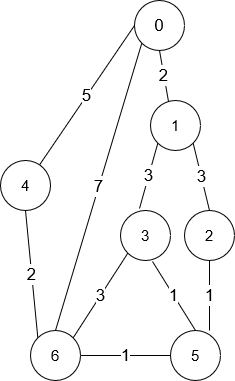
Input: n = 7, roads = [[0,6,7],[0,1,2],[1,2,3],[1,3,3],[6,3,3],[3,5,1],[6,5,1],[2,5,1],[0,4,5],[4,6,2]]
Output: 4
Explanation: The shortest amount of time it takes to go from intersection 0 to intersection 6 is 7 minutes.
The four ways to get there in 7 minutes are:
- 0 ➝ 6
- 0 ➝ 4 ➝ 6
- 0 ➝ 1 ➝ 2 ➝ 5 ➝ 6
- 0 ➝ 1 ➝ 3 ➝ 5 ➝ 6
Example 2:
Input: n = 2, roads = [[1,0,10]]
Output: 1
Explanation: There is only one way to go from intersection 0 to intersection 1, and it takes 10 minutes.
Constraints:
1 <= n <= 200n - 1 <= roads.length <= n * (n - 1) / 2roads[i].length == 30 <= ui, vi <= n - 11 <= timei <= 109ui != vi- There is at most one road connecting any two intersections.
- You can reach any intersection from any other intersection.
Approach Overview
Problem Overview: Given n intersections and bidirectional roads with travel times, compute how many distinct ways you can reach node n-1 from node 0 using the minimum total time. The graph can contain multiple routes, but only paths with the shortest distance count. The result must be returned modulo 1e9 + 7.
Approach 1: Dijkstra's Algorithm with Path Counting (Time: O(E log V), Space: O(V + E))
This approach combines classic shortest path computation with dynamic counting of paths. Use an adjacency list and a min-heap priority queue to run Dijkstra from node 0. Maintain two arrays: dist[i] for the shortest distance to node i, and ways[i] for the number of shortest paths reaching that node. When relaxing an edge, update normally if a strictly shorter distance is found and copy the path count from the parent. If another path reaches the same node with the exact same shortest distance, add the parent’s path count instead of replacing it. This effectively layers a dynamic programming idea on top of Dijkstra. The priority queue ensures nodes are processed in increasing distance order, which guarantees correctness for weighted graphs with non‑negative edges.
Approach 2: Bellman-Ford Adaptation (Time: O(V * E), Space: O(V))
Another way to compute shortest paths is the Bellman-Ford relaxation process. Iterate over all edges up to V-1 times, updating distances similarly to standard Bellman-Ford. Alongside the distance array, track a ways[] array storing the number of shortest routes to each node. When a relaxation produces a smaller distance, copy the path count from the source node; when it produces the same distance, add the counts. This approach works even if the algorithm repeatedly revisits nodes because the relaxations converge toward the minimum distance. The drawback is performance: iterating over every edge for each pass makes it significantly slower than heap-based methods for dense graphs.
Recommended for interviews: The expected solution uses Dijkstra with path counting. Interviewers want to see that you recognize the problem as a weighted graph shortest-path problem and augment the algorithm to track the number of optimal routes. Starting from brute reasoning about shortest paths is fine, but implementing the heap-based solution demonstrates strong algorithmic intuition and efficient handling of weighted graphs.
Complexity Analysis
| Approach | Time | Space | When to Use |
|---|---|---|---|
| Dijkstra's Algorithm with Path Counting | O(E log V) | O(V + E) | Best choice for weighted graphs with non-negative edges. Efficient and commonly expected in interviews. |
| Bellman-Ford Adaptation | O(V * E) | O(V) | Useful when demonstrating relaxation-based shortest path logic or when negative edges are possible. |