
Number of Closed Islands - Video Solutions
Number of Closed Islands - Leetcode 1254 - Python
Number of Closed Islands - Video Solution
Watch 10 video solutions for Number of Closed Islands, a medium level problem involving Array, Depth-First Search, Breadth-First Search. This walkthrough by NeetCodeIO has 25,050 views views. Want to try solving it yourself? Practice on FleetCode or read the detailed text solution.
Problem Statement
Given a 2D grid consists of 0s (land) and 1s (water). An island is a maximal 4-directionally connected group of 0s and a closed island is an island totally (all left, top, right, bottom) surrounded by 1s.
Return the number of closed islands.
Example 1:
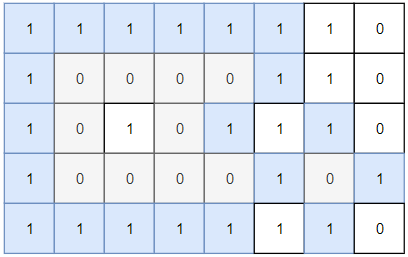
Input: grid = [[1,1,1,1,1,1,1,0],[1,0,0,0,0,1,1,0],[1,0,1,0,1,1,1,0],[1,0,0,0,0,1,0,1],[1,1,1,1,1,1,1,0]]
Output: 2
Explanation:
Islands in gray are closed because they are completely surrounded by water (group of 1s).
Example 2:
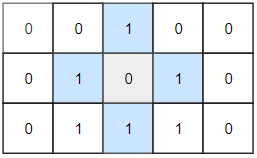
Input: grid = [[0,0,1,0,0],[0,1,0,1,0],[0,1,1,1,0]]
Output: 1
Example 3:
Input: grid = [[1,1,1,1,1,1,1],
               [1,0,0,0,0,0,1],
               [1,0,1,1,1,0,1],
               [1,0,1,0,1,0,1],
               [1,0,1,1,1,0,1],
               [1,0,0,0,0,0,1],
               [1,1,1,1,1,1,1]]
Output: 2
Constraints:
1 <= grid.length, grid[0].length <= 1000 <= grid[i][j] <=1
Approach Overview
Problem Overview: You are given a 2D grid where 0 represents land and 1 represents water. A closed island is a group of land cells completely surrounded by water and not touching the grid boundary. The task is to count how many such islands exist.
Approach 1: Depth-First Search (DFS) with Edge Checking (Time: O(m*n), Space: O(m*n))
This approach treats the grid as a graph and performs a DFS traversal from every unvisited land cell. During the DFS, you recursively explore four directions (up, down, left, right) and mark cells as visited. If any part of the island touches the grid boundary, the island cannot be closed. The key idea is to propagate a boolean flag during recursion that tracks whether the exploration ever reaches the edge. After the traversal finishes, only islands that never touched the boundary are counted. DFS works well because it naturally explores connected components in a matrix using Depth-First Search. This approach is concise and commonly expected in interviews.
Approach 2: Breadth-First Search (BFS) with Queue (Time: O(m*n), Space: O(m*n))
The BFS solution follows the same connected-component idea but replaces recursion with an explicit queue. When you find an unvisited land cell, push it into a queue and perform level-order exploration across its neighbors. While processing cells, track whether any coordinate lies on the boundary. If the component touches the grid edge, mark the island as open; otherwise, increment the closed island count after the traversal completes. BFS avoids recursion depth issues and can be easier to reason about in large grids. This method uses Breadth-First Search for systematic exploration and is equally optimal in terms of complexity.
Recommended for interviews: DFS with edge checking is usually the fastest to implement and easier to explain during interviews. It demonstrates your understanding of connected components in grids and recursive traversal. BFS is equally correct and useful when recursion depth might be a concern. Interviewers mainly expect you to recognize the problem as a graph traversal on a grid and solve it using DFS or BFS flood fill.
Complexity Analysis
| Approach | Time | Space | When to Use |
|---|---|---|---|
| Depth-First Search (DFS) with Edge Checking | O(m*n) | O(m*n) | Best general solution. Simple recursion for exploring connected land cells. |
| Breadth-First Search (BFS) with Queue | O(m*n) | O(m*n) | Useful when avoiding recursion or handling very deep grids. |