
Minimum Number of Flips to Make Binary Grid Palindromic II - Video Solutions
DP Solution | Minimum Number of Flips to Make Binary Grid Palindromic II | With Examples
Minimum Number of Flips to Make Binary Grid Palindromic II - Video Solution
Watch 10 video solutions for Minimum Number of Flips to Make Binary Grid Palindromic II, a medium level problem involving Array, Two Pointers, Matrix. This walkthrough by CodeNow - By Gopal Gupta has 1,270 views views. Want to try solving it yourself? Practice on FleetCode or read the detailed text solution.
Problem Statement
You are given an m x n binary matrix grid.
A row or column is considered palindromic if its values read the same forward and backward.
You can flip any number of cells in grid from 0 to 1, or from 1 to 0.
Return the minimum number of cells that need to be flipped to make all rows and columns palindromic, and the total number of 1's in grid divisible by 4.
Example 1:
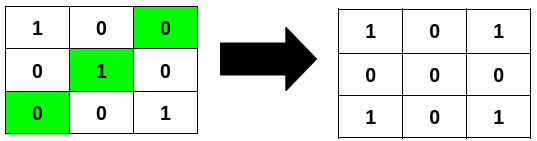
Input: grid = [[1,0,0],[0,1,0],[0,0,1]]
Output: 3
Explanation:
Example 2:
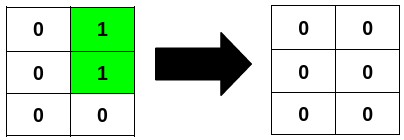
Input: grid = [[0,1],[0,1],[0,0]]
Output: 2
Explanation:
Example 3:
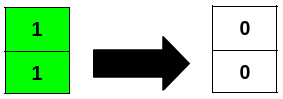
Input: grid = [[1],[1]]
Output: 2
Explanation:
Constraints:
m == grid.lengthn == grid[i].length1 <= m * n <= 2 * 1050 <= grid[i][j] <= 1
Approach Overview
Problem Overview: You are given a binary m x n grid. The goal is to flip the minimum number of cells so the grid becomes palindromic with respect to both horizontal and vertical symmetry constraints. Cells that mirror each other across the center must end up with the same value.
Approach 1: Symmetric Mirroring Method (O(m*n) time, O(1) space)
The key observation is that four cells linked by horizontal and vertical symmetry must share the same value. For any position (i, j), its mirrored group contains (i, j), (i, n-1-j), (m-1-i, j), and (m-1-i, n-1-j). Count how many of these are 1s and 0s, then flip the minority to match the majority. Iterate only through the top-left quadrant to avoid double counting. When the grid has a middle row or column, handle those symmetric pairs separately.
Approach 2: Grid Sweeping with Minimum Operations (O(m*n) time, O(1) space)
This approach sweeps the grid while evaluating symmetric constraints directly. For each cell group determined by reflection across the center, compute the minimum number of flips required to make the values equal. The sweep processes four-cell groups first, then two-cell groups in the middle row or column when dimensions are odd. The algorithm accumulates the minimal operations during traversal without additional storage, which keeps space usage constant.
Approach 3: Mirror-based Flip Strategy (O(m*n) time, O(1) space)
This strategy explicitly models the mirror relationships using index arithmetic. For every symmetric group, count the number of 1s and determine the minimal flips needed to make the group uniform. Groups of four cost min(ones, 4 - ones) flips. Special handling is required for the center cell (when both dimensions are odd) and for pairs along the middle row or column. The approach is simple to implement and works well with Array traversal and Matrix index manipulation.
Approach 4: Bit Manipulation for Divisibility Adjustment (O(m*n) time, O(1) space)
After processing symmetric groups, some implementations enforce additional parity constraints using bit manipulation. Counts of ones in special symmetric regions are adjusted so the resulting configuration satisfies divisibility conditions derived from mirror symmetry. Bitwise checks make these adjustments efficient. This method is mainly useful when implementing the solution in low-level languages and optimizing constant factors.
Recommended for interviews: The mirror-based grouping solution is what most interviewers expect. Start by explaining the symmetry insight: every cell belongs to a mirrored group of size four or two. Demonstrating the brute reasoning about symmetry shows understanding, while implementing the O(m*n) mirror strategy proves you can translate the observation into an efficient algorithm using simple Two Pointers-style mirrored indexing.
Complexity Analysis
| Approach | Time | Space | When to Use |
|---|---|---|---|
| Symmetric Mirroring Method | O(m*n) | O(1) | Best general solution using symmetric cell groups |
| Grid Sweeping with Minimum Operations | O(m*n) | O(1) | Simple traversal when implementing minimal flip counting directly |
| Mirror-based Flip Strategy | O(m*n) | O(1) | Most common interview implementation using mirror index pairs |
| Bit Manipulation for Divisibility Adjustment | O(m*n) | O(1) | Low-level optimization and parity adjustments in symmetric regions |