3240. Minimum Number of Flips to Make Binary Grid Palindromic II
You are given an m x n binary matrix grid.
A row or column is considered palindromic if its values read the same forward and backward.
You can flip any number of cells in grid from 0 to 1, or from 1 to 0.
Return the minimum number of cells that need to be flipped to make all rows and columns palindromic, and the total number of 1's in grid divisible by 4.
Example 1:
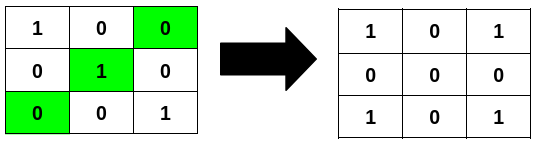
Input: grid = [[1,0,0],[0,1,0],[0,0,1]]
Output: 3
Explanation:
Example 2:
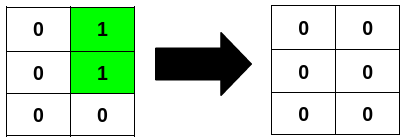
Input: grid = [[0,1],[0,1],[0,0]]
Output: 2
Explanation:
Example 3:
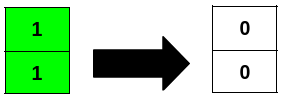
Input: grid = [[1],[1]]
Output: 2
Explanation:
Constraints:
m == grid.lengthn == grid[i].length1 <= m * n <= 2 * 1050 <= grid[i][j] <= 1
Asked at 1 company
 Google
Topics
Hints open one at a time
Hint 1
For each
(x, y), find (m - 1 - x, y), (m - 1 - x, n - 1 - y), and (x, n - 1 - y); they should be the same.Hint 2
Note that we need to specially handle the middle row (column) if the number of rows (columns) is odd.
Loading editor…
1class Solution:
2 def minFlips(self, grid: List[List[int]]) -> int:
3
Starter codePython 3Spaces: 4
Loading editor…
1class Solution:
2 def minFlips(self, grid: List[List[int]]) -> int:
3
Starter codePython 3Spaces: 4
Examples
Input
[[1,0,0],[0,1,0],[0,0,1]]
Input
[[0,1],[0,1],[0,0]]
Input
[[1],[1]]
Your code is saved on this device.Solution