
Minimum Absolute Difference in BST - Video Solutions
Minimum Absolute Difference in BST - Leetcode 530 - Trees (Python)
Minimum Absolute Difference in BST - Video Solution
Watch 10 video solutions for Minimum Absolute Difference in BST, a easy level problem involving Tree, Depth-First Search, Breadth-First Search. This walkthrough by Greg Hogg has 11,763 views views. Want to try solving it yourself? Practice on FleetCode or read the detailed text solution.
Problem Statement
Given the root of a Binary Search Tree (BST), return the minimum absolute difference between the values of any two different nodes in the tree.
Example 1:
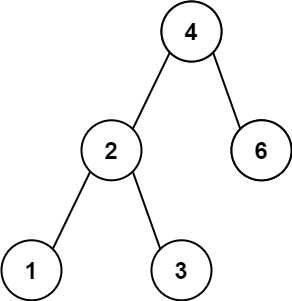
Input: root = [4,2,6,1,3]
Output: 1
Example 2:
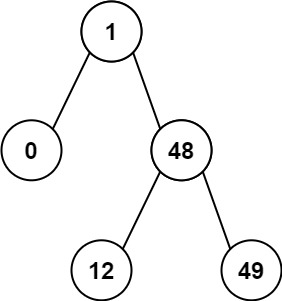
Input: root = [1,0,48,null,null,12,49]
Output: 1
Constraints:
- The number of nodes in the tree is in the range
[2, 104]. 0 <= Node.val <= 105
Note: This question is the same as 783: https://leetcode.com/problems/minimum-distance-between-bst-nodes/
Approach Overview
Problem Overview: You are given the root of a Binary Search Tree and must return the minimum absolute difference between values of any two different nodes. Because the tree follows BST ordering rules, an efficient solution relies on processing node values in sorted order.
Approach 1: In-order Traversal Using Stack (Time: O(n), Space: O(h))
A Binary Search Tree produces values in sorted order when visited using in-order traversal (left → node → right). Instead of recursion, this approach uses an explicit stack to simulate the traversal. As you iterate through nodes, track the value of the previously visited node. The minimum absolute difference must occur between two adjacent values in the sorted sequence, so compute current.val - prev at each step and update the minimum.
The algorithm repeatedly pushes left children onto the stack, pops the next node to process, then moves to the right subtree. Each node is visited exactly once. This makes the time complexity O(n), where n is the number of nodes. The stack stores at most the height of the tree, giving O(h) auxiliary space. Use this version when you want an iterative solution or when recursion depth might be a concern.
Approach 2: Recursive In-order Traversal (Time: O(n), Space: O(h))
This version performs the same sorted traversal but relies on recursion instead of a manual stack. The recursion explores the left subtree, processes the current node, then explores the right subtree. Maintain two variables across calls: the previously visited value and the global minimum difference. Each time the traversal visits a node, compare it with the previous value and update the minimum difference.
The key insight is identical: in a BST, the smallest difference always occurs between two consecutive values in the sorted in-order sequence. Because each node is visited once, the runtime is O(n). The recursion stack grows up to the tree height, so space complexity is O(h). This version is concise and commonly used in interview explanations when discussing Depth-First Search on trees.
Both approaches rely on the ordering property of a tree structured as a BST. Instead of comparing every pair of nodes, which would take O(n²), you only compare neighbors in the sorted traversal order.
Recommended for interviews: The recursive in-order traversal is the most common explanation because it clearly demonstrates how BST ordering reduces the problem to comparing adjacent values. Interviewers often accept either version, but showing the stack-based implementation proves you understand how recursion works under the hood.
Complexity Analysis
| Approach | Time | Space | When to Use |
|---|---|---|---|
| In-order Traversal Using Stack | O(n) | O(h) | When you prefer an iterative solution or want to avoid recursion depth limits. |
| Recursive In-order Traversal | O(n) | O(h) | Most common interview explanation; concise and easy to implement for BST problems. |