
Maximum Profit from Trading Stocks with Discounts - Video Solutions
Maximum Profit from Trading Stocks with Discounts | Super Detailed | Beginner | Leetcode 3562 | MIK
Maximum Profit from Trading Stocks with Discounts - Video Solution
Watch 10 video solutions for Maximum Profit from Trading Stocks with Discounts, a hard level problem involving Array, Dynamic Programming, Tree. This walkthrough by codestorywithMIK has 7,444 views views. Want to try solving it yourself? Practice on FleetCode or read the detailed text solution.
Problem Statement
You are given an integer n, representing the number of employees in a company. Each employee is assigned a unique ID from 1 to n, and employee 1 is the CEO, is the direct or indirect boss of every employee. You are given two 1-based integer arrays, present and future, each of length n, where:
present[i]represents the current price at which theithemployee can buy a stock today.future[i]represents the expected price at which theithemployee can sell the stock tomorrow.
The company's hierarchy is represented by a 2D integer array hierarchy, where hierarchy[i] = [ui, vi] means that employee ui is the direct boss of employee vi.
Additionally, you have an integer budget representing the total funds available for investment.
However, the company has a discount policy: if an employee's direct boss purchases their own stock, then the employee can buy their stock at half the original price (floor(present[v] / 2)).
Return the maximum profit that can be achieved without exceeding the given budget.
Note:
- You may buy each stock at most once.
- You cannot use any profit earned from future stock prices to fund additional investments and must buy only from
budget.
Example 1:
Input: n = 2, present = [1,2], future = [4,3], hierarchy = [[1,2]], budget = 3
Output: 5
Explanation:

- Employee 1 buys the stock at price 1 and earns a profit of
4 - 1 = 3. - Since Employee 1 is the direct boss of Employee 2, Employee 2 gets a discounted price of
floor(2 / 2) = 1. - Employee 2 buys the stock at price 1 and earns a profit of
3 - 1 = 2. - The total buying cost is
1 + 1 = 2 <= budget. Thus, the maximum total profit achieved is3 + 2 = 5.
Example 2:
Input: n = 2, present = [3,4], future = [5,8], hierarchy = [[1,2]], budget = 4
Output: 4
Explanation:
- Employee 2 buys the stock at price 4 and earns a profit of
8 - 4 = 4. - Since both employees cannot buy together, the maximum profit is 4.
Example 3:
Input: n = 3, present = [4,6,8], future = [7,9,11], hierarchy = [[1,2],[1,3]], budget = 10
Output: 10
Explanation:
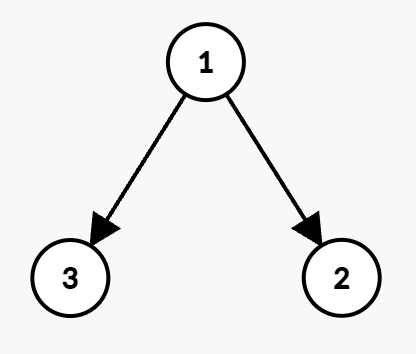
- Employee 1 buys the stock at price 4 and earns a profit of
7 - 4 = 3. - Employee 3 would get a discounted price of
floor(8 / 2) = 4and earns a profit of11 - 4 = 7. - Employee 1 and Employee 3 buy their stocks at a total cost of
4 + 4 = 8 <= budget. Thus, the maximum total profit achieved is3 + 7 = 10.
Example 4:
Input: n = 3, present = [5,2,3], future = [8,5,6], hierarchy = [[1,2],[2,3]], budget = 7
Output: 12
Explanation:
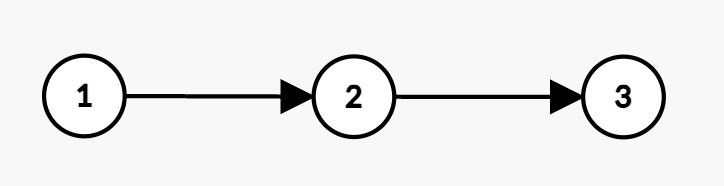
- Employee 1 buys the stock at price 5 and earns a profit of
8 - 5 = 3. - Employee 2 would get a discounted price of
floor(2 / 2) = 1and earns a profit of5 - 1 = 4. - Employee 3 would get a discounted price of
floor(3 / 2) = 1and earns a profit of6 - 1 = 5. - The total cost becomes
5 + 1 + 1 = 7 <= budget. Thus, the maximum total profit achieved is3 + 4 + 5 = 12.
Constraints:
1 <= n <= 160present.length, future.length == n1 <= present[i], future[i] <= 50hierarchy.length == n - 1hierarchy[i] == [ui, vi]1 <= ui, vi <= nui != vi1 <= budget <= 160- There are no duplicate edges.
- Employee 1 is the direct or indirect boss of every employee.
- The input graph
hierarchyis guaranteed to have no cycles.
Approach Overview
Problem Overview: You are given a company structure represented as a tree where each employee can buy a stock. Each stock has a cost and expected profit, and some employees receive a discount if their manager buys first. The goal is to choose which employees buy stocks so the total profit is maximized while respecting the dependency between managers and subordinates.
Approach 1: Brute Force Subset Exploration (Exponential Time)
The most direct way is to try every combination of employees who buy stocks. For each subset, verify whether discount rules apply and compute the resulting profit. This requires iterating through all possible buy/not-buy states and recalculating costs depending on whether a parent in the management tree purchased the stock. The approach quickly becomes infeasible because the number of states grows exponentially with the number of employees. Time complexity is O(2^n) and space complexity is O(n) for recursion.
Approach 2: DFS with Memoization (Top-Down Tree DP) (O(n))
The dependency only exists between a node and its parent, which means the company hierarchy forms a natural tree dynamic programming structure. Run a depth-first search from the root and maintain two states for every node: profit when the employee buys the stock and profit when they do not. If the parent buys, the child may purchase at a discounted cost; otherwise the normal cost applies. During DFS, aggregate results from all children and store computed states in a DP table to avoid recomputation.
The transition is straightforward. When an employee buys, calculate their profit using the correct price (discounted or full) and add the best outcome from each child depending on whether that child benefits from the discount. When they skip buying, children evaluate independently using the non-discount state. Because each node is processed once and each edge is traversed once, the algorithm runs in O(n) time with O(n) space for recursion and DP storage.
Approach 3: Bottom-Up Tree Dynamic Programming (O(n))
A bottom-up version computes the same states but aggregates results while returning from DFS calls. Each node returns a pair [notBuy, buy]. While combining child results, you accumulate the maximum profit contribution from each subtree depending on the parent decision. This avoids repeated state checks and keeps transitions localized to the recursion stack. The algorithm still runs in O(n) time and uses O(n) space for the adjacency list and recursion.
Recommended for interviews: Interviewers expect the tree DP formulation using DFS. Explaining the brute force first shows you understand the decision space. Transitioning to a two-state DP on a dynamic programming tree demonstrates the key optimization and reduces exponential exploration to linear time.
Complexity Analysis
| Approach | Time | Space | When to Use |
|---|---|---|---|
| Brute Force Subset Enumeration | O(2^n) | O(n) | Only for understanding the decision space or very small inputs |
| DFS with Memoization (Top-Down Tree DP) | O(n) | O(n) | General case when the company hierarchy forms a tree and parent decisions affect children |
| Bottom-Up Tree Dynamic Programming | O(n) | O(n) | Preferred implementation for clean DFS aggregation and interview solutions |