
Largest BST Subtree - Video Solutions
Largest BST Subtree - Solution | Binary Trees | Data Structure and Algorithms in JAVA
Largest BST Subtree - Video Solution
Watch 10 video solutions for Largest BST Subtree, a medium level problem involving Dynamic Programming, Tree, Depth-First Search. This walkthrough by Pepcoding has 22,887 views views. Want to try solving it yourself? Practice on FleetCode or read the detailed text solution.
Problem Statement
Given the root of a binary tree, find the largest subtree, which is also a Binary Search Tree (BST), where the largest means subtree has the largest number of nodes.
A Binary Search Tree (BST) is a tree in which all the nodes follow the below-mentioned properties:
- The left subtree values are less than the value of their parent (root) node's value.
- The right subtree values are greater than the value of their parent (root) node's value.
Note: A subtree must include all of its descendants.
Example 1:
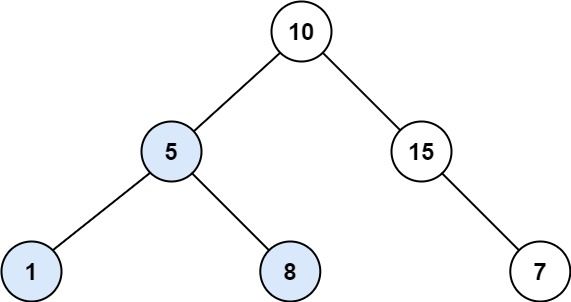
Input: root = [10,5,15,1,8,null,7]
Output: 3
Explanation: The Largest BST Subtree in this case is the highlighted one. The return value is the subtree's size, which is 3.
Example 2:
Input: root = [4,2,7,2,3,5,null,2,null,null,null,null,null,1]
Output: 2
Constraints:
- The number of nodes in the tree is in the range
[0, 104]. -104 <= Node.val <= 104
Follow up: Can you figure out ways to solve it with O(n) time complexity?
Approach Overview
Problem Overview: You are given a binary tree that is not necessarily a binary search tree. The task is to find the size (number of nodes) of the largest subtree that satisfies the Binary Search Tree property. A subtree counts only if every node inside it follows the BST rule: left values are smaller and right values are larger.
Approach 1: Validate Every Subtree (Brute Force) (Time: O(n^2), Space: O(h))
The direct idea is to treat every node as the root of a potential BST. For each node, run a validation check to confirm whether the subtree rooted at that node satisfies BST rules. The validation function recursively ensures left < root < right while computing the subtree size. If the subtree is valid, update the global maximum size. Because each validation may traverse many nodes repeatedly, the worst-case complexity becomes O(n^2) when the tree is skewed. Space complexity is O(h) due to recursion depth. This approach is straightforward but inefficient for large trees.
Approach 2: Postorder DFS with Subtree Metadata (Optimal) (Time: O(n), Space: O(h))
The optimal solution uses a single postorder traversal from the leaves upward. Each DFS call returns metadata about the current subtree: whether it forms a BST, its size, and the minimum and maximum values inside it. While returning from recursion, you combine the results from the left and right children. A subtree is a valid BST if the left and right subtrees are BSTs and left.max < node.val < right.min. When this condition holds, the subtree size becomes left.size + right.size + 1, and the min/max boundaries are updated accordingly.
If the condition fails, the subtree is marked invalid so its parent cannot treat it as part of a BST. During traversal you maintain a global maximum representing the largest valid BST encountered so far. Each node is processed exactly once, giving O(n) time complexity and O(h) space for recursion. This technique is a classic combination of Depth-First Search and bottom-up state aggregation similar to Dynamic Programming on trees.
The key insight is that every subtree can summarize enough information (min, max, size, validity) for its parent to make a constant-time decision. This avoids repeatedly scanning subtrees. The pattern appears frequently in binary tree problems where parent decisions depend on child properties.
Recommended for interviews: The postorder DFS solution is what interviewers expect. Mentioning the brute force approach first demonstrates understanding of the problem structure. Transitioning to the single-pass postorder solution shows optimization skills and familiarity with bottom-up tree processing.
Complexity Analysis
| Approach | Time | Space | When to Use |
|---|---|---|---|
| Validate Each Subtree (Brute Force) | O(n^2) | O(h) | Good for understanding the problem and small trees where repeated validation cost is acceptable |
| Postorder DFS with Min/Max Tracking | O(n) | O(h) | Best general solution. Processes each node once and scales well for large trees |