
Kth Smallest Element in a BST - Video Solutions
Kth Smallest Element in a BST - Leetcode 230 - Python
Kth Smallest Element in a BST - Video Solution
Watch 10 video solutions for Kth Smallest Element in a BST, a medium level problem involving Tree, Depth-First Search, Binary Search Tree. This walkthrough by NeetCode has 266,719 views views. Want to try solving it yourself? Practice on FleetCode or read the detailed text solution.
Problem Statement
Given the root of a binary search tree, and an integer k, return the kth smallest value (1-indexed) of all the values of the nodes in the tree.
Example 1:
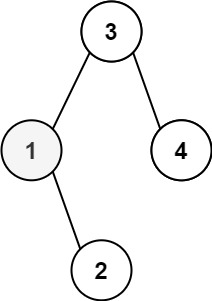
Input: root = [3,1,4,null,2], k = 1
Output: 1
Example 2:
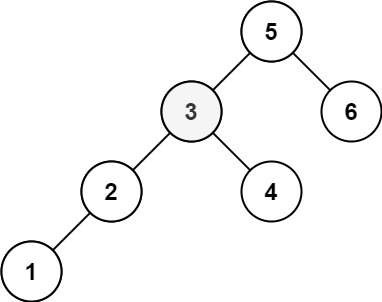
Input: root = [5,3,6,2,4,null,null,1], k = 3
Output: 3
Constraints:
- The number of nodes in the tree is
n. 1 <= k <= n <= 1040 <= Node.val <= 104
Follow up: If the BST is modified often (i.e., we can do insert and delete operations) and you need to find the kth smallest frequently, how would you optimize?
Approach Overview
Problem Overview: Given the root of a Binary Search Tree (BST) and an integer k, return the kth smallest value among all nodes. The key observation is that an in-order traversal of a BST visits nodes in strictly increasing order.
The BST property makes this problem straightforward once you recognize the traversal order. In-order traversal processes nodes as left → root → right, which naturally produces a sorted sequence. Instead of storing the entire sequence, you only need to count nodes until the kth element appears.
Approach 1: In-Order Traversal (Recursive) (O(n) time, O(h) space)
This approach performs a standard in-order traversal of the tree. Maintain a counter that increments every time you visit a node. Once the counter equals k, return that node’s value immediately. Because a BST guarantees sorted order during in-order traversal, the kth visited node is the kth smallest element.
The recursion stack holds at most h nodes where h is the tree height. In a balanced tree this is O(log n), but in the worst case (skewed tree) it becomes O(n). This solution is simple, easy to reason about, and commonly expected in interviews involving tree traversal or depth-first search.
Approach 2: Morris In-Order Traversal (Iterative) (O(n) time, O(1) space)
Morris Traversal performs in-order traversal without recursion or an explicit stack. It temporarily modifies the tree by creating threaded links from a node’s predecessor back to the current node. This allows traversal to return to parent nodes without storing them in memory.
During traversal, increment a counter each time a node is processed. When the counter reaches k, return the current value. After visiting a node, restore the modified pointers so the tree structure remains unchanged. This method achieves constant extra space while still visiting each node at most twice.
Morris traversal is especially useful when memory usage must stay minimal. It’s less commonly written in interviews but demonstrates strong understanding of binary search tree traversal mechanics.
Recommended for interviews: The recursive in-order traversal is the expected answer in most interviews because it directly uses the BST ordering property and is easy to implement quickly. Mentioning Morris traversal as a follow-up shows deeper knowledge of tree traversal optimizations and space reduction techniques.
Complexity Analysis
| Approach | Time | Space | When to Use |
|---|---|---|---|
| In-Order Traversal (Recursive) | O(n) | O(h) | General interview solution; simple and leverages BST ordering |
| Morris In-Order Traversal | O(n) | O(1) | When minimizing extra memory or demonstrating advanced traversal techniques |