
Flip Binary Tree To Match Preorder Traversal - Video Solutions
Flip Binary Tree To Match Preorder Traversal | Live Coding with Explanation | Leetcode - 971
Flip Binary Tree To Match Preorder Traversal - Video Solution
Watch 10 video solutions for Flip Binary Tree To Match Preorder Traversal, a medium level problem involving Tree, Depth-First Search, Binary Tree. This walkthrough by Algorithms Made Easy has 3,051 views views. Want to try solving it yourself? Practice on FleetCode or read the detailed text solution.
Problem Statement
You are given the root of a binary tree with n nodes, where each node is uniquely assigned a value from 1 to n. You are also given a sequence of n values voyage, which is the desired pre-order traversal of the binary tree.
Any node in the binary tree can be flipped by swapping its left and right subtrees. For example, flipping node 1 will have the following effect:
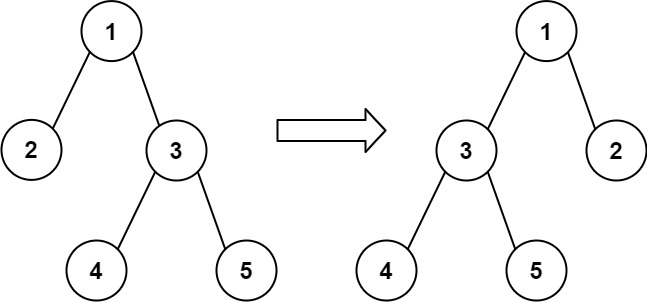
Flip the smallest number of nodes so that the pre-order traversal of the tree matches voyage.
Return a list of the values of all flipped nodes. You may return the answer in any order. If it is impossible to flip the nodes in the tree to make the pre-order traversal match voyage, return the list [-1].
Example 1:

Input: root = [1,2], voyage = [2,1]
Output: [-1]
Explanation: It is impossible to flip the nodes such that the pre-order traversal matches voyage.
Example 2:

Input: root = [1,2,3], voyage = [1,3,2]
Output: [1]
Explanation: Flipping node 1 swaps nodes 2 and 3, so the pre-order traversal matches voyage.
Example 3:
Input: root = [1,2,3], voyage = [1,2,3]
Output: []
Explanation: The tree's pre-order traversal already matches voyage, so no nodes need to be flipped.
Constraints:
- The number of nodes in the tree is
n. n == voyage.length1 <= n <= 1001 <= Node.val, voyage[i] <= n- All the values in the tree are unique.
- All the values in
voyageare unique.
Approach Overview
Problem Overview: You receive a binary tree and an array representing a desired preorder traversal. The task is to flip certain nodes (swap left and right children) so the tree's preorder traversal matches the given sequence. If it is impossible, return [-1]. Otherwise, return the list of node values where flips occurred.
Approach 1: Recursive Pre-order Traversal with Flipping (Time: O(n), Space: O(h))
This method simulates a normal preorder traversal (root → left → right) while comparing each visited node with the next value in the voyage array. Maintain an index pointer that tracks which element of the voyage should appear next. When visiting a node, check if its value matches the current voyage value. If the left child does not match the next expected value but the right child does, a flip is required. Record the node value and traverse the right child before the left. This approach works because preorder traversal order is strictly defined, so detecting a mismatch immediately tells you whether a flip can correct it. If neither child matches the next expected value, the traversal cannot be fixed and you return [-1]. The recursion depth equals the tree height, giving O(h) auxiliary space. This technique relies on standard depth-first search over a binary tree.
Approach 2: Iterative Pre-order Traversal with Stack (Time: O(n), Space: O(n))
An iterative version performs the same preorder simulation but replaces recursion with an explicit stack. Push nodes as you traverse and compare them against the voyage index. When a node's left child does not match the next expected value but the right child does, record the flip and push children in reversed order so traversal processes the correct branch first. Stack-based traversal avoids recursion limits and mirrors how preorder traversal works internally. Each node is pushed and popped at most once, keeping the runtime O(n). Space usage becomes O(n) in the worst case due to the stack storing nodes of a skewed tree. This version is useful when recursion depth might be large or when you prefer explicit control of traversal logic in a tree structure.
Recommended for interviews: The recursive preorder DFS is the most natural solution. It directly models the preorder definition and quickly detects when a flip is required. Interviewers typically expect the O(n) DFS approach with a global voyage index because it shows clear reasoning about traversal order and tree structure.
Complexity Analysis
| Approach | Time | Space | When to Use |
|---|---|---|---|
| Recursive Pre-order Traversal with Flipping | O(n) | O(h) | Best general solution. Clean logic that directly follows preorder traversal rules. |
| Iterative Pre-order Traversal with Stack | O(n) | O(n) | Useful when avoiding recursion or handling very deep trees. |