
Find the Number of Distinct Colors Among the Balls - Video Solutions
Find the Number of Distinct Colors Among the Balls | 2 Approaches | Leetcode 3160 | codestorywithMIK
Find the Number of Distinct Colors Among the Balls - Video Solution
Watch 10 video solutions for Find the Number of Distinct Colors Among the Balls, a medium level problem involving Array, Hash Table, Simulation. This walkthrough by codestorywithMIK has 9,243 views views. Want to try solving it yourself? Practice on FleetCode or read the detailed text solution.
Problem Statement
You are given an integer limit and a 2D array queries of size n x 2.
There are limit + 1 balls with distinct labels in the range [0, limit]. Initially, all balls are uncolored. For every query in queries that is of the form [x, y], you mark ball x with the color y. After each query, you need to find the number of distinct colors among the balls.
Return an array result of length n, where result[i] denotes the number of distinct colors after ith query.
Note that when answering a query, lack of a color will not be considered as a color.
Example 1:
Input: limit = 4, queries = [[1,4],[2,5],[1,3],[3,4]]
Output: [1,2,2,3]
Explanation:
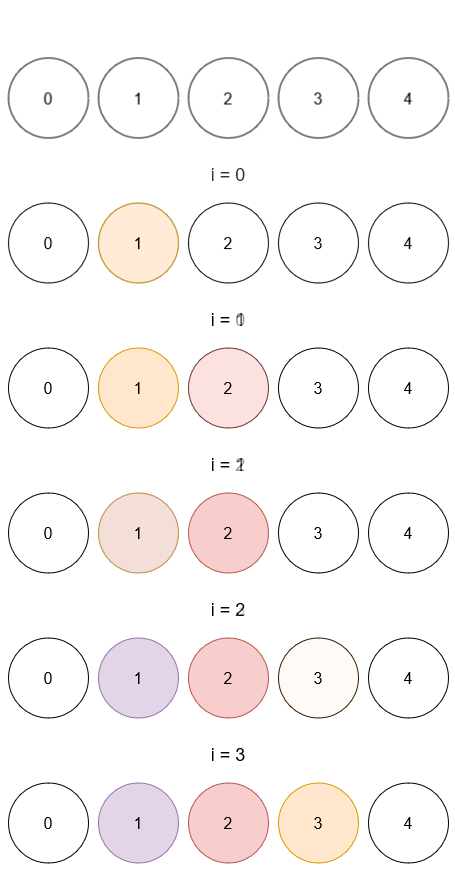
- After query 0, ball 1 has color 4.
- After query 1, ball 1 has color 4, and ball 2 has color 5.
- After query 2, ball 1 has color 3, and ball 2 has color 5.
- After query 3, ball 1 has color 3, ball 2 has color 5, and ball 3 has color 4.
Example 2:
Input: limit = 4, queries = [[0,1],[1,2],[2,2],[3,4],[4,5]]
Output: [1,2,2,3,4]
Explanation:
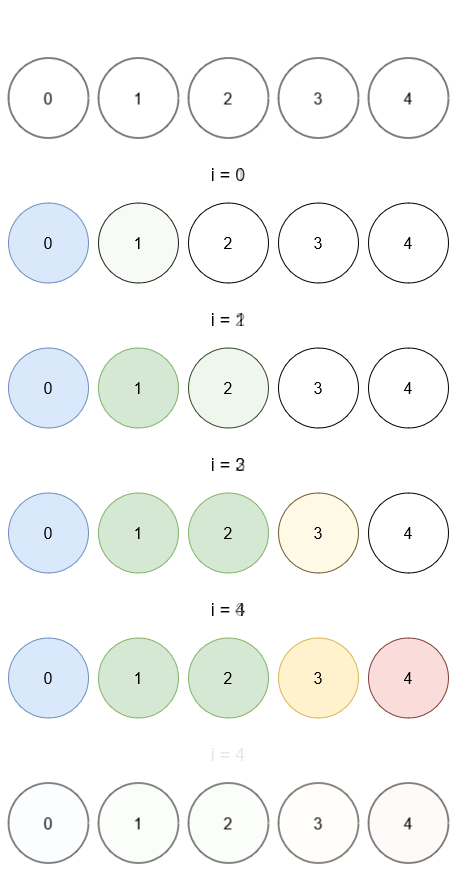
- After query 0, ball 0 has color 1.
- After query 1, ball 0 has color 1, and ball 1 has color 2.
- After query 2, ball 0 has color 1, and balls 1 and 2 have color 2.
- After query 3, ball 0 has color 1, balls 1 and 2 have color 2, and ball 3 has color 4.
- After query 4, ball 0 has color 1, balls 1 and 2 have color 2, ball 3 has color 4, and ball 4 has color 5.
Constraints:
1 <= limit <= 1091 <= n == queries.length <= 105queries[i].length == 20 <= queries[i][0] <= limit1 <= queries[i][1] <= 109
Approach Overview
Problem Overview: You receive queries that assign a color to a specific ball. After each assignment, you must report how many distinct colors currently exist among all colored balls. Balls may change colors multiple times, so the solution must correctly update color counts as assignments overwrite previous ones.
Approach 1: HashMap to Track Ball and Color Frequency (O(n) time, O(n) space)
Use two hash maps. The first maps ball -> color, storing the current color of each ball. The second maps color -> frequency, tracking how many balls currently use that color. For every query, check if the ball already has a color. If it does, decrement the frequency of the old color and remove it from the map when the count reaches zero. Then assign the new color, increment its frequency, and record the number of distinct colors as colorFrequency.size(). Each operation is constant time because hash lookups, insertions, and deletions are O(1) on average. This approach handles arbitrary ball IDs and color values efficiently and is the standard solution using Hash Table techniques combined with simple Simulation.
Approach 2: Arrays for Color Frequency (O(n) time, O(k) space)
If the maximum color value is reasonably bounded, replace the color-frequency hash map with an array. Maintain an array colorCount[color] that tracks how many balls currently have that color. You still keep a structure mapping ball -> color to detect previous assignments. When processing a query, decrement the previous color count, update the new color count, and maintain a running integer storing the number of distinct colors. Increment it when a color count transitions from 0 to 1, and decrement it when a count drops from 1 to 0. Array indexing is slightly faster than hashing and reduces overhead, making this a good optimization when color limits are known. The algorithm still processes each query once, so the total time remains O(n). This approach relies on simple operations over Array structures.
Recommended for interviews: The HashMap approach is what most interviewers expect. It works for large or sparse color ranges and demonstrates proper handling of state updates and frequency tracking. The array optimization is useful when constraints guarantee small color values, but the hash-based solution shows stronger general problem-solving skills.
Complexity Analysis
| Approach | Time | Space | When to Use |
|---|---|---|---|
| HashMap for Ball Color + Color Frequency | O(n) | O(n) | General case when ball IDs and colors may be large or sparse |
| Array for Color Frequency | O(n) | O(k) | When color values are bounded and an array is more memory‑efficient |