
Find Edges in Shortest Paths - Video Solutions
Find Edges in Shortest Paths | Dijkstra's Algo | Full Intuition | Leetcode 3123 | codestorywithMIK
Find Edges in Shortest Paths - Video Solution
Watch 10 video solutions for Find Edges in Shortest Paths, a hard level problem involving Depth-First Search, Breadth-First Search, Graph. This walkthrough by codestorywithMIK has 6,270 views views. Want to try solving it yourself? Practice on FleetCode or read the detailed text solution.
Problem Statement
You are given an undirected weighted graph of n nodes numbered from 0 to n - 1. The graph consists of m edges represented by a 2D array edges, where edges[i] = [ai, bi, wi] indicates that there is an edge between nodes ai and bi with weight wi.
Consider all the shortest paths from node 0 to node n - 1 in the graph. You need to find a boolean array answer where answer[i] is true if the edge edges[i] is part of at least one shortest path. Otherwise, answer[i] is false.
Return the array answer.
Note that the graph may not be connected.
Example 1:
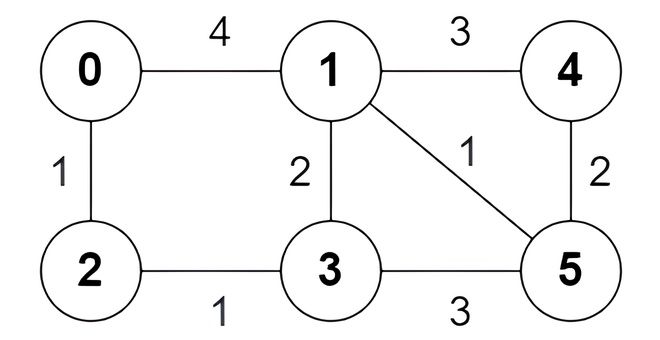
Input: n = 6, edges = [[0,1,4],[0,2,1],[1,3,2],[1,4,3],[1,5,1],[2,3,1],[3,5,3],[4,5,2]]
Output: [true,true,true,false,true,true,true,false]
Explanation:
The following are all the shortest paths between nodes 0 and 5:
- The path
0 -> 1 -> 5: The sum of weights is4 + 1 = 5. - The path
0 -> 2 -> 3 -> 5: The sum of weights is1 + 1 + 3 = 5. - The path
0 -> 2 -> 3 -> 1 -> 5: The sum of weights is1 + 1 + 2 + 1 = 5.
Example 2:
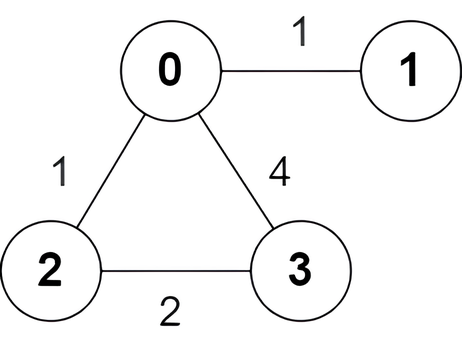
Input: n = 4, edges = [[2,0,1],[0,1,1],[0,3,4],[3,2,2]]
Output: [true,false,false,true]
Explanation:
There is one shortest path between nodes 0 and 3, which is the path 0 -> 2 -> 3 with the sum of weights 1 + 2 = 3.
Constraints:
2 <= n <= 5 * 104m == edges.length1 <= m <= min(5 * 104, n * (n - 1) / 2)0 <= ai, bi < nai != bi1 <= wi <= 105- There are no repeated edges.
Approach Overview
Problem Overview: You are given a weighted graph and must determine which edges appear in at least one shortest path from node 0 to node n-1. Instead of returning the path itself, the goal is to mark every edge that can participate in any optimal route.
Approach 1: Double Dijkstra's Algorithm (O(E log V) time, O(V + E) space)
This approach runs Dijkstra twice. First compute the shortest distance from the source node 0 to every node. Then run Dijkstra again from the target node n-1 (conceptually on the reversed graph, though for undirected graphs the same adjacency list works). Let distStart[u] be the distance from the start and distEnd[v] be the distance from the end. For an edge (u, v, w), the edge belongs to some shortest path if distStart[u] + w + distEnd[v] == distStart[n-1] or the symmetric direction distStart[v] + w + distEnd[u] == distStart[n-1]. The key insight: any shortest path can be decomposed into prefix distance from the start, the edge weight, and suffix distance to the target. If their sum equals the global shortest distance, the edge lies on an optimal path. The heavy lifting is done by a min-heap implementation of priority queue inside Dijkstra. This method works efficiently on large sparse graphs.
Approach 2: Bellman-Ford with Inverse Relaxation (O(V * E) time, O(V + E) space)
This version starts by computing shortest distances from the source using the Bellman-Ford relaxation process. After the distances stabilize, examine each edge to see whether it preserves shortest-path consistency: an edge (u, v, w) is valid if dist[u] + w == dist[v] or dist[v] + w == dist[u]. These edges form a directed acyclic structure that represents all valid shortest-path transitions. Build this filtered graph and run a DFS or BFS from node 0 to find which edges can actually reach n-1. Only edges reachable in this constrained graph belong to some shortest path. Bellman-Ford avoids priority queues and works even if negative weights exist (as long as there are no negative cycles). It relies on repeated relaxation over the full edge list, a classic technique in shortest path problems.
Recommended for interviews: Double Dijkstra is the expected solution. It runs in O(E log V), scales well for dense inputs, and clearly demonstrates understanding of graph shortest path decomposition. Bellman-Ford is a good fallback if negative weights appear or if the interviewer explicitly asks for a relaxation-based approach.
Complexity Analysis
| Approach | Time | Space | When to Use |
|---|---|---|---|
| Double Dijkstra's Algorithm | O(E log V) | O(V + E) | Best general solution for weighted graphs with non-negative edges |
| Bellman-Ford with Inverse Relaxation | O(V * E) | O(V + E) | Useful when negative edge weights are possible or when demonstrating relaxation-based shortest paths |