
Diameter of Binary Tree - Video Solutions
L16. Diameter of Binary Tree | C++ | Java
Diameter of Binary Tree - Video Solution
Watch 10 video solutions for Diameter of Binary Tree, a easy level problem involving Tree, Depth-First Search, Binary Tree. This walkthrough by take U forward has 629,509 views views. Want to try solving it yourself? Practice on FleetCode or read the detailed text solution.
Problem Statement
Given the root of a binary tree, return the length of the diameter of the tree.
The diameter of a binary tree is the length of the longest path between any two nodes in a tree. This path may or may not pass through the root.
The length of a path between two nodes is represented by the number of edges between them.
Example 1:
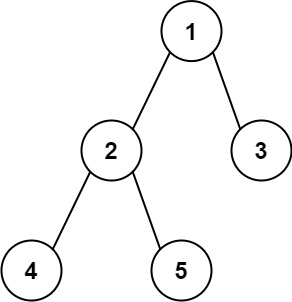
Input: root = [1,2,3,4,5]
Output: 3
Explanation: 3 is the length of the path [4,2,1,3] or [5,2,1,3].
Example 2:
Input: root = [1,2]
Output: 1
Constraints:
- The number of nodes in the tree is in the range
[1, 104]. -100 <= Node.val <= 100
Approach Overview
Problem Overview: You are given the root of a binary tree. The task is to compute the tree's diameter, defined as the number of edges on the longest path between any two nodes. The path may or may not pass through the root.
Approach 1: Depth First Search (Postorder Traversal) (Time: O(n), Space: O(h))
This is the optimal approach used in most interview solutions. Traverse the tree using DFS in postorder. For every node, compute the height of its left and right subtrees. The candidate diameter passing through that node is leftHeight + rightHeight. Maintain a global maximum while returning the subtree height as 1 + max(leftHeight, rightHeight). Each node is visited exactly once, so the time complexity is O(n), and recursion stack usage is O(h), where h is the tree height.
This method works because the longest path in a binary tree must pass through some node as the highest point of the path. DFS allows you to compute subtree heights while updating the best diameter in a single traversal. It's simple, efficient, and the expected approach in most coding interviews involving tree traversal.
Approach 2: Dynamic Programming with Memoization (Time: O(n), Space: O(n))
This approach separates height calculation and diameter evaluation using memoization. First compute the height of every node recursively and store results in a hash map or array keyed by node reference. When evaluating the diameter at a node, look up the cached heights of its left and right children instead of recomputing them. This avoids repeated height calculations that would otherwise make the naive solution O(n²).
The algorithm still performs a traversal of all nodes, keeping overall time complexity at O(n). However, the memoization structure stores subtree heights for every node, increasing auxiliary space usage to O(n) in addition to recursion stack space. This pattern resembles classic depth-first search combined with dynamic programming where intermediate subtree results are cached.
Recommended for interviews: The DFS postorder solution is what interviewers typically expect. It computes height and diameter in a single traversal with minimal space. Implementing it correctly shows strong understanding of recursive tree problems. The memoization version demonstrates awareness of avoiding repeated subtree computations, but the single-pass DFS solution is cleaner and more efficient.
Complexity Analysis
| Approach | Time | Space | When to Use |
|---|---|---|---|
| Depth First Search (Postorder) | O(n) | O(h) | Best general solution. Single traversal computes subtree heights and diameter simultaneously. |
| Dynamic Programming with Memoization | O(n) | O(n) | Useful when subtree heights are reused across multiple computations or when illustrating DP optimization over repeated recursion. |