
Design an Ordered Stream - Video Solutions
1656. Design an Ordered Stream (Leetcode Easy)
Design an Ordered Stream - Video Solution
Watch 4 video solutions for Design an Ordered Stream, a easy level problem involving Array, Hash Table, Design. This walkthrough by Programming Live with Larry has 7,166 views views. Want to try solving it yourself? Practice on FleetCode or read the detailed text solution.
Problem Statement
There is a stream of n (idKey, value) pairs arriving in an arbitrary order, where idKey is an integer between 1 and n and value is a string. No two pairs have the same id.
Design a stream that returns the values in increasing order of their IDs by returning a chunk (list) of values after each insertion. The concatenation of all the chunks should result in a list of the sorted values.
Implement the OrderedStream class:
OrderedStream(int n)Constructs the stream to takenvalues.String[] insert(int idKey, String value)Inserts the pair(idKey, value)into the stream, then returns the largest possible chunk of currently inserted values that appear next in the order.
Example:
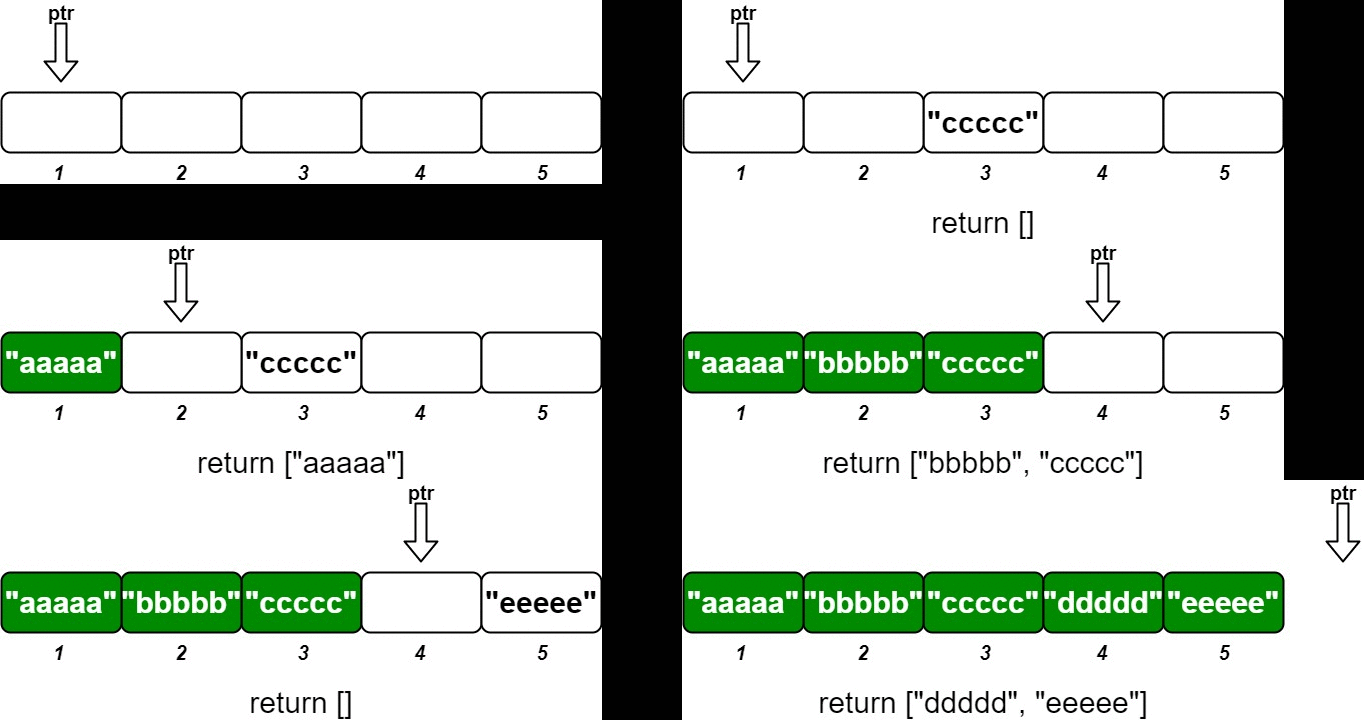
Input
["OrderedStream", "insert", "insert", "insert", "insert", "insert"]
[[5], [3, "ccccc"], [1, "aaaaa"], [2, "bbbbb"], [5, "eeeee"], [4, "ddddd"]]
Output
[null, [], ["aaaaa"], ["bbbbb", "ccccc"], [], ["ddddd", "eeeee"]]

Explanation
// Note that the values ordered by ID is ["aaaaa", "bbbbb", "ccccc", "ddddd", "eeeee"].
OrderedStream os = new OrderedStream(5);
os.insert(3, "ccccc"); // Inserts (3, "ccccc"), returns [].
os.insert(1, "aaaaa"); // Inserts (1, "aaaaa"), returns ["aaaaa"].
os.insert(2, "bbbbb"); // Inserts (2, "bbbbb"), returns ["bbbbb", "ccccc"].
os.insert(5, "eeeee"); // Inserts (5, "eeeee"), returns [].
os.insert(4, "ddddd"); // Inserts (4, "ddddd"), returns ["ddddd", "eeeee"].
// Concatentating all the chunks returned:
// [] + ["aaaaa"] + ["bbbbb", "ccccc"] + [] + ["ddddd", "eeeee"] = ["aaaaa", "bbbbb", "ccccc", "ddddd", "eeeee"]
// The resulting order is the same as the order above.
Constraints:
1 <= n <= 10001 <= id <= nvalue.length == 5valueconsists only of lowercase letters.- Each call to
insertwill have a uniqueid. - Exactly
ncalls will be made toinsert.
Approach Overview
Problem Overview: You design a data structure that stores (id, value) pairs arriving in arbitrary order. Each call to insert(idKey, value) stores the value and returns the longest ordered chunk of values starting from the current pointer. If the next expected id is missing, the stream returns an empty list.
Approach 1: Array-Based Stream with Pointer (O(1) amortized time, O(n) space)
This approach stores incoming values in a fixed array of size n + 1. A pointer ptr tracks the smallest id that has not been returned yet. When you call insert(idKey, value), place the value directly at stream[idKey]. If idKey equals the current pointer, iterate forward while consecutive positions are filled, collecting values and advancing the pointer. Each element is processed at most once, which gives O(1) amortized time per operation and O(n) total extra space. This design works well because ids are bounded and sequential, making array indexing faster than lookups in other structures. It’s the most common implementation when practicing array based design problems.
Approach 2: Map-Based Storage (O(log n) or O(1) average per insert, O(n) space)
Another option stores incoming values in a hash map keyed by id. Each insertion records map[idKey] = value. After inserting, repeatedly check whether the current pointer exists in the map. If it does, append the value to the output list and advance the pointer. Hash maps provide O(1) average lookup time, so each check is constant on average. The total runtime across all operations remains O(n) because each id is processed once. This approach works even if the ids are sparse or not strictly bounded by a small range, which makes it useful when implementing generic hash table or data stream systems.
The key insight behind both approaches is maintaining a moving pointer representing the next expected id in the ordered stream. Once a contiguous segment appears, you release it immediately and move the pointer forward. This prevents rescanning previously processed elements and keeps the implementation efficient.
Recommended for interviews: The array + pointer approach. It shows you understand how to exploit the bounded id range and maintain state efficiently. Interviewers typically expect this solution because it achieves O(1) amortized insertion with simple logic. Mentioning the map-based alternative demonstrates you understand the generalization when sequential indexing is not guaranteed.
Complexity Analysis
| Approach | Time | Space | When to Use |
|---|---|---|---|
| Array-Based Stream with Pointer | O(1) amortized per insert, O(n) total | O(n) | Best choice when ids are sequential and bounded from 1..n |
| Hash Map Based Stream | O(1) average per insert | O(n) | Useful when ids are sparse or array indexing is not practical |