
Checking Existence of Edge Length Limited Paths - Video Solutions
Checking Existence of Edge Length Limited Paths | Leetcode - 1697 | DSU | GOOGLE | Explanation
Checking Existence of Edge Length Limited Paths - Video Solution
Watch 10 video solutions for Checking Existence of Edge Length Limited Paths, a hard level problem involving Array, Two Pointers, Union Find. This walkthrough by codestorywithMIK has 9,009 views views. Want to try solving it yourself? Practice on FleetCode or read the detailed text solution.
Problem Statement
An undirected graph of n nodes is defined by edgeList, where edgeList[i] = [ui, vi, disi] denotes an edge between nodes ui and vi with distance disi. Note that there may be multiple edges between two nodes.
Given an array queries, where queries[j] = [pj, qj, limitj], your task is to determine for each queries[j] whether there is a path between pj and qj such that each edge on the path has a distance strictly less than limitj .
Return a boolean array answer, where answer.length == queries.length and the jth value of answer is true if there is a path for queries[j] is true, and false otherwise.
Example 1:
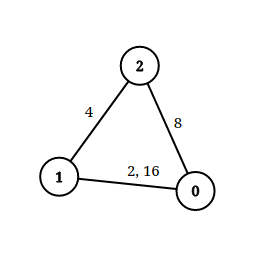
Input: n = 3, edgeList = [[0,1,2],[1,2,4],[2,0,8],[1,0,16]], queries = [[0,1,2],[0,2,5]]
Output: [false,true]
Explanation: The above figure shows the given graph. Note that there are two overlapping edges between 0 and 1 with distances 2 and 16.
For the first query, between 0 and 1 there is no path where each distance is less than 2, thus we return false for this query.
For the second query, there is a path (0 -> 1 -> 2) of two edges with distances less than 5, thus we return true for this query.
Example 2:
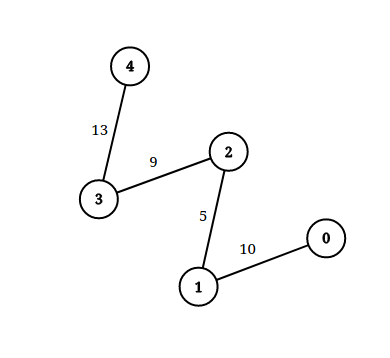
Input: n = 5, edgeList = [[0,1,10],[1,2,5],[2,3,9],[3,4,13]], queries = [[0,4,14],[1,4,13]]
Output: [true,false]
Explanation: The above figure shows the given graph.
Constraints:
2 <= n <= 1051 <= edgeList.length, queries.length <= 105edgeList[i].length == 3queries[j].length == 30 <= ui, vi, pj, qj <= n - 1ui != vipj != qj1 <= disi, limitj <= 109- There may be multiple edges between two nodes.
Approach Overview
Problem Overview: You are given an undirected weighted graph and several queries. Each query asks whether two nodes can be connected using only edges whose weight is strictly less than a given limit. For every query, return true if such a path exists, otherwise false.
Approach 1: Union-Find with Sorting (O((E + Q) log E) time, O(N) space)
The key idea is to process queries offline by sorting both the edges and the queries by edge weight limit. Instead of checking each query independently, sort the edgeList by weight and sort queries by their limit. Then gradually add edges into a Union-Find structure while their weights remain below the current query’s limit. Once all eligible edges are merged, simply check if the two query nodes belong to the same connected component. This works because connectivity only increases as you add edges in increasing weight order. The Union Find structure provides nearly constant-time find and union operations with path compression and union by rank. Sorting drives the overall complexity, giving O((E + Q) log E) time and O(N) space.
Approach 2: Kruskal's Algorithm Modification (O((E + Q) log E) time, O(N) space)
This approach interprets the problem through the lens of minimum spanning tree construction. Kruskal’s algorithm processes edges in ascending order of weight and connects components using a Union-Find. For each query limit, you effectively simulate running Kruskal until the edge weight reaches that limit. All edges smaller than the limit are merged into the structure. After those merges, checking connectivity between the two query nodes answers the query instantly. Conceptually this is identical to the previous method but framed as a partial MST build for each query threshold. This perspective is helpful if you already understand Kruskal’s algorithm for graph connectivity problems. Sorting the edges and queries ensures efficient processing, while the disjoint set structure maintains components.
Both approaches rely heavily on ordering edges by weight. Efficient preprocessing with sorting ensures edges are added exactly once and queries are answered without repeated graph traversal.
Recommended for interviews: The Union-Find with sorted queries approach is what most interviewers expect. It shows you recognize that queries can be processed offline and that dynamic connectivity can be handled efficiently with a disjoint set. Explaining the brute-force idea (running a constrained BFS/DFS per query) demonstrates baseline understanding, but switching to the sorted Union-Find solution shows strong algorithmic insight.
Complexity Analysis
| Approach | Time | Space | When to Use |
|---|---|---|---|
| Brute Force BFS/DFS per Query | O(Q * (N + E)) | O(N + E) | Small graphs or when constraints are tiny and implementation simplicity matters |
| Union-Find with Sorted Queries | O((E + Q) log E) | O(N) | Best general solution for large graphs and many queries |
| Modified Kruskal Processing | O((E + Q) log E) | O(N) | Useful when reasoning about MST construction or weight-ordered connectivity |