
The Maze III - Solution & Explanation
Problem Statement
There is a ball in a maze with empty spaces (represented as 0) and walls (represented as 1). The ball can go through the empty spaces by rolling up, down, left or right, but it won't stop rolling until hitting a wall. When the ball stops, it could choose the next direction (must be different from last chosen direction). There is also a hole in this maze. The ball will drop into the hole if it rolls onto the hole.
Given the m x n maze, the ball's position ball and the hole's position hole, where ball = [ballrow, ballcol] and hole = [holerow, holecol], return a string instructions of all the instructions that the ball should follow to drop in the hole with the shortest distance possible. If there are multiple valid instructions, return the lexicographically minimum one. If the ball can't drop in the hole, return "impossible".
If there is a way for the ball to drop in the hole, the answer instructions should contain the characters 'u' (i.e., up), 'd' (i.e., down), 'l' (i.e., left), and 'r' (i.e., right).
The distance is the number of empty spaces traveled by the ball from the start position (excluded) to the destination (included).
You may assume that the borders of the maze are all walls (see examples).
Example 1:
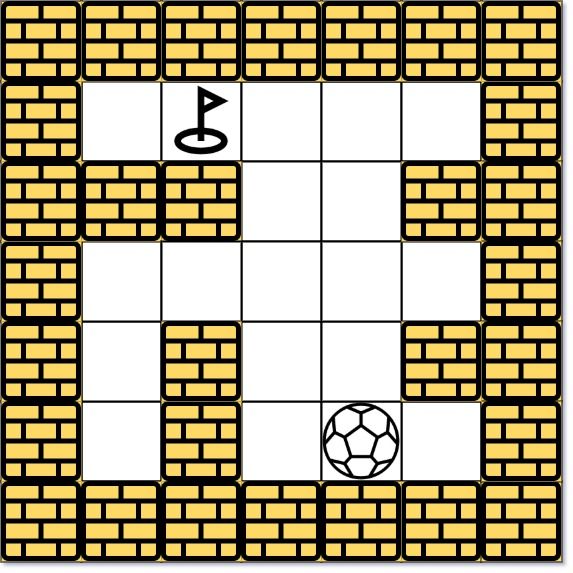
Input: maze = [[0,0,0,0,0],[1,1,0,0,1],[0,0,0,0,0],[0,1,0,0,1],[0,1,0,0,0]], ball = [4,3], hole = [0,1]
Output: "lul"
Explanation: There are two shortest ways for the ball to drop into the hole.
The first way is left -> up -> left, represented by "lul".
The second way is up -> left, represented by 'ul'.
Both ways have shortest distance 6, but the first way is lexicographically smaller because 'l' < 'u'. So the output is "lul".
Example 2:
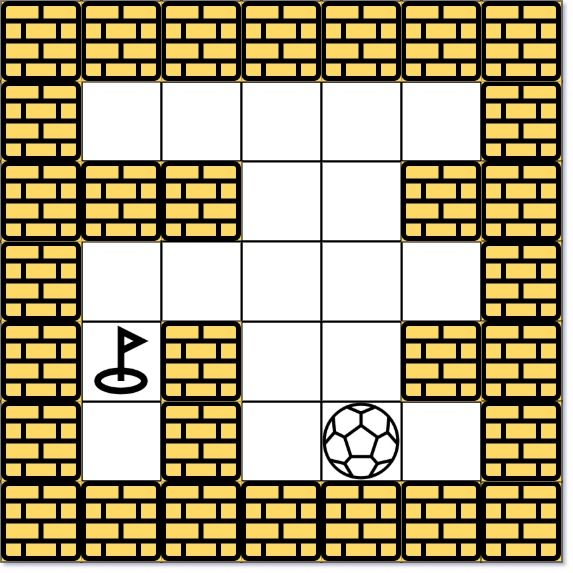
Input: maze = [[0,0,0,0,0],[1,1,0,0,1],[0,0,0,0,0],[0,1,0,0,1],[0,1,0,0,0]], ball = [4,3], hole = [3,0]
Output: "impossible"
Explanation: The ball cannot reach the hole.
Example 3:
Input: maze = [[0,0,0,0,0,0,0],[0,0,1,0,0,1,0],[0,0,0,0,1,0,0],[0,0,0,0,0,0,1]], ball = [0,4], hole = [3,5]
Output: "dldr"
Constraints:
m == maze.lengthn == maze[i].length1 <= m, n <= 100maze[i][j]is0or1.ball.length == 2hole.length == 20 <= ballrow, holerow <= m0 <= ballcol, holecol <= n- Both the ball and the hole exist in an empty space, and they will not be in the same position initially.
- The maze contains at least 2 empty spaces.
Approach Overview
Problem Overview: You are given a maze where a ball rolls in a direction until it hits a wall. The goal is to find the shortest distance for the ball to fall into a hole. If multiple shortest paths exist, return the lexicographically smallest path string. If the ball cannot reach the hole, return "impossible".
This problem combines grid traversal with weighted shortest path logic. Each roll travels multiple cells until a wall stops the ball, which means standard step-by-step traversal does not apply. The path string also introduces a lexicographical constraint when distances tie.
Approach 1: DFS with Backtracking (Exponential Time)
One direct idea is to simulate all possible rolling paths using Depth-First Search. From the current cell, roll the ball in four directions until it hits a wall or the hole. Track the distance traveled and the path string. Maintain the best result found so far and prune branches where the current distance already exceeds it. Time complexity is exponential in the number of open cells because many paths are explored repeatedly, and space complexity is O(mn) for recursion and visited tracking. This approach demonstrates the mechanics of rolling movement but struggles with performance on large grids.
Approach 2: BFS with Distance Tracking (O(mn * max(m,n)))
You can treat each stopping position as a node and use Breadth-First Search. From every node, roll in four directions until hitting a wall and enqueue the stopping cell. Maintain a distance matrix storing the shortest distance to each cell. However, since each roll may travel multiple steps, edges effectively have different weights. Plain BFS does not always guarantee optimal ordering, so additional checks are required to update distances and paths. Time complexity becomes O(mn * max(m,n)) because each roll scans up to the maze dimension. Space complexity is O(mn).
Approach 3: Dijkstra with Priority Queue (Optimal) (O(mn log(mn)))
The optimal solution models the maze as a weighted graph and applies Dijkstra's algorithm using a priority queue. Each state contains (distance, path, row, col). Always expand the node with the smallest distance; if distances tie, compare path strings lexicographically. For each direction, simulate the rolling process until hitting a wall or the hole, count the steps taken, and push the resulting cell into the heap. Maintain a visited or distance map to avoid processing worse states. The time complexity is O(mn log(mn)) due to heap operations over grid cells, and space complexity is O(mn). This method guarantees both the shortest distance and the lexicographically smallest path.
Recommended for interviews: Dijkstra with a priority queue is the expected solution. Interviewers want to see that you recognize the rolling movement creates weighted edges, making BFS insufficient. Implementing the algorithm cleanly on a matrix grid while tracking lexicographical paths demonstrates strong shortest path problem-solving skills.
Solution
Try this approach in the editor →Detailed Complexity Analysis
| Approach | Time | Space | When to Use |
|---|---|---|---|
| DFS with Backtracking | Exponential | O(mn) | Conceptual exploration or small mazes where performance is not critical |
| BFS with Distance Updates | O(mn * max(m,n)) | O(mn) | Intermediate approach when modeling grid traversal but before recognizing weighted edges |
| Dijkstra with Priority Queue | O(mn log(mn)) | O(mn) | General case. Handles weighted rolling distances and lexicographic tie-breaking correctly |
Video Solution
Leetcode 499. The Maze III • Algorithms for Big Bucks • 1,166 views views
Watch 7 more video solutions →Frequently Asked Questions
Is The Maze III easy or hard?
The Maze III Python/Java solution
How to solve The Maze III in O(mn log mn)?
What is the best approach for The Maze III?
Is The Maze III asked at Google/Amazon/Meta?
What data structure is used in The Maze III?
What is the time complexity of The Maze III?
Ready to solve this problem?
Practice The Maze III with our built-in code editor and test cases.
Practice on FleetCode