
Paths in Maze That Lead to Same Room - Solution & Explanation
Problem Statement
A maze consists of n rooms numbered from 1 to n, and some rooms are connected by corridors. You are given a 2D integer array corridors where corridors[i] = [room1i, room2i] indicates that there is a corridor connecting room1i and room2i, allowing a person in the maze to go from room1i to room2i and vice versa.
The designer of the maze wants to know how confusing the maze is. The confusion score of the maze is the number of different cycles of length 3.
- For example,
1 → 2 → 3 → 1is a cycle of length 3, but1 → 2 → 3 → 4and1 → 2 → 3 → 2 → 1are not.
Two cycles are considered to be different if one or more of the rooms visited in the first cycle is not in the second cycle.
Return the confusion score of the maze.
Example 1:
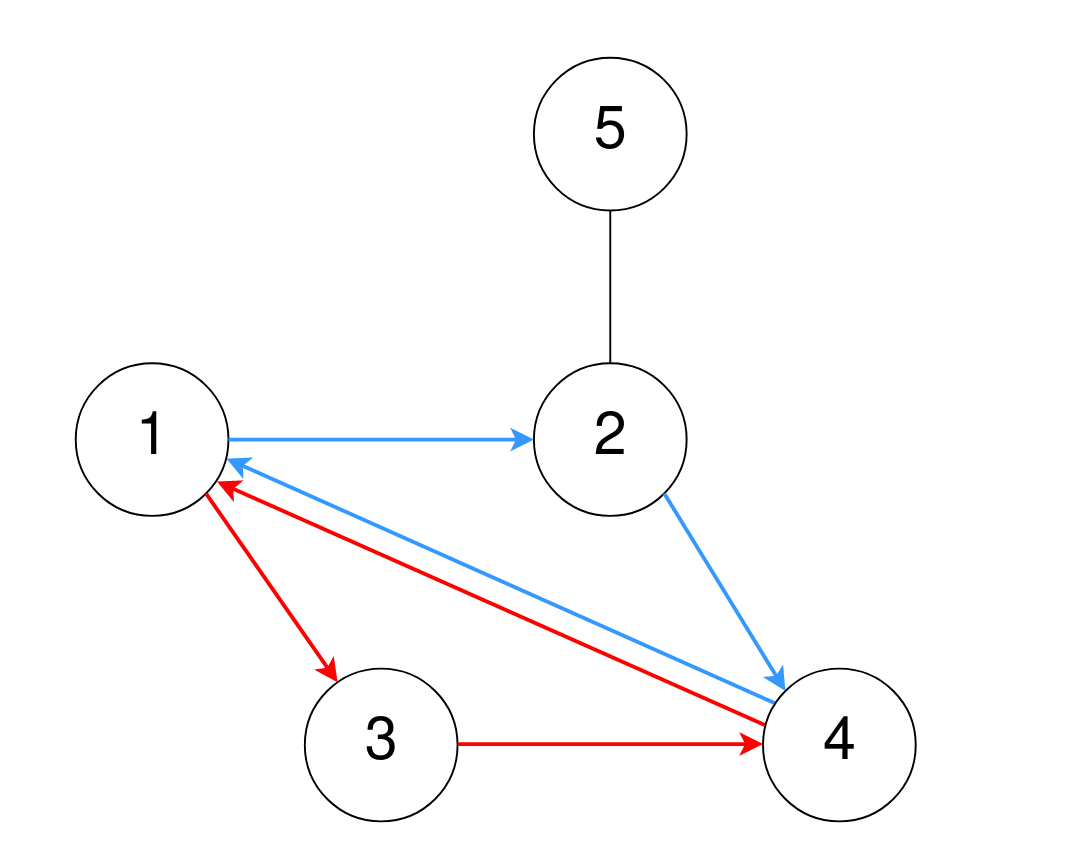
Input: n = 5, corridors = [[1,2],[5,2],[4,1],[2,4],[3,1],[3,4]]
Output: 2
Explanation:
One cycle of length 3 is 4 → 1 → 3 → 4, denoted in red.
Note that this is the same cycle as 3 → 4 → 1 → 3 or 1 → 3 → 4 → 1 because the rooms are the same.
Another cycle of length 3 is 1 → 2 → 4 → 1, denoted in blue.
Thus, there are two different cycles of length 3.
Example 2:
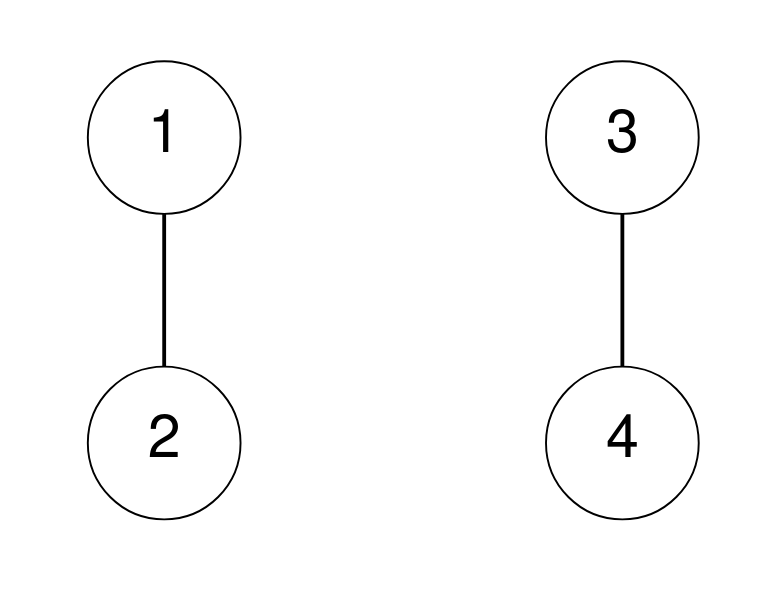
Input: n = 4, corridors = [[1,2],[3,4]]
Output: 0
Explanation:
There are no cycles of length 3.
Constraints:
2 <= n <= 10001 <= corridors.length <= 5 * 104corridors[i].length == 21 <= room1i, room2i <= nroom1i != room2i- There are no duplicate corridors.
Approach Overview
Problem Overview: You are given an undirected maze of rooms connected by corridors. The task is to count distinct paths of the form a → b → c → a where you start and end in the same room without repeating edges. In graph terms, this is counting the number of triangles in an undirected graph.
Approach 1: Brute Force Triplet Check (O(n^3) time, O(n^2) space)
Construct an adjacency matrix so you can check connectivity in constant time. Then iterate through every triple of rooms (i, j, k). If edges (i, j), (j, k), and (k, i) exist, they form a valid cycle of length three. This directly counts triangles in the graph. The downside is the cubic iteration over all node triplets, which becomes expensive when the number of rooms grows. This method mainly demonstrates the underlying structure of the problem.
Approach 2: Edge Iteration with Common Neighbors (O(E * min(deg(u),deg(v))) time, O(E) space)
Store the graph using an adjacency list backed by hash sets. For each corridor (u, v), look for rooms that connect to both u and v. Every common neighbor w forms a triangle u → v → w → u. To do this efficiently, iterate through the smaller adjacency set and check membership in the other using constant-time hash lookups. Each triangle is discovered three times (once per edge), so divide the final count by three.
This approach works well because most real graphs are sparse. The work per edge becomes proportional to the smaller node degree rather than the total number of nodes. Using an adjacency list keeps memory usage linear relative to the number of corridors.
Approach 3: Degree Ordering Optimization (O(E * sqrt(E)) typical, O(E) space)
You can further reduce checks by ordering nodes by degree and only exploring edges in a consistent direction (from lower degree to higher degree). This avoids repeatedly scanning large neighbor lists. For each directed edge under this ordering, count intersections between forward neighbors. This trick appears frequently in triangle-counting algorithms for large graphs.
Recommended for interviews: The adjacency-set intersection approach is what interviewers typically expect. The brute force method shows you understand the triangle definition, but the optimized solution demonstrates practical graph handling, efficient neighbor lookup, and awareness of sparse graph behavior.
Solution
Try this approach in the editor →Detailed Complexity Analysis
| Approach | Time | Space | When to Use |
|---|---|---|---|
| Brute Force Triplet Check | O(n^3) | O(n^2) | Small graphs or when demonstrating the triangle definition |
| Edge + Common Neighbor Intersection | O(E * min(deg(u),deg(v))) | O(E) | General case for sparse graphs; typical interview solution |
| Degree Ordered Triangle Counting | ~O(E * sqrt(E)) | O(E) | Large graphs where node degrees vary widely |
Video Solution
[Leetcode] 2077. Paths in Maze That Lead to Same Room • Simple Code • 624 views views
Watch 1 more video solutions →Frequently Asked Questions
Is Paths in Maze That Lead to Same Room easy or hard?
Paths in Maze That Lead to Same Room Python/Java solution
What is the best approach for Paths in Maze That Lead to Same Room?
Is Paths in Maze That Lead to Same Room asked at Google/Amazon/Meta?
What data structure is used in Paths in Maze That Lead to Same Room?
What is the time complexity of Paths in Maze That Lead to Same Room?
How to solve Paths in Maze That Lead to Same Room in O(E * min(deg)) time?
Ready to solve this problem?
Practice Paths in Maze That Lead to Same Room with our built-in code editor and test cases.
Practice on FleetCode