
Path With Maximum Minimum Value - Solution & Explanation
Problem Statement
Given an m x n integer matrix grid, return the maximum score of a path starting at (0, 0) and ending at (m - 1, n - 1) moving in the 4 cardinal directions.
The score of a path is the minimum value in that path.
- For example, the score of the path
8 → 4 → 5 → 9is4.
Example 1:
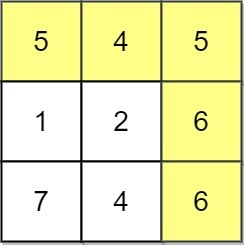
Input: grid = [[5,4,5],[1,2,6],[7,4,6]]
Output: 4
Explanation: The path with the maximum score is highlighted in yellow.
Example 2:
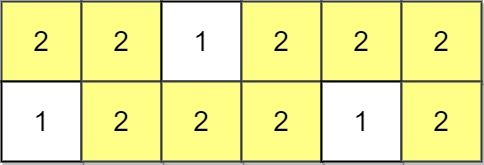
Input: grid = [[2,2,1,2,2,2],[1,2,2,2,1,2]]
Output: 2
Example 3:
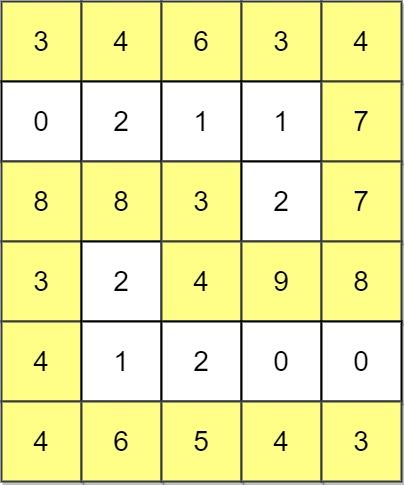
Input: grid = [[3,4,6,3,4],[0,2,1,1,7],[8,8,3,2,7],[3,2,4,9,8],[4,1,2,0,0],[4,6,5,4,3]]
Output: 3
Constraints:
m == grid.lengthn == grid[i].length1 <= m, n <= 1000 <= grid[i][j] <= 109
Approach Overview
Problem Overview: Given an m × n grid, you start at (0,0) and must reach (m-1,n-1). Every path has a score defined by the minimum value encountered along that path. The goal is to choose the path whose minimum value is as large as possible.
Approach 1: Max Heap (Priority Queue) Search (O(mn log(mn)) time, O(mn) space)
This approach is a variation of Dijkstra’s algorithm on a grid. Instead of minimizing distance, you maximize the minimum value seen so far. Use a max heap (priority queue) that always expands the cell with the highest value first. Track the path score as the minimum value along the current path. Each time you pop a cell, update the score and push its four neighbors if they are unvisited. The first time you reach the bottom-right cell, the recorded score is the best possible. The greedy ordering works because exploring higher values first guarantees no later path can produce a better minimum.
This method resembles graph traversal using BFS with a priority queue. It is easy to implement and performs well for typical grid sizes.
Approach 2: Sorting + Union-Find (O(mn log(mn)) time, O(mn) space)
Think about the problem in reverse: instead of building a path, gradually allow cells from highest value to lowest. Sort all grid cells in descending order by value. As you activate each cell, connect it with its already-active neighbors using a Union-Find structure. The moment the start cell and end cell become connected, the current value is the maximum possible minimum value of a valid path.
The key insight: if you only allow cells with value ≥ x, you are effectively checking whether a path exists where every cell meets that threshold. Activating cells from largest to smallest guarantees that the first successful connection yields the optimal answer.
This approach turns the grid into a connectivity problem. Union-Find keeps the operations near constant time using path compression and union by rank.
Recommended for interviews: The max-heap search is the most intuitive and closest to classic graph algorithms, so many candidates reach it first. The sorting + Union-Find method demonstrates deeper insight into connectivity and threshold problems. Showing the heap approach first and then discussing the Union-Find optimization signals strong problem-solving range.
Approach 1: Sorting + Union-Find
First, we construct a triplet (v, i, j) for each element in the matrix, where v represents the element value, and i and j represent the row and column of the element in the matrix, respectively. Then we sort these triplets in descending order by element value and store them in a list q.
Next, we take out the triplets from q in order, use the corresponding element value as the score of the path, and mark the position as visited. Then we check the four adjacent positions (up, down, left, and right) of this position. If an adjacent position has been visited, we merge this position with the current position. If we find that the position (0, 0) and the position (m - 1, n - 1) have been merged, we can directly return the score of the current path as the answer.
The time complexity is O(m times n times (log (m times n) + \alpha(m times n))), where m and n are the number of rows and columns of the matrix, respectively.
Approach 2: Default Approach
Code
Python
Java
C++
Go
TypeScript
Complexity Comparison
| Approach | Complexity |
|---|---|
| Sorting + Union-Find | — |
| Default Approach | — |
Detailed Complexity Analysis
| Approach | Time | Space | When to Use |
|---|---|---|---|
| Max Heap (Priority Queue) Grid Search | O(mn log(mn)) | O(mn) | General solution. Intuitive if you think of the grid as a graph and apply Dijkstra-style traversal. |
| Sorting + Union-Find | O(mn log(mn)) | O(mn) | Best when reasoning about connectivity thresholds. Efficient and elegant for grid activation problems. |
Video Solution
1102. Path With Maximum Minimum Value | Medium | English • Simple Code - 단순코드 • 4,484 views views
Watch 7 more video solutions →Frequently Asked Questions
Is Path With Maximum Minimum Value easy or hard?
How to solve Path With Maximum Minimum Value in O(mn log(mn))?
What is the best approach for Path With Maximum Minimum Value?
Is Path With Maximum Minimum Value asked at Google/Amazon/Meta?
What data structure is used in Path With Maximum Minimum Value?
What is the time complexity of Path With Maximum Minimum Value?
Path With Maximum Minimum Value Python or Java solution approach?
Ready to solve this problem?
Practice Path With Maximum Minimum Value with our built-in code editor and test cases.
Practice on FleetCodeTable of Contents
Practice this problem
Open in Editor