
Path Sum IV - Solution & Explanation
Problem Statement
If the depth of a tree is smaller than 5, then this tree can be represented by an array of three-digit integers. You are given an ascending array nums consisting of three-digit integers representing a binary tree with a depth smaller than 5, where for each integer:
- The hundreds digit represents the depth
dof this node, where1 <= d <= 4. - The tens digit represents the position
pof this node within its level, where1 <= p <= 8, corresponding to its position in a full binary tree. - The units digit represents the value
vof this node, where0 <= v <= 9.
Return the sum of all paths from the root towards the leaves.
It is guaranteed that the given array represents a valid connected binary tree.
Example 1:
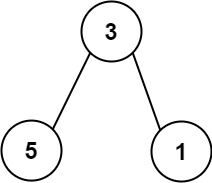
Input: nums = [113,215,221]
Output: 12
Explanation:
The tree that the list represents is shown.
The path sum is (3 + 5) + (3 + 1) = 12.
Example 2:
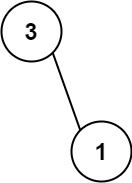
Input: nums = [113,221]
Output: 4
Explanation:
The tree that the list represents is shown.
The path sum is (3 + 1) = 4.
Constraints:
1 <= nums.length <= 15110 <= nums[i] <= 489numsrepresents a valid binary tree with depth less than5.numsis sorted in ascending order.
Approach Overview
Problem Overview: The input represents a binary tree using three-digit integers where the hundreds digit is the depth, the tens digit is the position within that level, and the units digit is the node value. Your task is to reconstruct the structure logically and compute the total of all root‑to‑leaf path sums.
Approach 1: Build the Binary Tree then DFS (O(n) time, O(n) space)
A straightforward method is to explicitly build the tree structure first. Parse each number to extract depth, position, and value, then map each node to its parent using the rule that a node at (d, p) has a parent at (d-1, (p+1)//2). Once the structure is built, run a standard Depth-First Search from the root, accumulating path sums until reaching leaf nodes. Each leaf contributes its path total to the final answer. This approach mirrors how you normally solve path sum problems on a Binary Tree, making it easy to reason about during implementation.
Approach 2: Hash Map + Implicit DFS (O(n) time, O(n) space)
A more efficient approach avoids building the full tree. Store each node in a Hash Table using a key like depth * 10 + position. Then run DFS starting from the root (depth 1, position 1). For each node, compute the keys of its potential children: left child at (d+1, 2p-1) and right child at (d+1, 2p). If neither child exists in the map, the node is a leaf and the current path sum gets added to the result. Otherwise, continue DFS with the updated sum. This method leverages the encoded structure directly and avoids explicit node objects.
The key insight is that the position encoding uniquely determines parent‑child relationships. Because each node can be found with a constant‑time hash lookup, the traversal runs in linear time relative to the number of encoded nodes.
Recommended for interviews: The hash map + implicit DFS approach. It demonstrates that you understand how the positional encoding works and can reconstruct relationships without building a full tree. Mentioning the explicit tree construction approach first can show baseline understanding, but the optimized DFS with hash lookups shows stronger problem‑solving ability.
Solution
Try this approach in the editor →Detailed Complexity Analysis
| Approach | Time | Space | When to Use |
|---|---|---|---|
| Build Tree then DFS | O(n) | O(n) | When you want a clear tree structure and standard DFS traversal |
| Hash Map + Implicit DFS | O(n) | O(n) | General case; avoids building the tree and uses constant-time lookups |
Video Solution
Leetcode 666 path sum 4 • DayDay-UpUp • 641 views views
Watch 4 more video solutions →Frequently Asked Questions
Is Path Sum IV easy or hard?
Path Sum IV Python/Java solution
How to solve Path Sum IV in O(n)?
What is the best approach for Path Sum IV?
Is Path Sum IV asked at Google/Amazon/Meta?
What data structure is used in Path Sum IV?
What is the time complexity of Path Sum IV?
Ready to solve this problem?
Practice Path Sum IV with our built-in code editor and test cases.
Practice on FleetCode