
Number of Orders in the Backlog - Solution & Explanation
Problem Statement
You are given a 2D integer array orders, where each orders[i] = [pricei, amounti, orderTypei] denotes that amounti orders have been placed of type orderTypei at the price pricei. The orderTypei is:
0if it is a batch ofbuyorders, or1if it is a batch ofsellorders.
Note that orders[i] represents a batch of amounti independent orders with the same price and order type. All orders represented by orders[i] will be placed before all orders represented by orders[i+1] for all valid i.
There is a backlog that consists of orders that have not been executed. The backlog is initially empty. When an order is placed, the following happens:
- If the order is a
buyorder, you look at thesellorder with the smallest price in the backlog. If thatsellorder's price is smaller than or equal to the currentbuyorder's price, they will match and be executed, and thatsellorder will be removed from the backlog. Else, thebuyorder is added to the backlog. - Vice versa, if the order is a
sellorder, you look at thebuyorder with the largest price in the backlog. If thatbuyorder's price is larger than or equal to the currentsellorder's price, they will match and be executed, and thatbuyorder will be removed from the backlog. Else, thesellorder is added to the backlog.
Return the total amount of orders in the backlog after placing all the orders from the input. Since this number can be large, return it modulo 109 + 7.
Example 1:
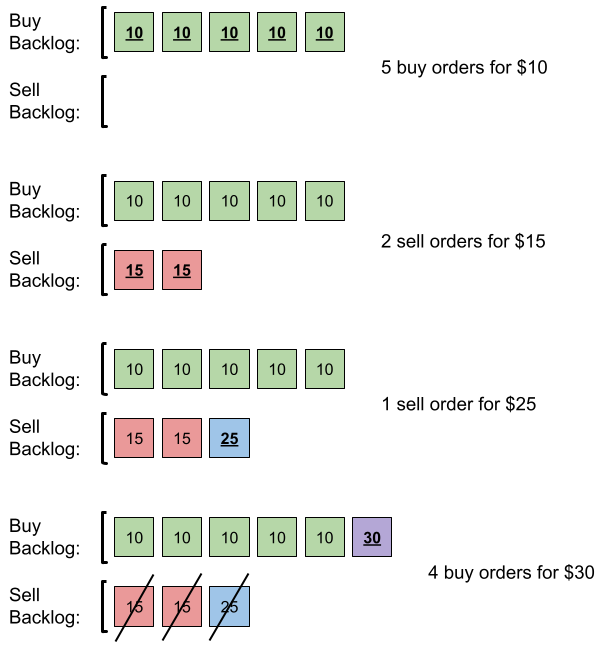
Input: orders = [[10,5,0],[15,2,1],[25,1,1],[30,4,0]]
Output: 6
Explanation: Here is what happens with the orders:
- 5 orders of type buy with price 10 are placed. There are no sell orders, so the 5 orders are added to the backlog.
- 2 orders of type sell with price 15 are placed. There are no buy orders with prices larger than or equal to 15, so the 2 orders are added to the backlog.
- 1 order of type sell with price 25 is placed. There are no buy orders with prices larger than or equal to 25 in the backlog, so this order is added to the backlog.
- 4 orders of type buy with price 30 are placed. The first 2 orders are matched with the 2 sell orders of the least price, which is 15 and these 2 sell orders are removed from the backlog. The 3rd order is matched with the sell order of the least price, which is 25 and this sell order is removed from the backlog. Then, there are no more sell orders in the backlog, so the 4th order is added to the backlog.
Finally, the backlog has 5 buy orders with price 10, and 1 buy order with price 30. So the total number of orders in the backlog is 6.
Example 2:
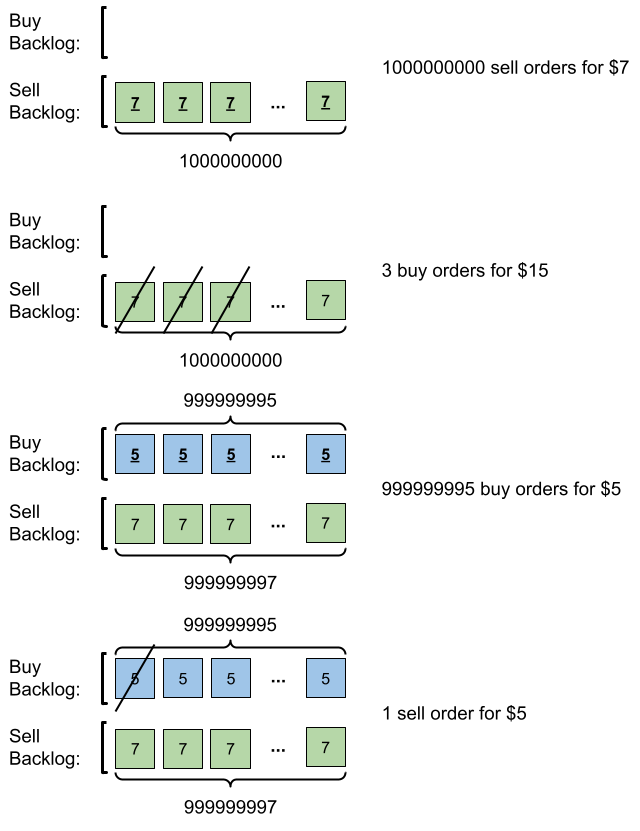
Input: orders = [[7,1000000000,1],[15,3,0],[5,999999995,0],[5,1,1]]
Output: 999999984
Explanation: Here is what happens with the orders:
- 109 orders of type sell with price 7 are placed. There are no buy orders, so the 109 orders are added to the backlog.
- 3 orders of type buy with price 15 are placed. They are matched with the 3 sell orders with the least price which is 7, and those 3 sell orders are removed from the backlog.
- 999999995 orders of type buy with price 5 are placed. The least price of a sell order is 7, so the 999999995 orders are added to the backlog.
- 1 order of type sell with price 5 is placed. It is matched with the buy order of the highest price, which is 5, and that buy order is removed from the backlog.
Finally, the backlog has (1000000000-3) sell orders with price 7, and (999999995-1) buy orders with price 5. So the total number of orders = 1999999991, which is equal to 999999984 % (109 + 7).
Constraints:
1 <= orders.length <= 105orders[i].length == 31 <= pricei, amounti <= 109orderTypeiis either0or1.
Approach Overview
Problem Overview: You receive a stream of buy and sell orders for a stock. Each order has a price, amount, and type (buy or sell). When possible, orders should match with existing opposite orders in the backlog. After processing all orders, return the total remaining amount in the backlog modulo 1e9 + 7.
Approach 1: Using Two Priority Queues (O(n log n) time, O(n) space)
This approach simulates a real trading order book using two heaps. Maintain a max‑heap for buy orders (highest price first) and a min‑heap for sell orders (lowest price first). When a new buy order arrives, repeatedly match it with the cheapest sell order while the sell price is less than or equal to the buy price. Similarly, when a sell order arrives, match it with the highest buy order while the buy price is greater than or equal to the sell price. Each match reduces quantities until one order is exhausted. Remaining quantities are pushed back into the appropriate heap. Heap operations like push and pop take O(log n), so processing all orders costs O(n log n). This approach directly models the trading system and is the standard solution using a heap (priority queue).
Approach 2: Sorting and Two Pointers (O(n log n) time, O(n) space)
Another way to reason about the problem is to process orders after grouping and sorting them by price. Buy orders are sorted descending by price while sell orders are sorted ascending. Two pointers then iterate through both lists and simulate matching between the current highest buy and lowest sell order. Whenever the buy price is at least the sell price, reduce the smaller amount and move the pointer when an order is exhausted. If prices no longer match, the unmatched orders remain in the backlog. Sorting dominates the runtime at O(n log n), while pointer traversal is linear. This approach avoids heaps but requires preprocessing and additional arrays, making it less natural for streaming input. It still relies on understanding the matching process using arrays and careful simulation of order execution.
Recommended for interviews: The two‑priority‑queue approach is what interviewers expect. It mirrors how real order books work and demonstrates strong knowledge of heaps and simulation problems. The sorting method shows the matching logic clearly but is less flexible because the input is processed sequentially. Showing awareness of both approaches is useful, but implementing the heap-based solution signals solid problem‑solving skill.
Approach 1: Using Two Priority Queues
This approach involves using two priority queues (heaps) to represent the buy and sell orders in the backlog:
- The buy orders are stored in a max-heap based on their price, allowing us to quickly access the order with the highest price.
- The sell orders are stored in a min-heap based on their price, allowing us to quickly access the order with the lowest price.
- For each incoming order, we try to match it with the existing orders in the opposite type's heap. If it can be matched, we reduce the amount accordingly. Otherwise, we add it to the appropriate heap.
This Python solution uses two heaps to manage the buy and sell orders:
- The buy orders are stored in a max-heap (using negative prices to simulate max behavior).
- The sell orders are stored in a min-heap.
- Every order is processed by attempting to match it with opposite orders in the backlog. If they are matchable, execution occurs reducing the order amount on both ends. Orders that can't be completely matched are added to their respective heaps.
Code
Python
C++
Java
C#
JavaScript
Complexity
Time Complexity: O(n log n), where n is the number of orders since each order insertion/deletion into the heap takes O(log n), and there can be at most n such operations.
Space Complexity: O(n), storing all unmatched orders in heaps.
Approach 2: Using Sorting and Two Pointers
This approach leverages sorting to handle and manage orders efficiently:
- First, separate the orders into buy and sell lists.
- Sort buy orders in descending order by price and sell orders in ascending order by price.
- Use two pointers to traverse the buy and sell lists to match orders. Execute matching as long as the buy price is greater than or equal to the sell price.
- When matching isn’t possible, simply track unmatched orders in a combined list.
This approach can be efficient, as sorting can be done in O(n log n), allowing a straightforward linear scan for matching orders.
This solution involves sorting both buy and sell orders to efficiently match them using two pointers:
- Buy orders are sorted in descending order, while sell orders are in ascending order.
- Using a two-pointer technique, orders are matched if possible and reduced accordingly.
- Unmatched orders are simply accumulated in their respective lists to count total backlog.
Code
Python
JavaScript
Complexity
Time Complexity: O(n log n) due to sorting, followed by O(n) scanning.
Space Complexity: O(n) to store orders separately.
Approach 3: Priority Queue (Max-Min Heap) + Simulation
We can use a priority queue (max-min heap) to maintain the current backlog of orders, where the max heap buy maintains the backlog of purchase orders, and the min heap sell maintains the backlog of sales orders. Each element in the heap is a tuple (price, amount), indicating that the number of orders at price price is amount.
Next, we traverse the order array orders, and simulate according to the problem's requirements.
After the traversal, we add the order quantities in buy and sell, which is the final backlog of orders. Note that the answer may be very large, so we need to take the modulus of 10^9 + 7.
The time complexity is O(n times log n), and the space complexity is O(n). Here, n is the length of orders.
Complexity Comparison
| Approach | Complexity |
|---|---|
| Using Two Priority Queues | Time Complexity: O(n log n), where n is the number of orders since each order insertion/deletion into the heap takes O(log n), and there can be at most n such operations. |
| Using Sorting and Two Pointers | Time Complexity: O(n log n) due to sorting, followed by O(n) scanning. |
| Priority Queue (Max-Min Heap) + Simulation | — |
Detailed Complexity Analysis
| Approach | Time | Space | When to Use |
|---|---|---|---|
| Two Priority Queues (Order Book Simulation) | O(n log n) | O(n) | General case. Best for streaming order processing and typical interview expectations. |
| Sorting + Two Pointers | O(n log n) | O(n) | Useful when orders can be preprocessed and sorted before matching. |
Video Solution
LeetCode 1801. Number of Orders in the Backlog | 🏆 Weekly Contest 233 | Medium | Algorithm Explained • Cherry Coding [IIT-G] • 1,519 views views
Watch 6 more video solutions →Frequently Asked Questions
Is Number of Orders in the Backlog easy or hard?
How to solve Number of Orders in the Backlog efficiently?
What is the best approach for Number of Orders in the Backlog?
What data structure is used in Number of Orders in the Backlog?
What is the time complexity of Number of Orders in the Backlog?
Is Number of Orders in the Backlog asked at Google, Amazon, or Meta?
Is there a Python or Java solution for Number of Orders in the Backlog?
Ready to solve this problem?
Practice Number of Orders in the Backlog with our built-in code editor and test cases.
Practice on FleetCodeProblem Info
Table of Contents
Practice this problem
Open in Editor