
Maximum Profit of Operating a Centennial Wheel - Solution & Explanation
Problem Statement
You are the operator of a Centennial Wheel that has four gondolas, and each gondola has room for up to four people. You have the ability to rotate the gondolas counterclockwise, which costs you runningCost dollars.
You are given an array customers of length n where customers[i] is the number of new customers arriving just before the ith rotation (0-indexed). This means you must rotate the wheel i times before the customers[i] customers arrive. You cannot make customers wait if there is room in the gondola. Each customer pays boardingCost dollars when they board on the gondola closest to the ground and will exit once that gondola reaches the ground again.
You can stop the wheel at any time, including before serving all customers. If you decide to stop serving customers, all subsequent rotations are free in order to get all the customers down safely. Note that if there are currently more than four customers waiting at the wheel, only four will board the gondola, and the rest will wait for the next rotation.
Return the minimum number of rotations you need to perform to maximize your profit. If there is no scenario where the profit is positive, return -1.
Example 1:
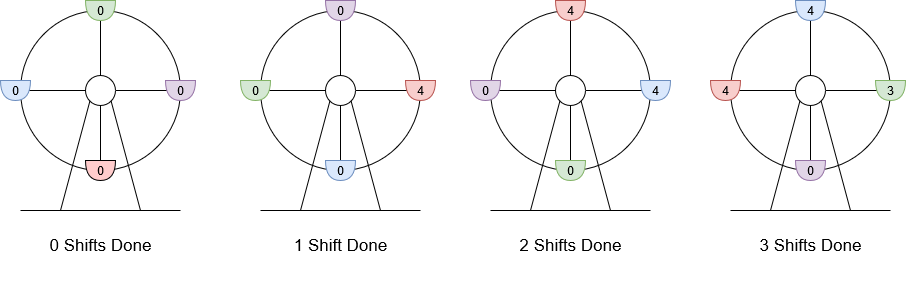
Input: customers = [8,3], boardingCost = 5, runningCost = 6
Output: 3
Explanation: The numbers written on the gondolas are the number of people currently there.
1. 8 customers arrive, 4 board and 4 wait for the next gondola, the wheel rotates. Current profit is 4 * $5 - 1 * $6 = $14.
2. 3 customers arrive, the 4 waiting board the wheel and the other 3 wait, the wheel rotates. Current profit is 8 * $5 - 2 * $6 = $28.
3. The final 3 customers board the gondola, the wheel rotates. Current profit is 11 * $5 - 3 * $6 = $37.
The highest profit was $37 after rotating the wheel 3 times.
Example 2:
Input: customers = [10,9,6], boardingCost = 6, runningCost = 4
Output: 7
Explanation:
1. 10 customers arrive, 4 board and 6 wait for the next gondola, the wheel rotates. Current profit is 4 * $6 - 1 * $4 = $20.
2. 9 customers arrive, 4 board and 11 wait (2 originally waiting, 9 newly waiting), the wheel rotates. Current profit is 8 * $6 - 2 * $4 = $40.
3. The final 6 customers arrive, 4 board and 13 wait, the wheel rotates. Current profit is 12 * $6 - 3 * $4 = $60.
4. 4 board and 9 wait, the wheel rotates. Current profit is 16 * $6 - 4 * $4 = $80.
5. 4 board and 5 wait, the wheel rotates. Current profit is 20 * $6 - 5 * $4 = $100.
6. 4 board and 1 waits, the wheel rotates. Current profit is 24 * $6 - 6 * $4 = $120.
7. 1 boards, the wheel rotates. Current profit is 25 * $6 - 7 * $4 = $122.
The highest profit was $122 after rotating the wheel 7 times.
Example 3:
Input: customers = [3,4,0,5,1], boardingCost = 1, runningCost = 92
Output: -1
Explanation:
1. 3 customers arrive, 3 board and 0 wait, the wheel rotates. Current profit is 3 * $1 - 1 * $92 = -$89.
2. 4 customers arrive, 4 board and 0 wait, the wheel rotates. Current profit is 7 * $1 - 2 * $92 = -$177.
3. 0 customers arrive, 0 board and 0 wait, the wheel rotates. Current profit is 7 * $1 - 3 * $92 = -$269.
4. 5 customers arrive, 4 board and 1 waits, the wheel rotates. Current profit is 11 * $1 - 4 * $92 = -$357.
5. 1 customer arrives, 2 board and 0 wait, the wheel rotates. Current profit is 13 * $1 - 5 * $92 = -$447.
The profit was never positive, so return -1.
Constraints:
n == customers.length1 <= n <= 1050 <= customers[i] <= 501 <= boardingCost, runningCost <= 100
Approach Overview
Problem Overview: You operate a Centennial Wheel where each rotation boards up to 4 customers. Every boarded customer pays a boarding cost, while each rotation incurs a running cost. Given an array representing arriving customers per rotation, determine the rotation number that produces the maximum profit. If the wheel never becomes profitable, return -1.
Approach 1: Greedy Approach for Immediate Boarding (O(n) time, O(1) space)
This approach simulates the wheel operation rotation by rotation. Track the number of waiting customers, board up to four each rotation, and update profit using profit += boarded * boardingCost - runningCost. Maintain variables for current profit, maximum profit seen so far, and the rotation where that maximum occurs. Continue processing while customers are arriving or still waiting in the queue.
The greedy insight: boarding as many customers as possible immediately always maximizes short-term profit because revenue is proportional to boarded riders. The simulation uses simple counters and an iteration over the arrival array, which makes it a classic simulation problem combined with basic array traversal.
Approach 2: Mathematical Computation and Optimization (O(n) time, O(1) space)
This version still iterates through arrivals but focuses on profit deltas and avoids unnecessary rotations once continuing would only reduce profit. Track cumulative customers and determine whether additional rotations after processing the array remain profitable. If remaining waiting customers can fill profitable rotations (where 4 * boardingCost > runningCost), compute those rotations mathematically rather than simulating one-by-one.
The optimization reduces redundant simulation when many customers remain after the input array ends. Instead of repeatedly boarding four customers until the queue empties, compute how many full profitable rotations exist and update profit directly. This keeps the implementation concise while maintaining constant memory usage.
Both solutions rely on simple counters and profit tracking, making them natural examples of greedy decision making combined with simulation.
Recommended for interviews: The greedy simulation approach is the expected solution. It clearly models the wheel operation and demonstrates control over queue management, state tracking, and incremental profit computation. The mathematical optimization is a nice improvement once the simulation logic is correct, but interviewers mainly want to see the O(n) simulation with careful handling of remaining customers.
Approach 1: Greedy Approach for Immediate Boarding
This approach simulates each rotation step by step. For each rotation, it checks how many customers are waiting or arriving and boards as many as possible (up to 4). It then calculates the profit for that rotation. By keeping track of the maximum profit and corresponding rotation, it returns the rotation at which the maximum profit occurs.
This C code iterates over each customer arrival event and calculates how many can board the gondola (up to 4). This is tracked with the 'waiting' variable, which carries over to future rotations. It computes the profit after each rotation and keeps track of the maximum profit found and when it occurs.
Complexity
Time Complexity: O(n), where n is the length of the customers array.
Space Complexity: O(1), as we use only constant extra space.
Approach 2: Mathematical Computation and Optimization
This approach reduces the problem complexity through mathematical optimization. The idea is to derive maximum profit by analyzing the trading-off point where performing extra rotations (only those necessary to board waiting customers) ceases to increase profits substantially.
Mathematical computation offers more theoretical efficiency through trade-off analysis instead of full iterative simulation, slightly more complex to code directly in C.
Complexity
Time Complexity: O(n) but potentially reducing constants with deeper analysis.
Space Complexity: might remain O(1).
Approach 3: Simulation
We directly simulate the rotation process of the Ferris wheel. Each time it rotates, we add up the waiting customers and the newly arrived customers, then at most 4 people get on the ride, update the number of waiting customers and profit, and record the maximum profit and its corresponding number of rotations.
The time complexity is O(n), where n is the length of the customers array. The space complexity is O(1).
Complexity Comparison
| Approach | Complexity |
|---|---|
| Greedy Approach for Immediate Boarding | Time Complexity: O(n), where n is the length of the customers array. |
| Mathematical Computation and Optimization | Time Complexity: O(n) but potentially reducing constants with deeper analysis. |
| Simulation | — |
Detailed Complexity Analysis
| Approach | Time | Space | When to Use |
|---|---|---|---|
| Greedy Approach for Immediate Boarding | O(n) | O(1) | General case. Best for interviews and easiest to implement using direct simulation. |
| Mathematical Computation and Optimization | O(n) | O(1) | When many customers remain after processing the input array and you want to compute profitable rotations directly. |
Video Solution
Leetcode 1599. Maximum Profit of Operating a Centennial Wheel • Fraz • 2,519 views views
Watch 4 more video solutions →Frequently Asked Questions
Is Maximum Profit of Operating a Centennial Wheel easy or hard?
Maximum Profit of Operating a Centennial Wheel Python/Java solution
How to solve Maximum Profit of Operating a Centennial Wheel in O(n)?
What is the best approach for Maximum Profit of Operating a Centennial Wheel?
Is Maximum Profit of Operating a Centennial Wheel asked at Google/Amazon/Meta?
What data structure is used in Maximum Profit of Operating a Centennial Wheel?
What is the time complexity of Maximum Profit of Operating a Centennial Wheel?
Ready to solve this problem?
Practice Maximum Profit of Operating a Centennial Wheel with our built-in code editor and test cases.
Practice on FleetCode