
K-th Largest Perfect Subtree Size in Binary Tree - Solution & Explanation
Problem Statement
You are given the root of a binary tree and an integer k.
Return an integer denoting the size of the kth largest perfect binary subtree, or -1 if it doesn't exist.
A perfect binary tree is a tree where all leaves are on the same level, and every parent has two children.
Example 1:
Input: root = [5,3,6,5,2,5,7,1,8,null,null,6,8], k = 2
Output: 3
Explanation:
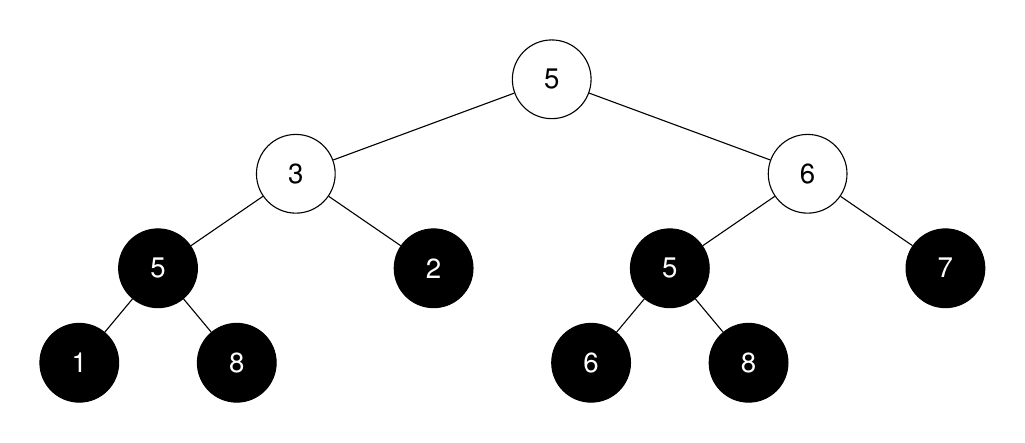
The roots of the perfect binary subtrees are highlighted in black. Their sizes, in non-increasing order are [3, 3, 1, 1, 1, 1, 1, 1].
The 2nd largest size is 3.
Example 2:
Input: root = [1,2,3,4,5,6,7], k = 1
Output: 7
Explanation:
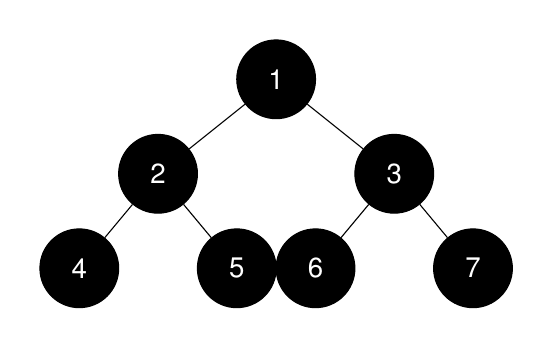
The sizes of the perfect binary subtrees in non-increasing order are [7, 3, 3, 1, 1, 1, 1]. The size of the largest perfect binary subtree is 7.
Example 3:
Input: root = [1,2,3,null,4], k = 3
Output: -1
Explanation:
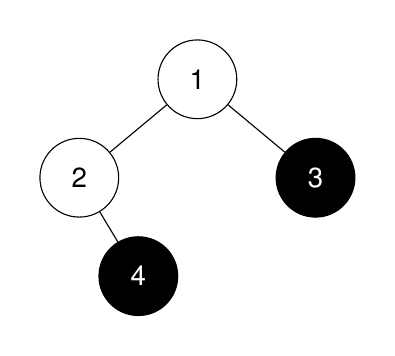
The sizes of the perfect binary subtrees in non-increasing order are [1, 1]. There are fewer than 3 perfect binary subtrees.
Constraints:
- The number of nodes in the tree is in the range
[1, 2000]. 1 <= Node.val <= 20001 <= k <= 1024
Approach Overview
Problem Overview: You are given the root of a binary tree and an integer k. A subtree is perfect if every internal node has exactly two children and all leaves are at the same depth. The task is to compute the size of every perfect subtree and return the k-th largest size.
The key observation: a subtree is perfect only if both its left and right subtrees are perfect and their heights are equal. That condition is naturally evaluated using depth-first search with a post-order traversal.
Approach 1: Post-order Traversal + Collect and Sort (O(n log n) time, O(n) space)
Traverse the binary tree using post-order DFS. Each recursive call returns the height of the subtree if it is perfect, otherwise a sentinel like -1. When both children return valid heights and those heights are equal, the current subtree is perfect. Its size can be computed using (1 << (height + 1)) - 1 or accumulated from child sizes.
Every time a perfect subtree is detected, append its size to a list. After the DFS finishes, sort the list in descending order using a standard sorting algorithm and return the k-th element if it exists. This approach is straightforward to implement and works well because the DFS visits each node exactly once.
The runtime is O(n) for the traversal plus O(m log m) for sorting, where m is the number of perfect subtrees (worst case n). Space complexity is O(n) due to recursion stack and the array storing subtree sizes.
Approach 2: Post-order Traversal + Min Heap of Size k (O(n log k) time, O(k) space)
The DFS logic for detecting perfect subtrees stays the same. The difference is how you track the k-th largest size. Instead of storing all sizes and sorting later, maintain a min-heap of size at most k. Whenever you discover a perfect subtree, push its size into the heap. If the heap grows beyond k, remove the smallest element.
After processing all nodes, the root of the heap represents the k-th largest perfect subtree size. This reduces memory usage when many perfect subtrees exist and avoids sorting the entire list.
The traversal still costs O(n), and each heap operation costs O(log k). Overall time complexity becomes O(n log k) with O(k) extra space, which is more efficient when k is much smaller than the number of perfect subtrees.
Recommended for interviews: Use the post-order DFS that detects perfect subtrees by comparing left and right heights. Interviewers expect you to recognize that subtree properties must be evaluated bottom-up. Collect-and-sort is simpler and communicates the idea clearly, while the heap optimization shows stronger algorithmic awareness when discussing scalability.
Approach 1: Post-order Traversal with Size Calculation
This approach involves performing a post-order traversal of the binary tree. For each node, determine if its subtrees form a perfect binary tree. If they do, calculate its size.
In post-order traversal, we recursively visit the left subtree, then the right subtree, and finally process the root node. By checking the height and size of left and right subtrees, we can ascertain if a node is the root of a perfect subtree.
Collect all valid subtree sizes and retrieve the k-th largest using sorting.
The function countPerfectSubtreeSizes utilizes a recursive helper function post_order, which traverses the tree and accumulates the sizes of perfect subtrees in a list. The tree's perfect subtree sizes are calculated using the condition that both left and right subtrees are perfect and have equal heights.
Complexity
Time Complexity: O(n log n), where n is the number of nodes in the tree. The traversal takes O(n) and sorting the subtree sizes takes O(log n).
Space Complexity: O(n), for storing the sizes of perfect subtrees.
Approach 2: DFS + Sorting
We define a function dfs to calculate the size of the perfect binary subtree rooted at the current node, using an array nums to record the sizes of all perfect binary subtrees. If the subtree rooted at the current node is not a perfect binary subtree, it returns -1.
The execution process of the function dfs is as follows:
- If the current node is null, return
0; - Recursively calculate the sizes of the perfect binary subtrees of the left and right subtrees, denoted as
landrrespectively; - If the sizes of the left and right subtrees are not equal, or if the sizes of the left and right subtrees are less than
0, return-1; - Calculate the size of the perfect binary subtree rooted at the current node
cnt = l + r + 1, and addcntto the arraynums; - Return
cnt.
We call the dfs function to calculate the sizes of all perfect binary subtrees. If the length of the array nums is less than k, return -1. Otherwise, sort the array nums in descending order and return the k-th largest perfect binary subtree size.
The time complexity is O(n times log n), and the space complexity is O(n). Here, n is the number of nodes in the binary tree.
Code
Python
Java
C++
Go
TypeScript
Complexity Comparison
| Approach | Complexity |
|---|---|
| Post-order Traversal with Size Calculation | Time Complexity: O(n log n), where n is the number of nodes in the tree. The traversal takes O(n) and sorting the subtree sizes takes O(log n). Space Complexity: O(n), for storing the sizes of perfect subtrees. |
| DFS + Sorting | — |
Detailed Complexity Analysis
| Approach | Time | Space | When to Use |
|---|---|---|---|
| Post-order DFS + Collect Sizes + Sort | O(n log n) | O(n) | Best for clarity and typical interview constraints where storing all subtree sizes is acceptable. |
| Post-order DFS + Min Heap of Size k | O(n log k) | O(k) | Useful when the tree is large but only the k-th largest value matters. |
Video Solution
K-th Largest Perfect Subtree Size in Binary Tree || LeetCode Weekly Contest 419 || Leetcode Solution • codi • 547 views views
Watch 6 more video solutions →Frequently Asked Questions
Is K-th Largest Perfect Subtree Size in Binary Tree easy or hard?
K-th Largest Perfect Subtree Size in Binary Tree Python/Java solution
How to solve K-th Largest Perfect Subtree Size in Binary Tree in O(n)?
What is the best approach for K-th Largest Perfect Subtree Size in Binary Tree?
Is K-th Largest Perfect Subtree Size in Binary Tree asked at Google/Amazon/Meta?
What data structure is used in K-th Largest Perfect Subtree Size in Binary Tree?
What is the time complexity of K-th Largest Perfect Subtree Size in Binary Tree?
Ready to solve this problem?
Practice K-th Largest Perfect Subtree Size in Binary Tree with our built-in code editor and test cases.
Practice on FleetCode